



Speed records on Mount Rainier have always belonged to the people who know her best. Since Lou and Jim Whittaker, along with John Day, made the first documented speed ascent in 1959 -- summit to parking lot in 7 hours and 20 minutes -- the record has almost always been set by guides, climbers, and athletes for whom Rainier isn't just a destination, but a home mountain. On May 9th, 2026, RMI guide Simon Kearns added his name to that lineage in a big way, running from the Paradise parking lot to the summit and back in 3 hours, 43 minutes, and 52 seconds -- the fastest unsupported on-foot round trip in the mountain's recorded history, shattering the previous mark by more than 30 minutes.
For Simon, it was a long time coming. Follow along on his Instagram -- he shared his own account of the record here.

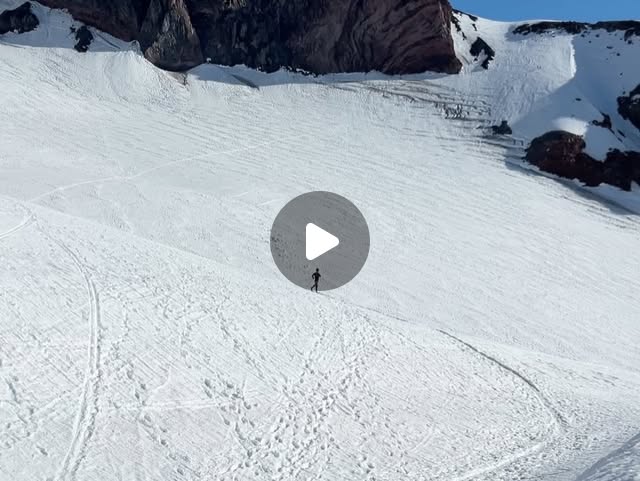
"I have wanted to break the Rainier FKT since I got into trail running 13 years ago," he said. "It always seemed like the biggest, coolest peak in the US I could run up and down."
A Record With Deep Roots
The modern era of Rainier speed records began to take shape in the mid-2000s, when Chad Kellogg became the first person to make the round trip in under five hours. What followed was a gradual, hard-fought compression of the clock over the next two decades: Willie Benegas, then Uli Steidl (4:24:30 in 2016), then Alex King, who set the unsupported on-foot record in June 2021 with a time of 4:14:13.
King's run was a serious effort -- he navigated mostly snow-covered terrain, dealt with soft conditions at the bottom, and held remarkable pacing discipline all the way to the crater rim. His record stood for five years, and Simon had his eye on it for most of them.
"I got serious about going for the FKT two years ago and had two attempts over the last few years where I didn't get the record," Simon said. The near-misses stung – including one Rainier attempt in the summer of 2024 that ended in heartbreak just short of the mark. But rather than walk away, they sharpened his focus.
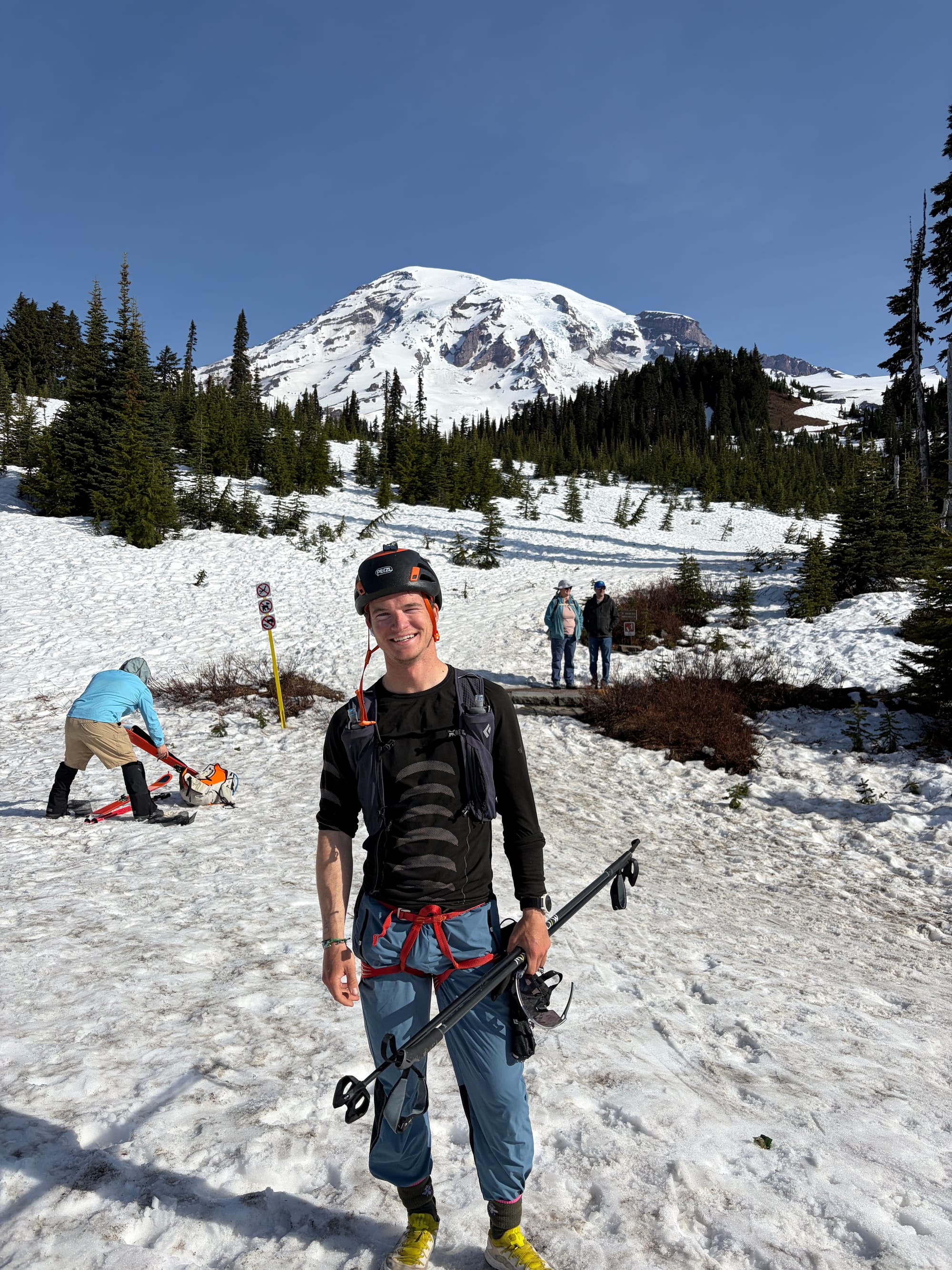
Training for One Mountain
This past winter, Simon overhauled his preparation in a way he hadn't since high school. He hired a coach for the first time and significantly increased both his volume and the intensity of his structured work.
"My training was primarily on skis this winter," he said. "I averaged around 25,000 feet of climbing every week and did one threshold session -- usually something like 4x15 minutes very hard -- and one long endurance effort, usually 4-5 hours at a fairly hard effort."
The plan was actually to go after the ski record first. When his race ski snapped and a difficult snow year made that pivot unavoidable, Simon redirected everything back to the on-foot effort. In the final weeks before the attempt, he transitioned some training back to running and set a final fitness benchmark: an FKT on Mailbox Peak near North Bend, covering the steep, unforgiving old trail up and down in 1:15. For anyone who has done Mailbox as a training run, it's a meaningful number.
He was ready.
The Run
Simon stepped onto the snow at Paradise on May 9th carrying only what the unsupported category allows -- no outside assistance, no crew, no resupply. The early going was uncertain.
"I felt pretty off for the first twenty minutes running in the soft snow at the bottom," he said. "But by Pebble Creek, 30 minutes in, my body came around and I knew it would be a good day."
From there, the run became something else entirely. He split 1:15 to Camp Muir -- a benchmark that told him everything -- and felt stronger the higher he climbed. The upper mountain, the part that breaks most people, was where Simon came alive. Friends, RMI colleagues, and guides out skiing for the day cheered him on as he moved through the high camps.
He reached the summit at 2:34 -- roughly 30 minutes faster than King's ascent split during his FKT run. The record, barring a catastrophic descent, was his.
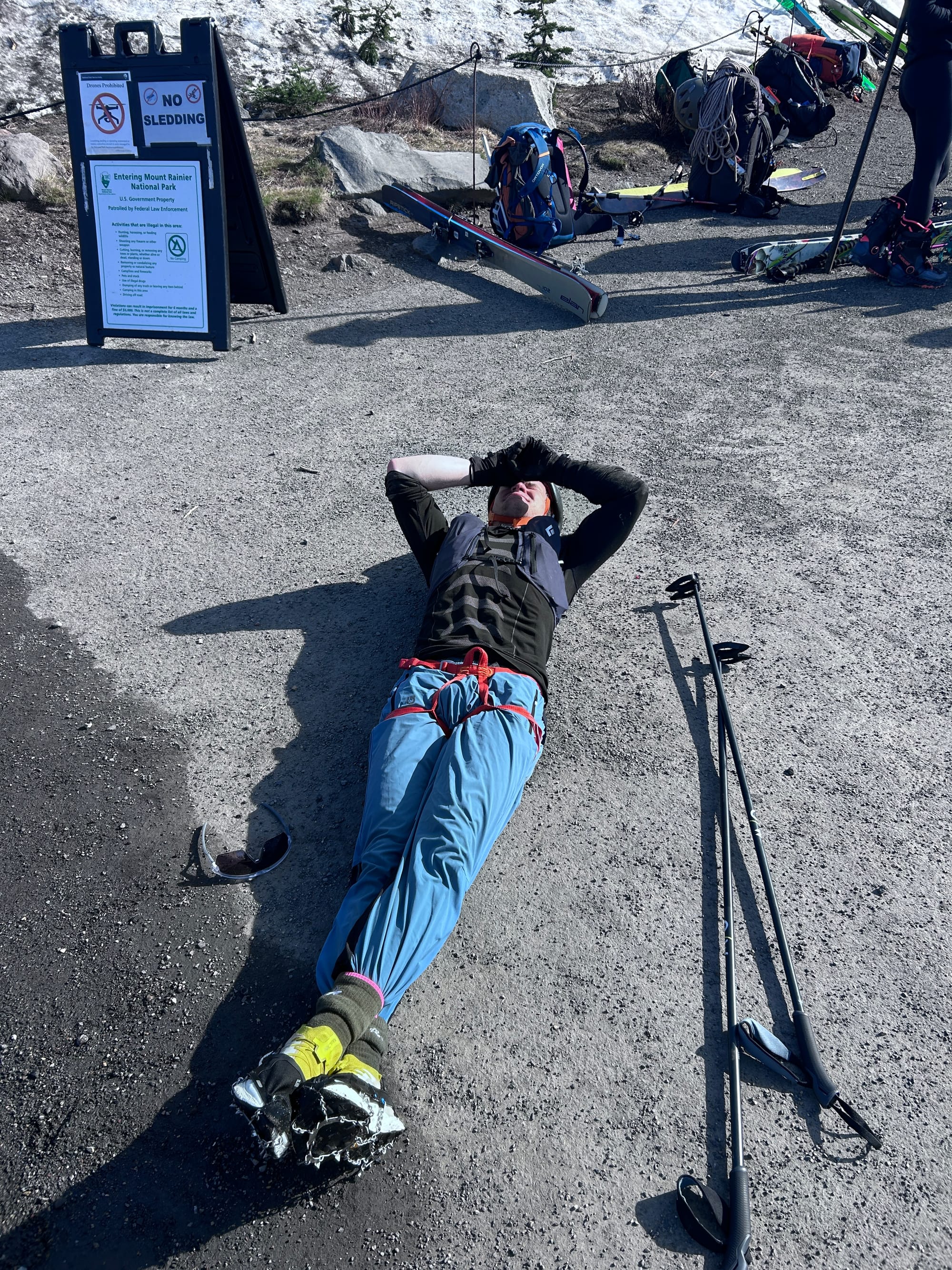
"Getting back down to the parking lot 31 minutes under the record felt incredibly emotional and I had to sit and cry for a bit, which I'm sure confused the tourists."
Final time: 3:43:52.
Bringing It Home
The emotional weight of the moment wasn't just about the number. Simon started guiding for RMI in 2025, and joining the team changed the meaning of the record for him in a way that surprised even him.
"Once I started guiding for RMI last year it made me so much more motivated to get the record," he said. "This mountain means a ton to me and I wanted to bring it back home to RMI."
That's a sentiment with roots. Speed records on Rainier have historically been set by guides -- people who climb the mountain repeatedly, who know where the snow softens in the afternoon and where the wind picks up above the cleaver, who have a relationship with the mountain that goes deeper than any single attempt. Simon's run fits squarely in that tradition.
He's already got seven Rainier summits on his resume -- including the new car-to-car best time of 4:18 -- along with FKTs on Mount Hood and Mount Massive, summits of Mont Blanc, the Grand Teton, and 33 of Colorado's 58 14ers. He grew up at the foot of the San Juans in southwestern Colorado and has been running mountains since he was 12 years old. If you catch him at Camp Muir between guiding trips, he's probably got a chess board.
But on May 9th, he was just running. Running a mountain he loves, in a time no one has touched.
Want to climb with Simon or learn more about him? Check out his guide profile here!


