
×

Log In

Need an RMI account? Create an account

Register With Us

Already have an account?

*required fields

The password must meet the following criteria:

  • At least 8 characters
  • At least 1 lowercase letter
  • At least 1 uppercase letter
  • At least 1 number
  • At least 1 symbol (allowed symbols: !?@#$%^&/*()[]{}><,.+-=;)

Keep up to date with information about our latest climbs by joining our mailing list. Sign up and we'll keep you informed about new adventures, special offers, competitions, and news.

Privacy Policy

×
×

Check Availability

RMI Logo

When Is the Best Time to Climb Mount Rainier: Choosing the Right Season for Your Goals

Early, peak, or late season, learn what to expect when climbing Mount Rainier at different times of year and how to prepare for changing conditions.
When Is the Best Time to Climb Mount Rainier: Choosing the Right Season for Your Goals

If you ask ten climbers when the "best" time to climb Mount Rainier is, you'll get ten confident answers, and at least half of them will contradict each other.

That's because the question itself is incomplete.

There is a peak season on Rainier. There are also early and late windows that many climbers overlook or misunderstand. What often gets lost in the conversation is this: the best time to climb Rainier depends less on the calendar and more on what you want out of the climb.

For an in-depth webinar on this topic, check out this presentation by senior RMI guide Dominic Cifelli.
Rainier is not a static mountain. It evolves continuously from spring through late summer, reshaping its glaciers, routes, hazards, and learning opportunities along the way. Each phase offers something distinct, not better or worse, just different.

Below, we'll walk through how Rainier changes through the season, what experienced guides actually prefer, and how to choose the timing that best aligns with your experience level, learning objectives, and future climbing goals. We'll also do something we haven't done publicly before: show five years of RMI's own climb records, broken down month by month, so "the best time" isn't only a guide's opinion. It's a number you can weigh against your own priorities.
What We Mean by "Summit Opportunity"

Guides have opinions about timing. So does the data. To make the comparison fair, we pulled five full seasons of RMI's own climb records, 2021 through 2025, and built a metric we call Summit Opportunity Rate: the share of climbers who were not turned back by weather or route conditions.

We built it this way on purpose. Look at every reason a climber didn't summit across all 7,712 climbers in the dataset, and two very different kinds of things emerge: reasons outside anyone's control, like weather and route conditions, and reasons that sit entirely with the climber, like fitness, injury, or a personal decision to turn around.

Summit Opportunity Rate isolates the first group. It answers one question only: was the mountain open? A climber who turns back on a bluebird day for reasons of fitness or a personal decision still counts as an opportunity, because the mountain gave them the chance. That's deliberate. It means the numbers below measure Rainier, not the climbers on it. What you bring to the mountain is still on you, and it deserves its own look before we get into the season.

Zoom in on just the climbers who didn't summit, for any reason, and physical conditioning is the single largest individual cause at 32.5%, ahead of weather (27.8%) and route conditions (26.3%) taken separately. Keep that in mind as you read the month-by-month numbers below. A record-clean month doesn't lower the bar on conditioning. It just means conditioning is the one variable still fully in your hands, no matter which month you book.

The Shape of the Season

Here's what that produces across five years and every Rainier summit program RMI runs.

July stands alone at 88.9%. June and August form a clear second tier, both in the high 60s to low 70s. May is close to a coin flip at 52.8%. April, the deep shoulder, is the toughest month of all at 24.9%.

The reason shifts as the season moves, and it's worth seeing plainly:

Early in the season, weather is the dominant obstacle. April climbers are turned back by weather more than twice as often as by route conditions, and May isn't far behind. By July, both numbers bottom out at once, which is a big part of why July's rate is so high. Late in the season the pattern flips entirely. August's route-condition turnarounds pull ahead of its weather turnarounds, and September, in five years of records, has never turned back a single climber for weather. Every September turnaround has been the glacier itself.

That single chart is close to a summary of everything the rest of this article walks through, month by month.

The Long-Term View: Shifting Seasonality

The five years above are the right window for planning next year's climb, they reflect the mountain as it is right now. But zoom out to 2013, and a longer trend shows up: route conditions have roughly doubled as a share of turnarounds, from a 5.4% average across 2013 to 2019 to a 13.3% average across 2021 to 2025.

RMI has already adjusted for a shift like this once. From 2013 through 2019, September wasn't a marginal month, it regularly out-produced May; in 2014, RMI put 166 climbers on the summit in September against just 34 in May.

Starting in 2021, RMI stopped scheduling standard September climbs, a direct response to route conditions becoming too unreliable to keep booking climbers into that window. That's the actual value of tracking a mountain this closely: catching a real, structural shift early enough to act on it, rather than years after the fact. Keep that in mind as a backdrop while you read the season-by-season breakdown below, it's part of why the guide leading your climb matters as much as the month you pick.

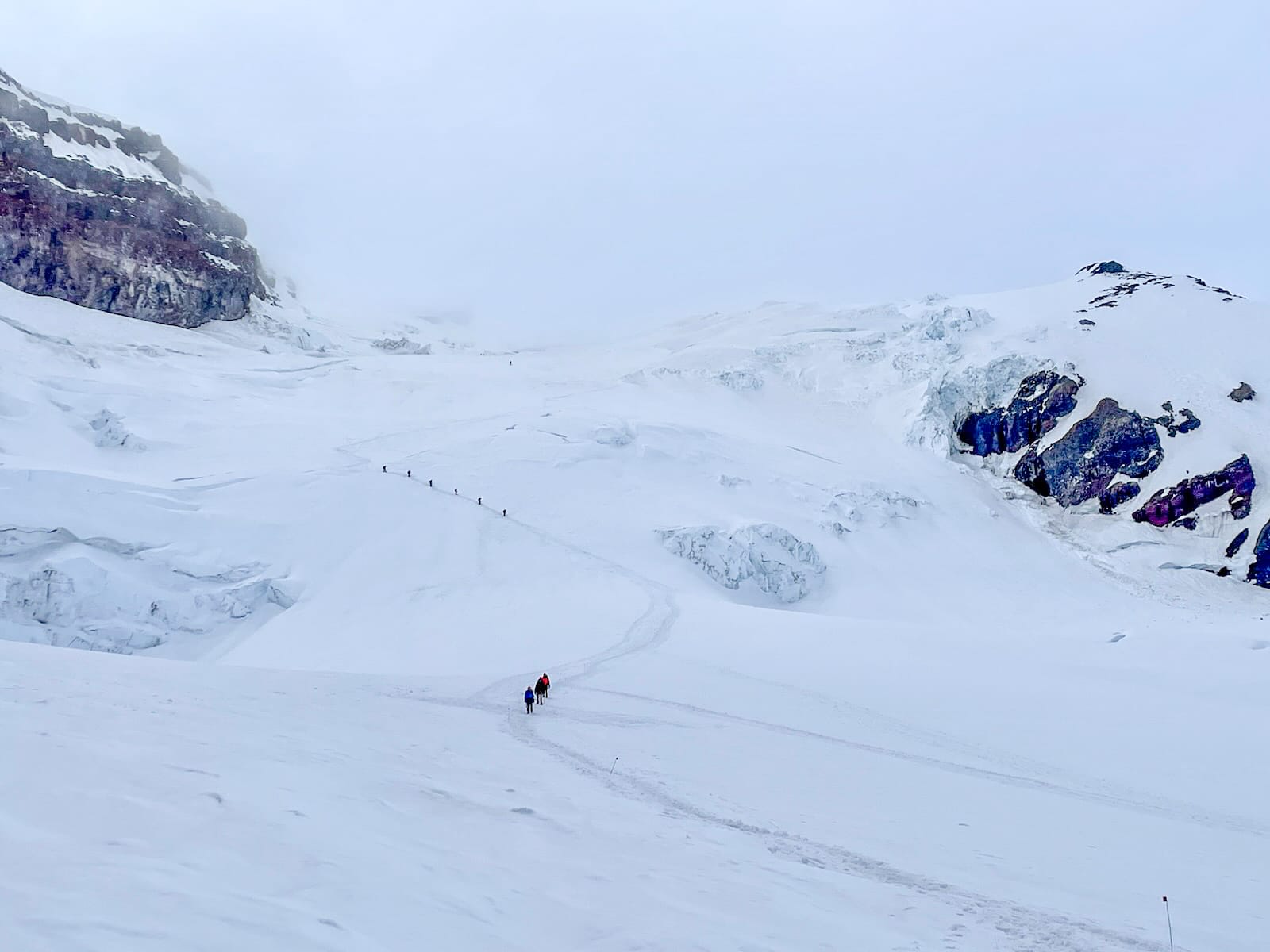
The Emmons Glacier in early spring.

Early-Season Climbing: A Snow-Covered, More Direct Route

For many climbers, early season carries a misconception: that climbing before summer somehow lowers your odds of success. In reality, most of RMI's most tenured guides consider early season their favorite time on Rainier, and for good reason.

What the Mountain Is Like

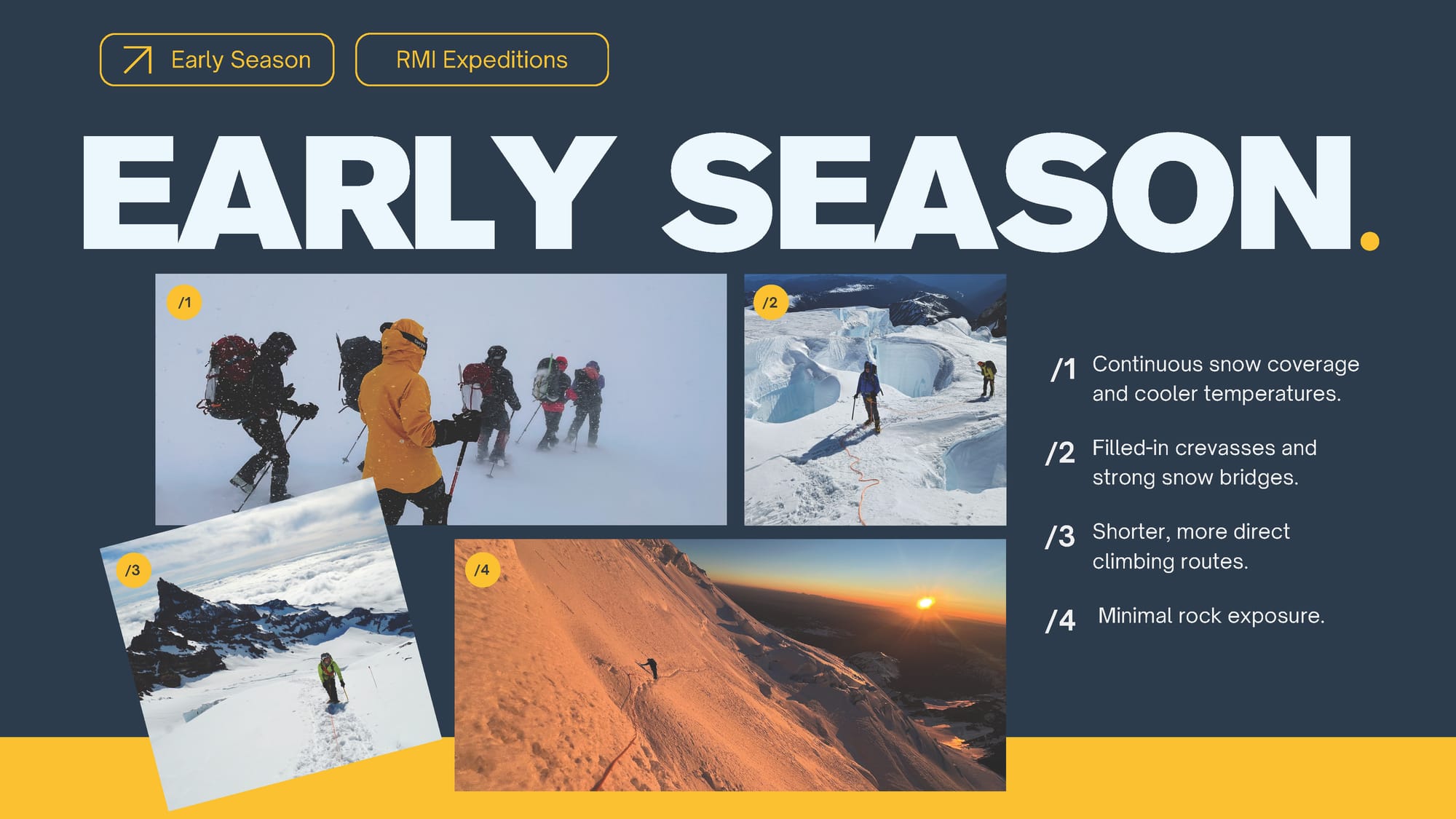
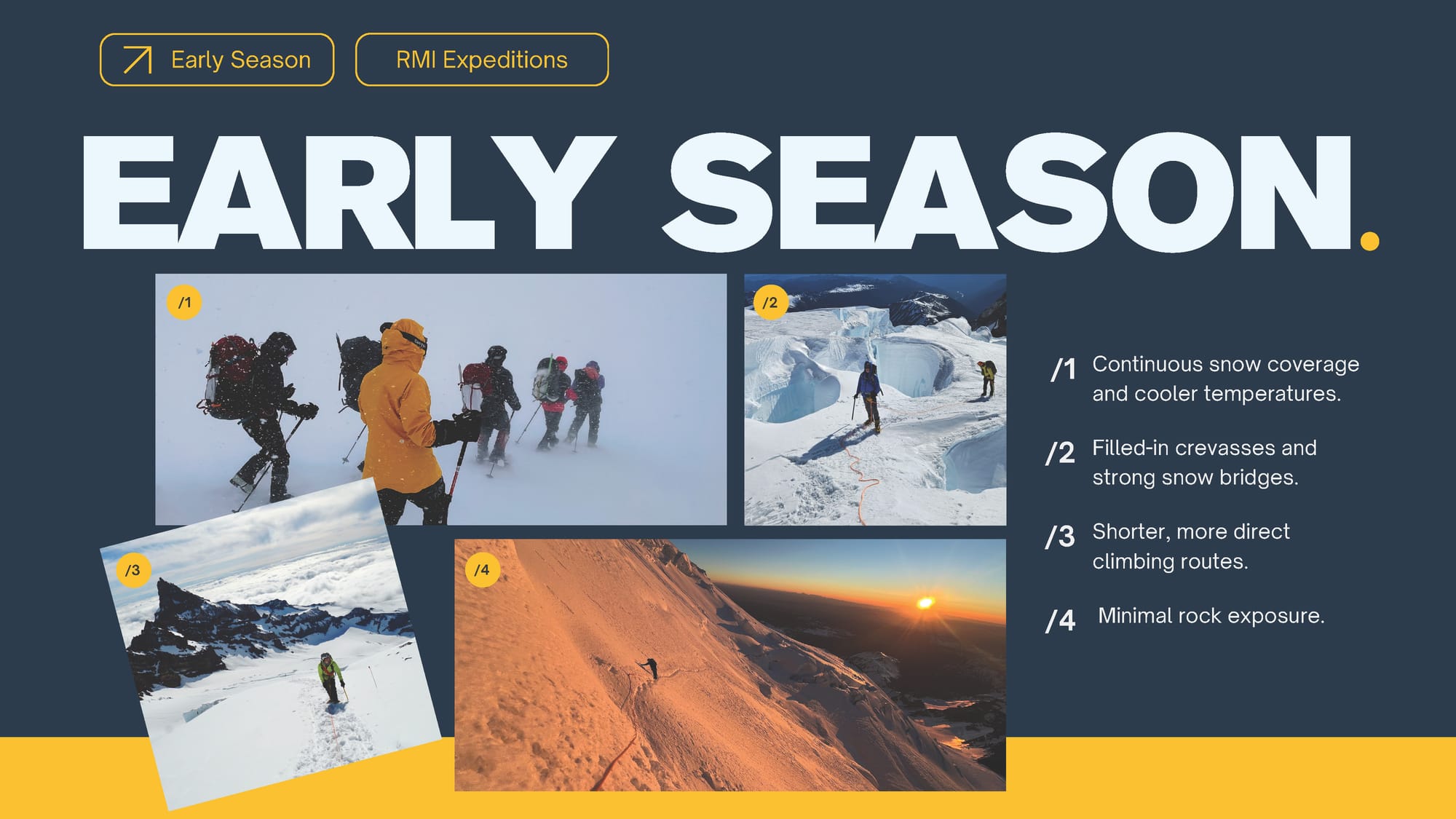
In spring and early summer, Rainier is still wearing its winter coat. A deep, continuous snowpack covers glaciers and rock bands alike, creating a cleaner, more unified alpine environment.
Key characteristics:

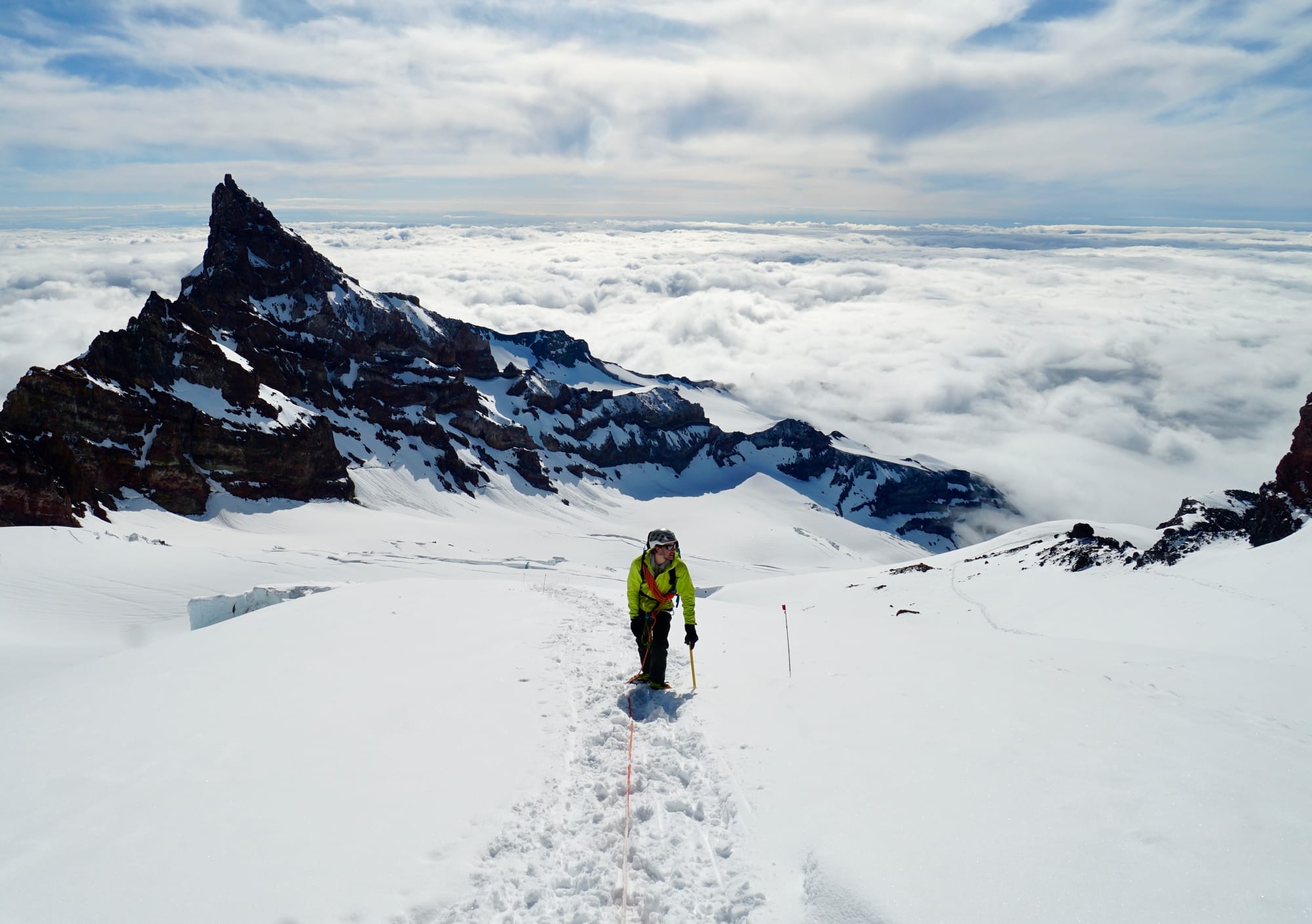
  • Filled-in crevasses with strong snow bridges
  • Shorter, more direct routes with fewer detours
  • Consistent snow travel from base to summit
  • Minimal time on exposed rock
  • Cooler temperatures, especially compared to mid-summer heat

The result is a mountain that rewards efficient movement, strong snow technique, and good decision-making, without the constant transitions between snow, rock, and ice that develop later in the season.
Why Guides Love It

RMI guides answer questions about early-season climbing constantly, and the answers are remarkably consistent.

Early season offers:

  • Fewer climbers on route and less traffic-induced congestion
  • Lower overhead rock hazard due to snow coverage
  • More aesthetic, "classic alpine" conditions
  • Opportunities to kick in fresh routes and adapt to changing terrain
  • Excellent terrain for teaching glacier travel, crampon technique, and rope systems
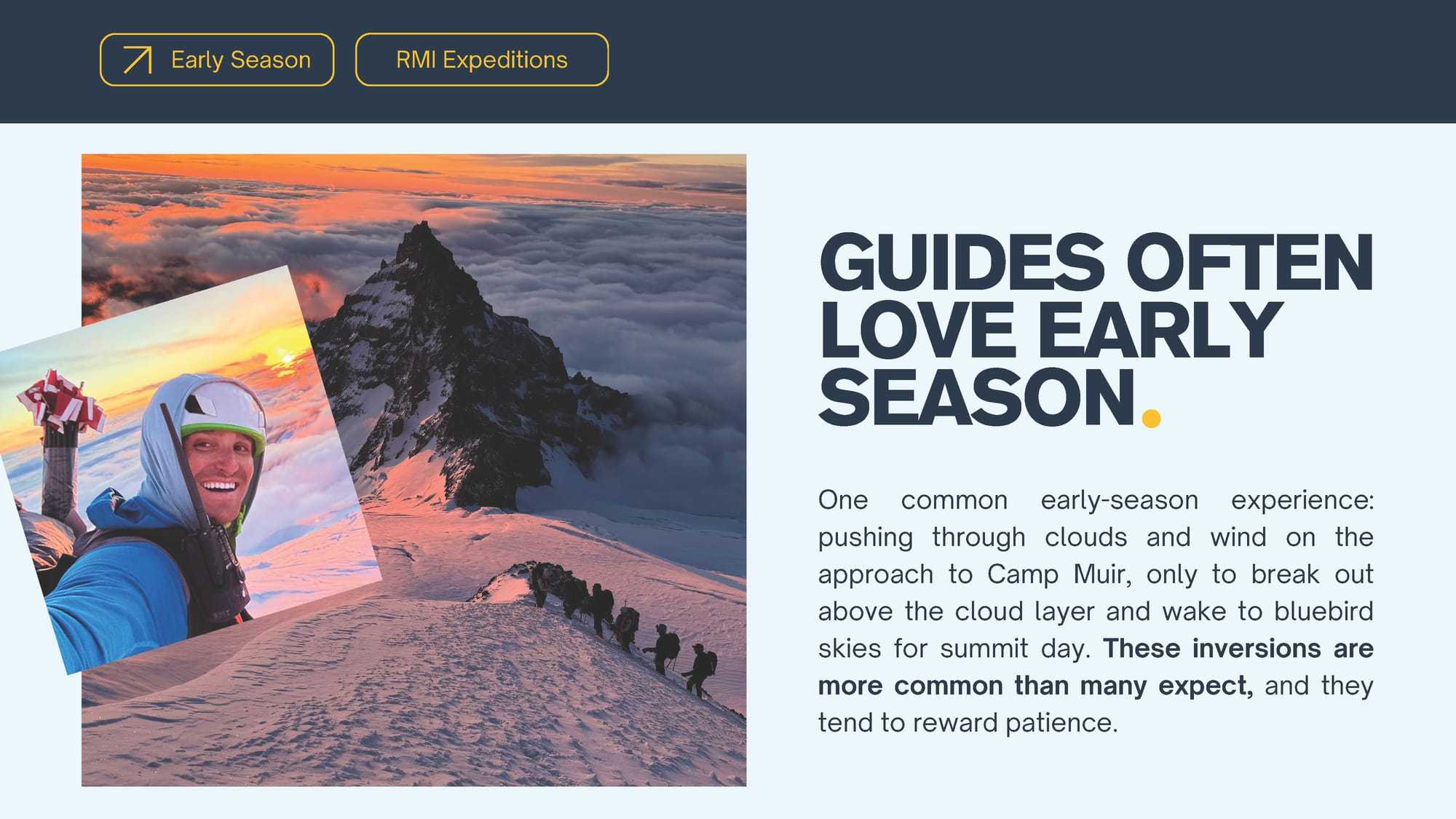
One common early-season experience: pushing through clouds and wind on the approach to Camp Muir, only to break out above the cloud layer and wake to bluebird skies for summit day. These inversions are more common than many expect, and they tend to reward patience.

What the Data Says

Here's the honest complication. April and May are also the two toughest months on the mountain by Summit Opportunity Rate, 24.9% and 52.8% across every Rainier program, almost entirely because of weather rather than route difficulty. May is also one of the most volatile months in the whole five-year dataset: in its worst season it opened at a 25% opportunity rate, in its best it hit 87%. Same month, same mountain, very different years.

None of that contradicts what guides love about early season, and it's worth taking that seriously rather than treating it as a consolation prize. The direct routes, the quiet trail, the training value for bigger glaciated objectives, the inversions above the clouds, none of that shows up in a turnaround statistic, and none of it gets worse because the odds are lower. A guide who's spent fifteen seasons on this mountain isn't wrong about what makes April and May special; the data just adds a second, separate fact alongside that one. Early season is a genuine trade-off, not a hidden upside and not a hidden downside either. You're weighing some of the best conditions of the year against a real chance the mountain doesn't open for you. Choose it for what it offers.

If you do choose early season, there's one concrete lever worth knowing about: RMI's 5-Day Summit Climb earns back some of that gap, and it earns back more of it here than anywhere else in the season.

In May, the 5-Day program outperforms the 4-Day by 6.1 points, the single largest gap anywhere on this chart. Compare that to July, already the cleanest month of the year, where the gap narrows to 1.9 points and barely matters, or August, where it actually reverses and the 4-Day edges out the 5-Day by 1.7 points. The pattern makes intuitive sense: a spare day is worth a lot when you need to wait out weather or work around a slow-forming snow bridge, and worth very little when the mountain isn't asking you to wait for anything. If early season's quieter trail and direct route are what you're after, the 5-Day is the version of that trip built to absorb the weather early season is most likely to throw at you.

Who Early Season Is Best For

Early season is especially well-suited to climbers who:

  • Prefer snow climbing over mixed terrain
  • Value efficiency and flow over technical complexity
  • Want fewer crowds and a quieter mountain
  • Are training for larger glaciated peaks like Denali
  • Enjoy shoulder-season hiking and alpine travel
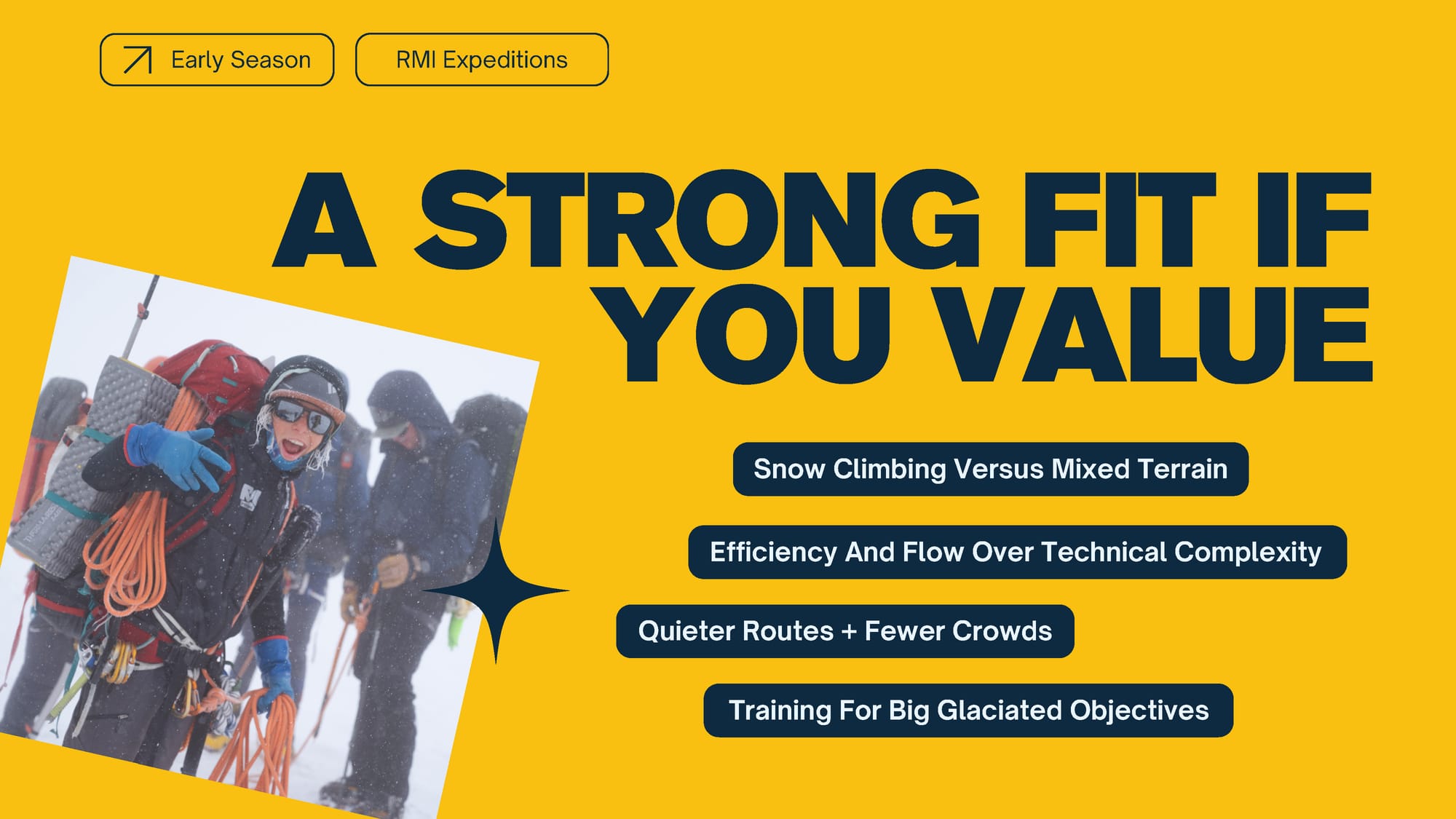
  • Are climbing for the experience first and are comfortable with lower odds of a summit in exchange for it

For climbers building toward Alaska or other big glaciated objectives, early-season Rainier provides some of the most relevant training terrain in the lower 48.
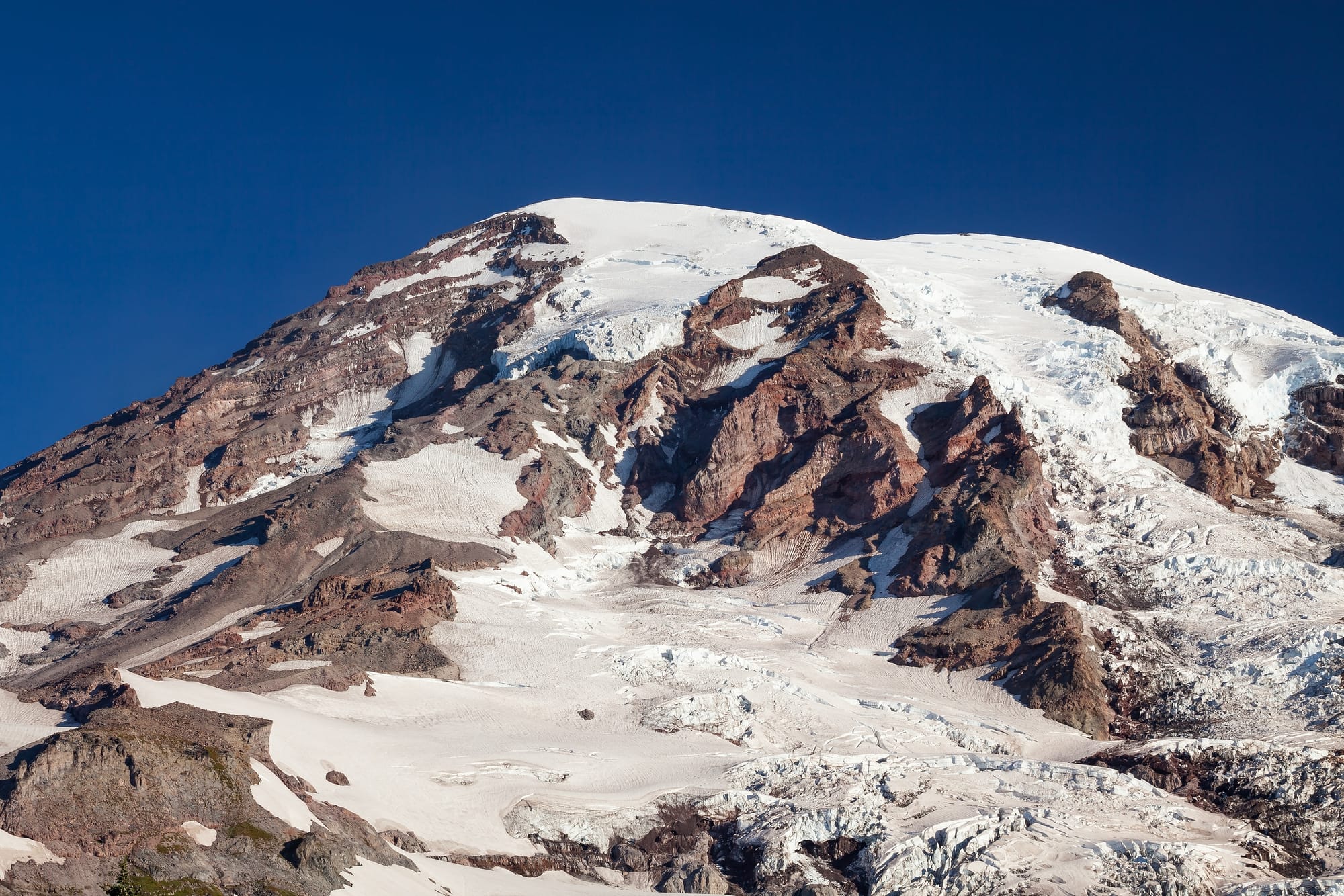
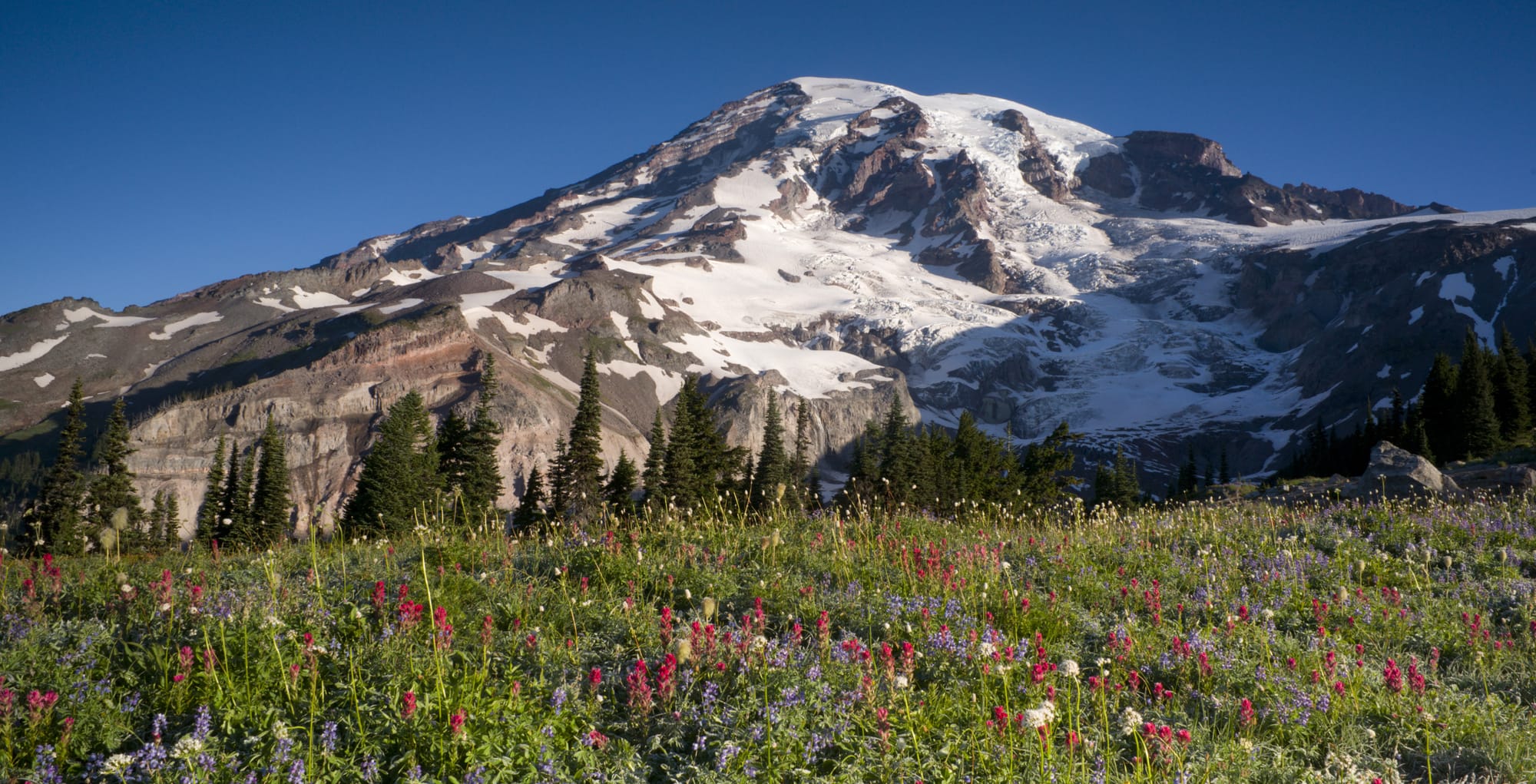
The Disappointment Cleaver route in Mid Summer

Peak Season: Predictability and Accessibility

Peak season exists for a reason. As the snowpack consolidates and weather patterns stabilize, Rainier often offers its longest stretches of predictable climbing.

What the Mountain Is Like

By mid-summer:

  • Routes are well-established and clearly defined
  • Crevasses begin to open, requiring engineered solutions
  • Ladders and fixed protection become more common
  • Weather windows tend to be longer and easier to forecast
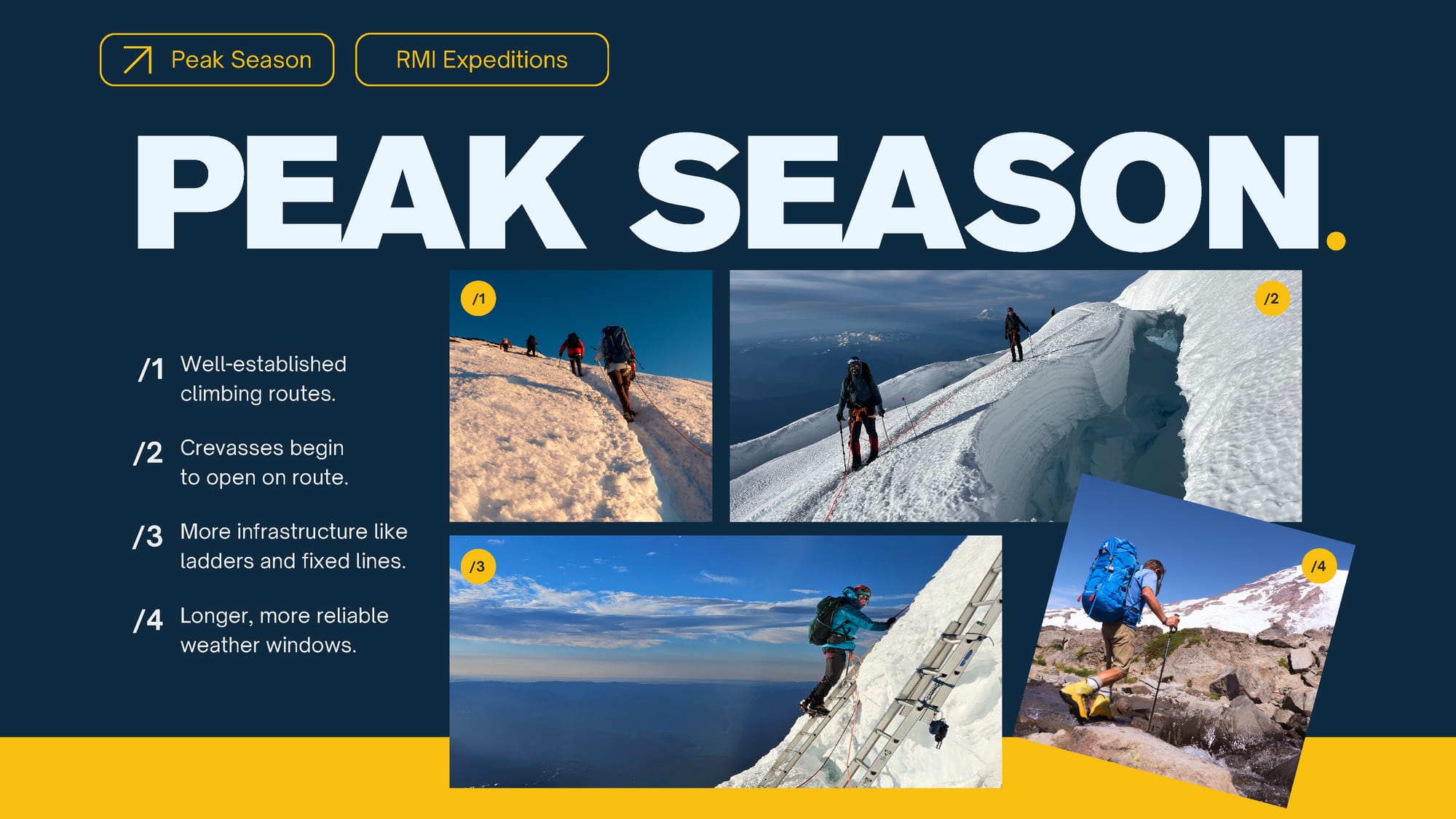
This is the period most climbers picture when they imagine a Rainier ascent, and it's a great time to be on the mountain.

Tradeoffs to Understand

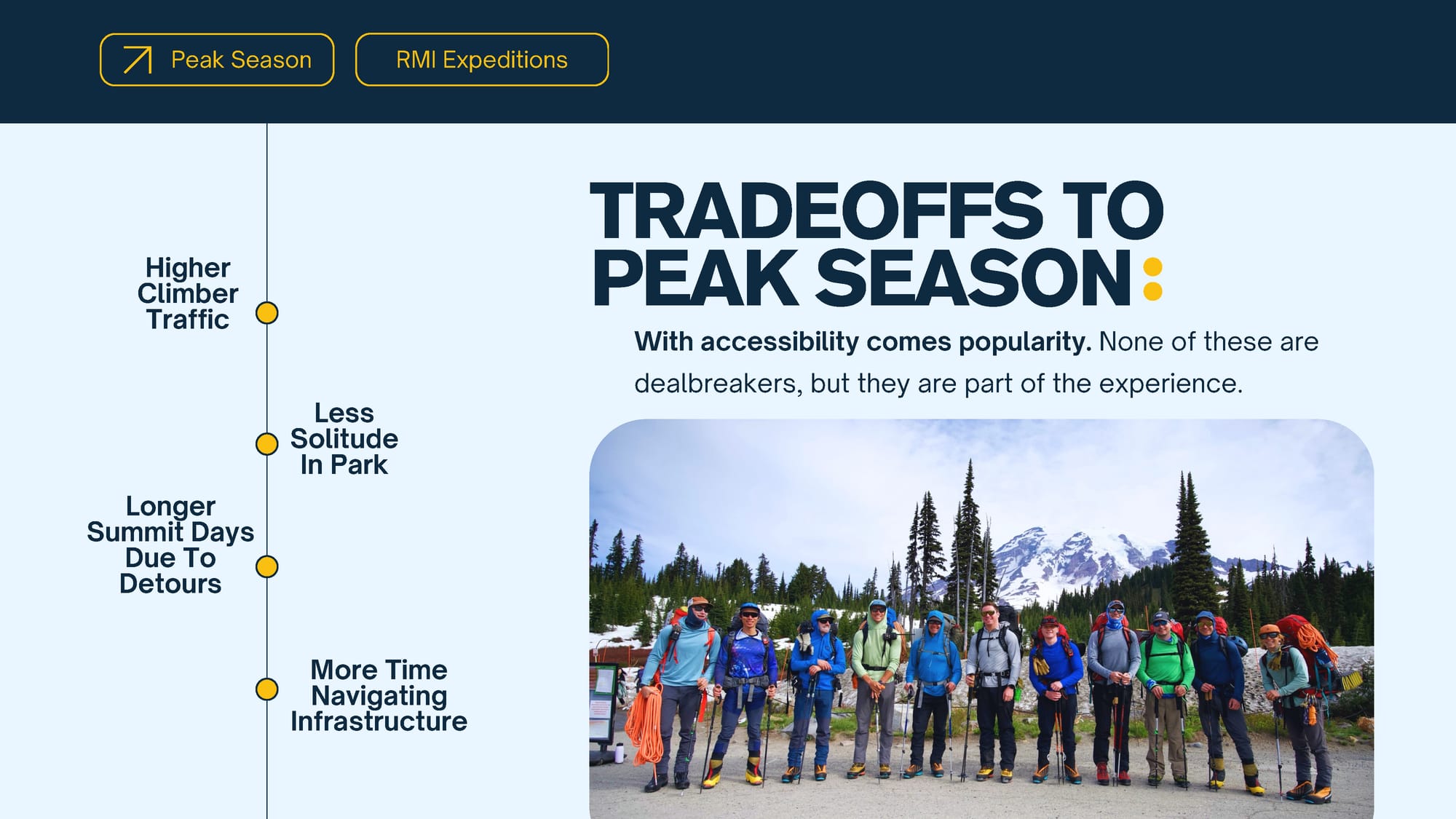
With accessibility comes popularity. Peak season typically brings:

  • Increased route traffic
  • Longer summit days as routes wind around open crevasses
  • More time navigating infrastructure like ladders and fixed lines

None of these are dealbreakers, but they are part of the experience.
What the Data Says

Within what most people call "peak season," June through August, the differences are bigger than the label suggests. July's 88.9% Summit Opportunity Rate isn't just the best month of the summer, it's the best month of the year, full stop. June trails by nearly 18 points at 71.1%. August, despite being deeper into what most climbers picture as peak season, is barely different from June at 68.7%. If your schedule has any flexibility, July is the month to build a trip around.

Worth remembering, though: conditioning is still the single largest reason climbers don't summit, in any month. Book July for the odds. Train like it's August anyway.

Who Peak Season Is Best For

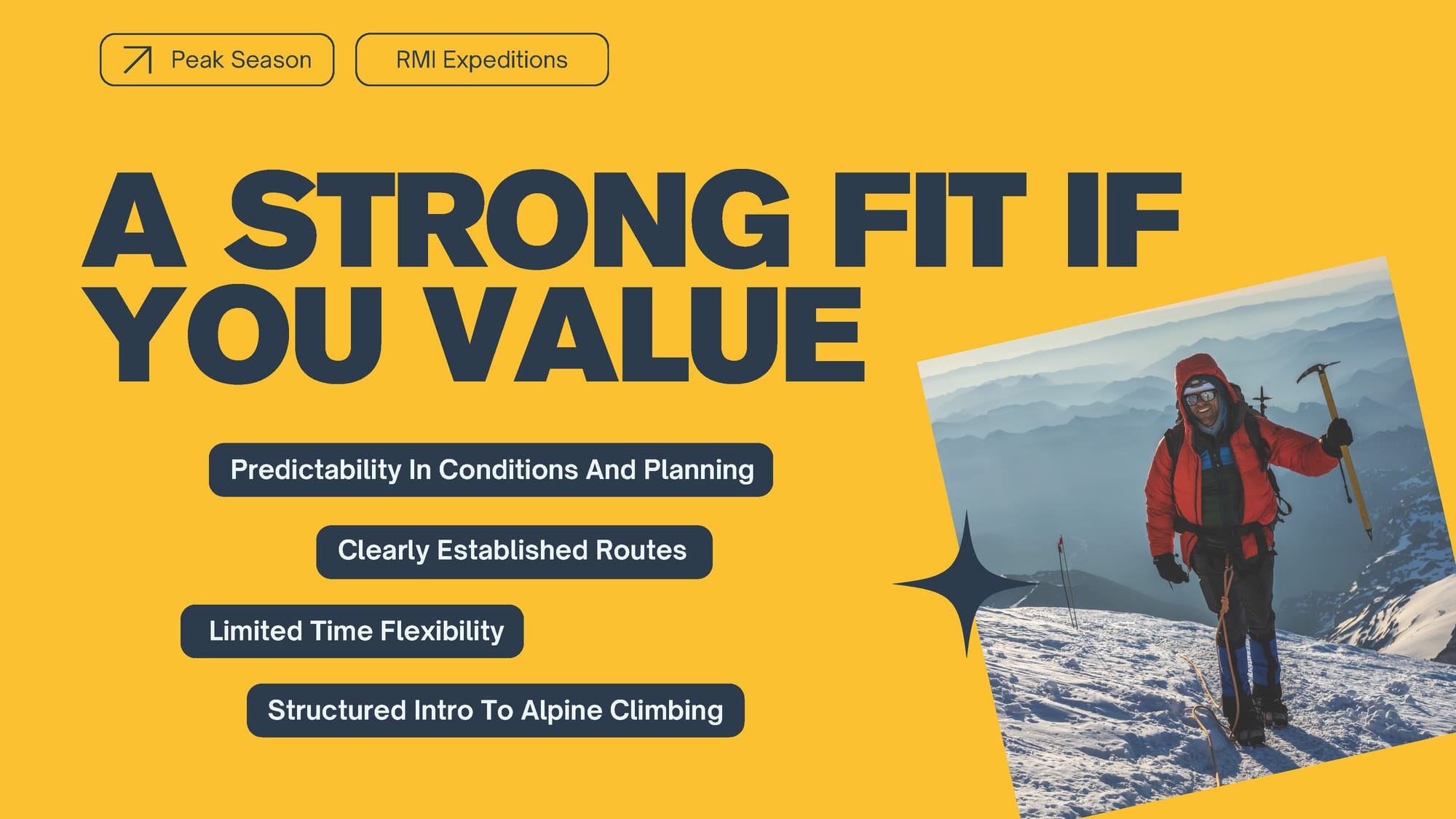
Peak season is a strong fit for climbers who:

  • Want the most predictable conditions
  • Are newer to alpine climbing
  • Prefer established routes and infrastructure
  • Have limited scheduling flexibility

For many first-time Rainier climbers, this window offers an ideal blend of challenge, support, and consistency, and July specifically offers the best odds RMI has on record.

Late Summer on Mount Rainier

Late-Season Climbing: A Dynamic, Technical Experience

As summer progresses, Rainier becomes more sculpted and dramatic. Glaciers pull apart, snow thins, and the mountain demands a different kind of attention.

What the Mountain Is Like

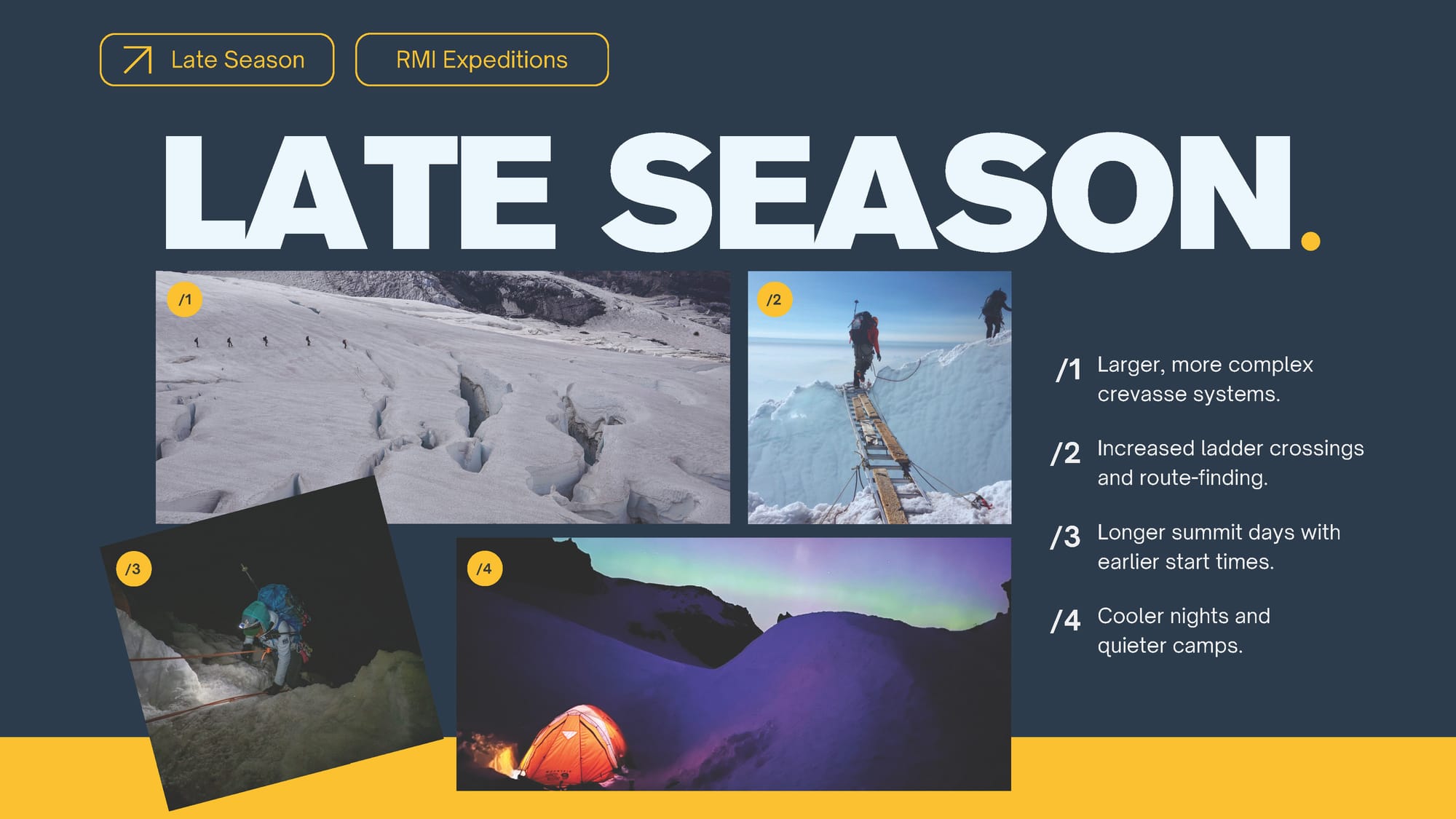
Late season conditions often include:

  • Wider, more complex crevasses
  • Increased ladder crossings and route-finding
  • Longer summit days (and earlier start times) with more elevation loss and gain
  • Firmer snow during early morning travel
  • Cooler nights and quieter camps

Late season is not inherently "harder," but it is more dynamic. Routes can change rapidly, and climbers must be comfortable adapting to evolving terrain.

Why Climbers Choose Late Season

Late season rewards:

  • Strong endurance
  • Mental resilience
  • Willingness to engage with complexity rather than avoid it

It's also an excellent match for climbers preparing for high-altitude, less glaciated objectives like Aconcagua or other Andean peaks, where long days and variable terrain are the norm.
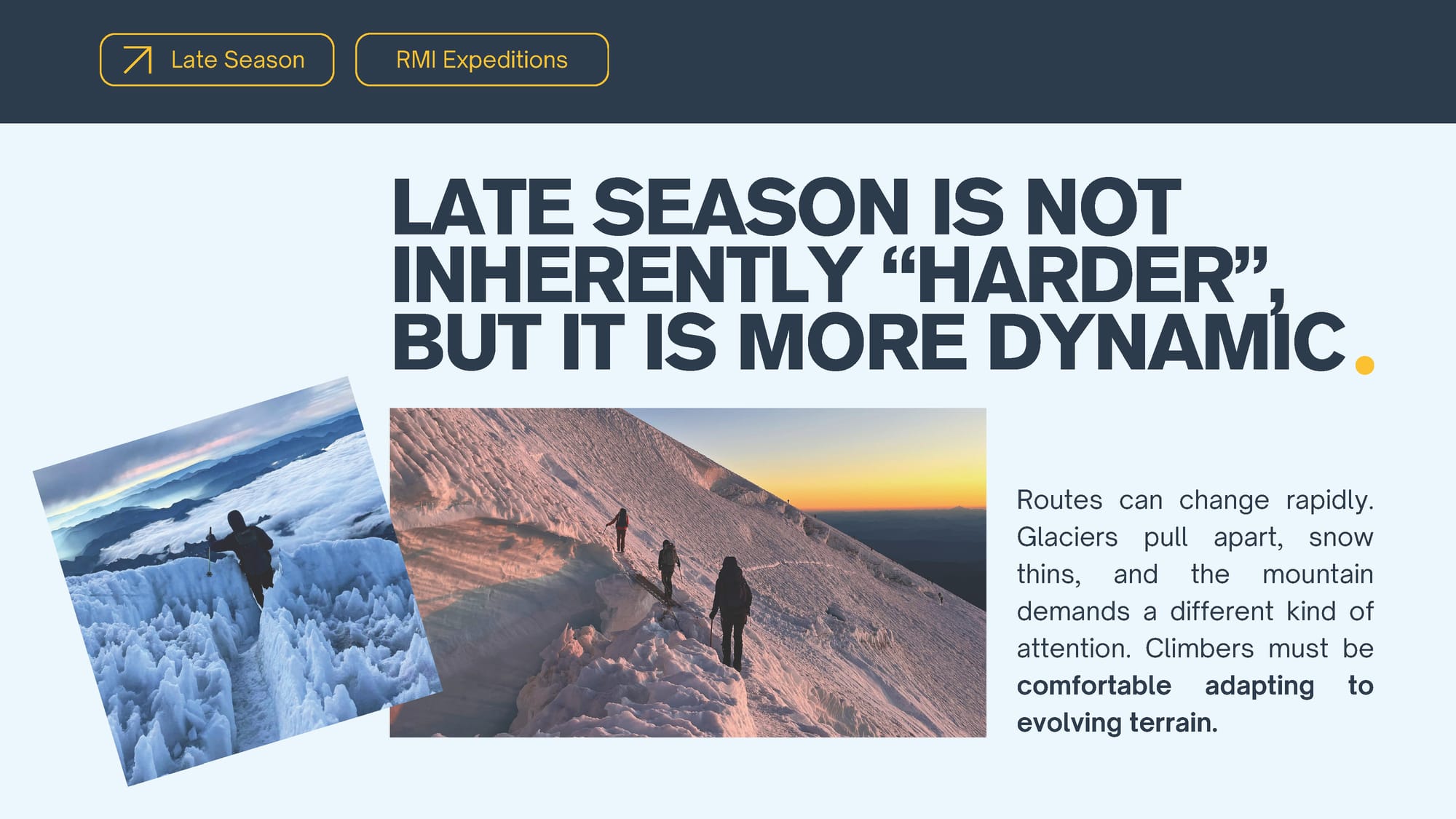
Late season is not inherently “harder”, but it is more dynamic. Routes can change rapidly, and climbers must be comfortable adapting to evolving terrain.

What the Data Says

Late season is where the obstacle finishes its flip from weather to route conditions, the tail end of what the overview chart already showed. By September, 62.2% of turnarounds are route-related and zero are weather, which matches exactly what late-season climbing already promises: a mountain that's stopped being generous with route-finding. Volume in September is small (127 climbers across five years), so treat the exact figure as directional rather than precise. One practical note if you're booking: the extra day on the 5-Day Summit Climb, the biggest lever earlier in the season, has already reversed by August, so it's not one to lean on here.

Who Late Season Is Best For

Late season attracts climbers who value:

  • Solitude and intensity
  • Long, demanding summit days
  • Exposure to evolving glacier terrain
  • Conditions that better resemble Andean or expedition-style objectives
  • Route-finding as part of the experience, not an obstacle to avoid

Weather Dictates Everything - And It’s Always Unpredictable

While seasonal trends provide general guidance, no one can precisely predict the "best" time to climb Rainier each year. Weather patterns can shift dramatically from season to season, completely reshaping climbing conditions.
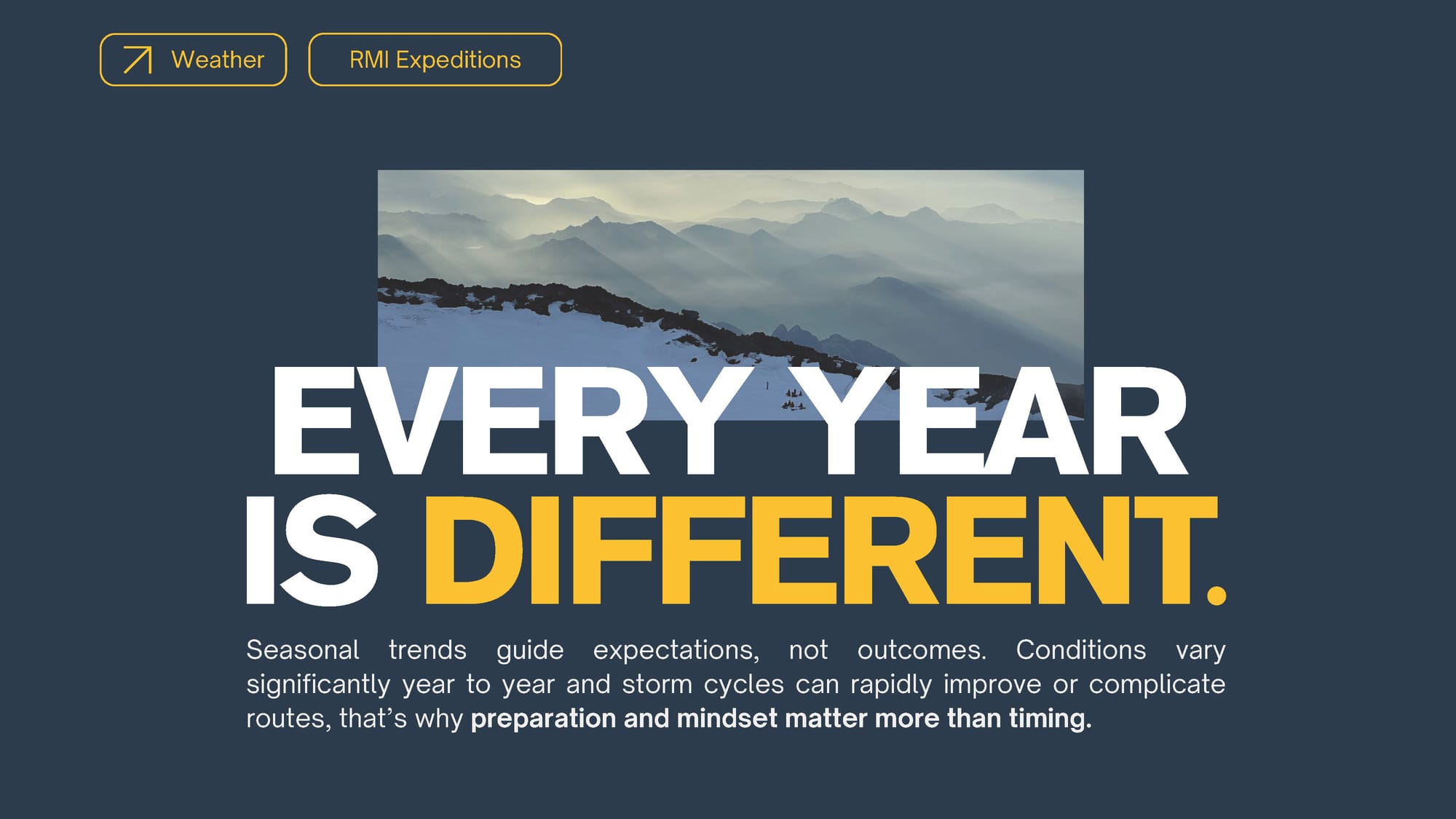
Take 2024, for example. Early August saw a series of significant storms that dropped fresh snow on the upper mountain, covering crevasses and smoothing the route. Instead of deteriorating as expected, conditions improved, and excellent climbing continued through the end of the season. Conversely, in other years, warm, dry conditions in mid-July made the route more technical than anticipated.

This is exactly why RMI reports this data as a five-season average, never a single year.

May alone has ranged from a 25% opportunity rate in its worst season to 87% in its best. August has swung between 44% and 92%. Even July, the most dependable month by a wide margin, has ranged from 70% to 97%. September is the widest swing of all, 0% in its worst season and 100% in its best, though on volume small enough that both extremes deserve a grain of salt. Whatever number you take from this article, take it as the average of five very different seasons, not a promise about the one you'll get.

This variability means there is no "perfect" time to climb Rainier, only the time that works for your schedule and goals. Early and late-season climbs often get overlooked because of assumptions about difficulty, but in reality, every season has its advantages and unknowns. What matters most is being prepared for a range of conditions and embracing the experience Rainier offers, no matter when you climb.

A Better Question: What Do You Want to Get Out of Your Climb?

Rather than asking when Mount Rainier is "best," a more useful, and more honest, question is this:

What do you want this climb to give you?

Rainier can be a summit objective, a classroom, a proving ground, or all three. The season you choose shapes how you experience the mountain, not whether the experience is worthwhile.

Some climbers arrive with a singular focus: standing on the summit. Others care just as much about the process, learning how to move efficiently on snow, understanding glacier systems, or spending quiet hours in an alpine environment that feels wild and immersive.
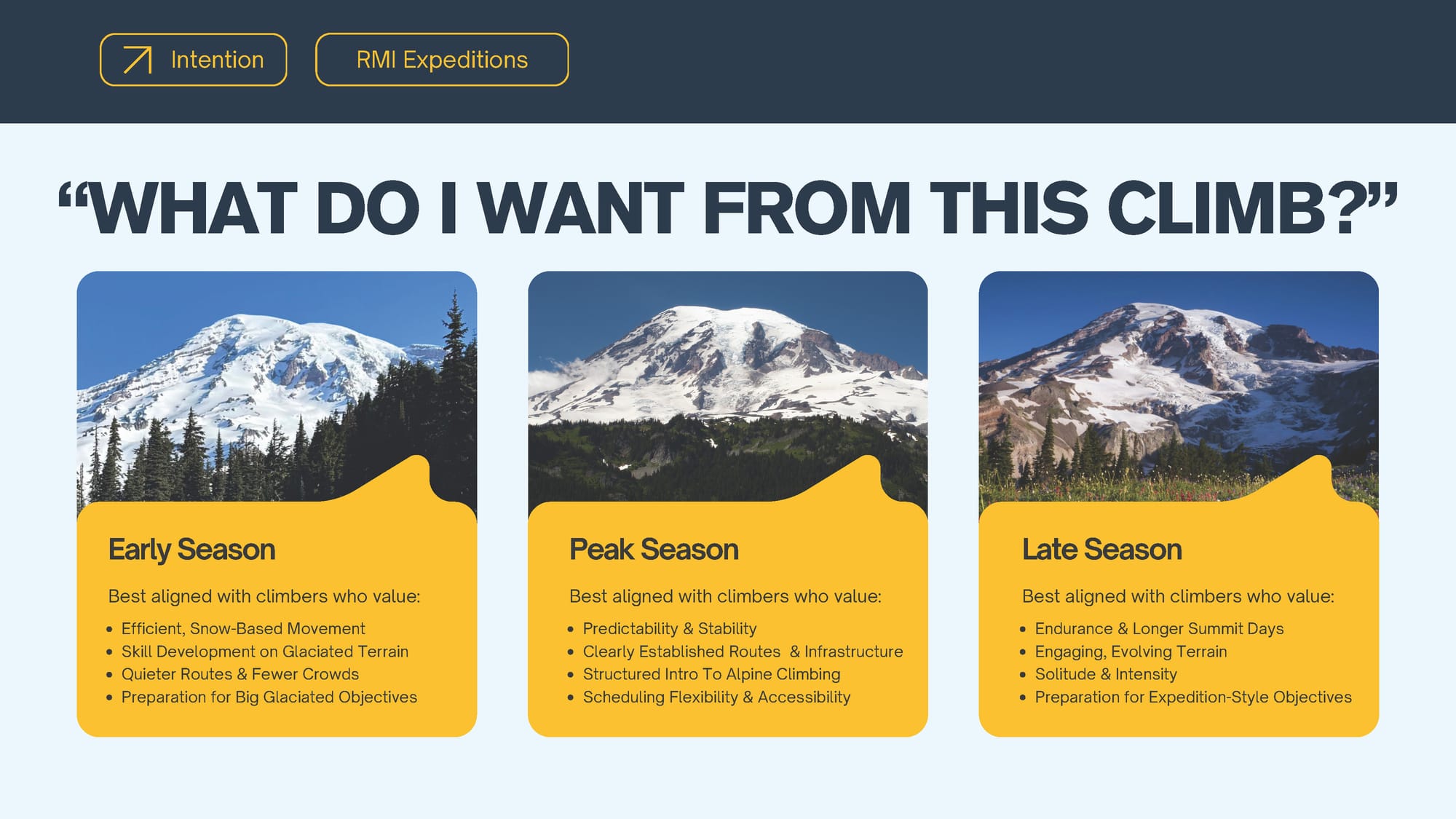
Early season often appeals to climbers who want:

  • A fast, efficient, snow-based ascent
  • Fewer crowds and a more personal experience on route
  • Conditions that emphasize classic alpine movement
  • Terrain that closely mirrors big glaciated peaks they may have their eyes on next

Peak season tends to suit climbers who want:

  • Predictability and clearly established routes
  • A strong balance between instruction and accessibility
  • A first Rainier experience with the widest margin for consistency

Late season attracts climbers who value:

  • Solitude and intensity
  • Long, demanding summit days
  • Exposure to evolving glacier terrain
  • Conditions that better resemble Andean or expedition-style objectives

The Program Mix

If you're weighing programs as well as timing, the data has an opinion there too.

Across RMI's standard 4-Day and 5-Day Summit Climbs, choosing your month swings your odds by 37.4 points, from 53.9% in the weakest core-season month to 91.3% in the strongest. Choosing your program, once you've already picked the best month, swings your odds by only 14.0 points among the programs with real July volume. Pick your dates first. Your program still matters, but it matters roughly a third as much.

It's also worth being straight about what a seminar buys you that a Summit Climb doesn't. Across the core season, RMI's seminars return a lower Summit Opportunity Rate than the standard Summit Climb, and that gap is largest in the shoulder months when seminars run most often. That's not a knock against seminars, it's a different product. A seminar is built to teach glacier travel, rope systems, and crevasse rescue, not to optimize summit odds. If odds are the priority, a well-timed Summit Climb beats a seminar timed the same way. If skill-building is the priority, that trade-off is the whole point of signing up.

None of these approaches is more legitimate than the others. They simply reflect different intentions.

Mount Rainier has a rare ability to meet climbers where they are, and to give them exactly what they're ready for, if they choose their timing thoughtfully. Whether your goal is a summit, skill-building, future preparation, or simply time spent moving through a powerful alpine landscape, the "right" season is the one that aligns with that purpose.

Climb with intention, and Rainier will deliver, no matter the month on the calendar.

Mt. Rainier Programs | RMI Expeditions
With 50-plus years of guiding experience, RMI is the leading guide service on Mt. Rainier. We offer a variety of program choices for climbers of all abilities.
About the author
Kristian Whittaker

Kristian Whittaker

Marketing Director for RMI Expeditions. Not nearly as skilled in the mountains as my father and grandfather, but I can navigate an ad campaign almost as well as they could navigate glaciers!

Success! Check your email for magic link to sign-in.

Success! Your billing info has been updated.

Your billing was not updated.

Back to Top
×