

RMI rates every program on a five-level scale, Novice through Expert, based on the pack weight, terrain, camping, glacier travel, and prior experience each one actually demands — not the destination or the price.
Five levels, one honest scale: Novice, Beginner, Intermediate, Advanced, Expert.
Whether you're booking your first mountain program or your tenth expedition, these levels are built to help you choose accurately — not aspirationally. Compare all five below, then browse each level's full program list to find your fit.
| Criteria | Novice | Beginner | Intermediate | Advanced | Expert |
| Pack Weight | Up to 25 lbs | Up to 40 lbs | 40–50 lbs | 50–65 lbs | 60+ lbs |
| Elevation | Below 10,000' | Up to 14,410' on glaciated climbs; up to 19,341' on non-technical treks | Up to 20,700' | Up to 22,850' | Up to 29,032' — the 8,000m peaks |
| Terrain | Trails and gentle training slopes | Established glaciated routes, maintained trails | Steeper snow/ice, moderate rock, less-traveled routes | Sustained steep snow/ice/rock, remote approaches | Extreme high-altitude terrain, technical ice/rock |
| Camping | Hotels/lodges; occasional single-night hut or camp | 1–2 nights in tents or huts on the mountain | Multiple nights in tents at established or high camps | Extended multi-week expedition camps, fixed camps plus rotations | Multi-week to two-month expedition camps, multiple rotations |
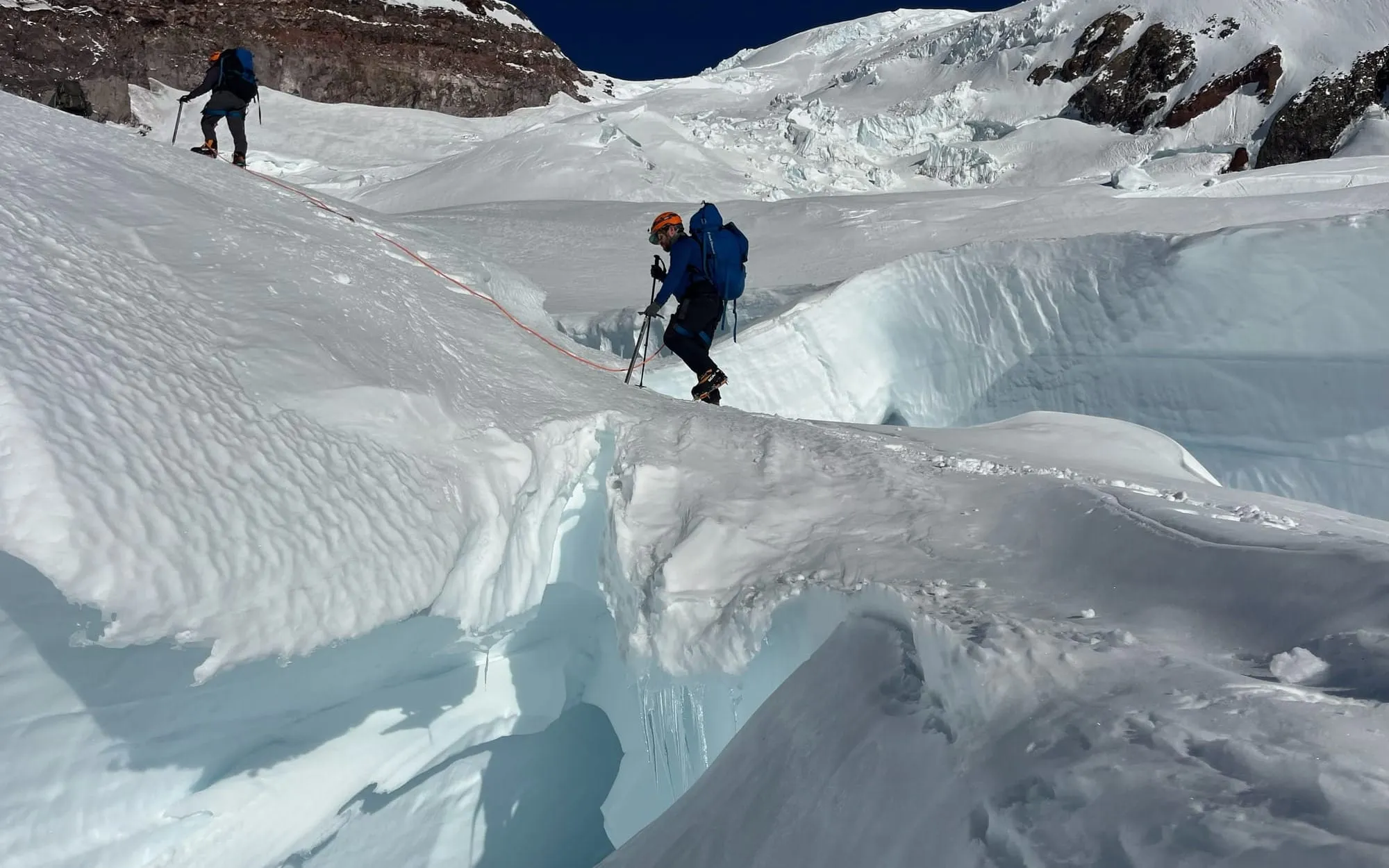
| Glacier Travel | None to introductory — fundamentals only, guide-led | A single guided glaciated route; guides manage crevasse hazard | Extended, multi-day glacier travel over more complex terrain | Sustained glacier travel including crevasse rescue and fixed lines | Extensive high-altitude glacier/icefall travel over a multi-week expedition |
| Prior Experience Required | None | None — fitness and willingness to learn | Basic glacier skills (roped travel, crampon use, ice-axe arrest) | Required — demonstrated glacier travel, crevasse rescue, often a completed Expedition Skills Seminar | Required — prior 7,000–8,000m altitude experience plus Expedition Skills Seminar completion |
Start with your prior experience: no climbing background puts you at Novice or Beginner; some roped glacier travel puts you at Intermediate; a documented resume of glacier travel and crevasse rescue is required for Advanced and Expert. Compare the table above, then read the FAQ on the specific level you're considering.
It's possible but not typical. Most climbers build a resume level by level — an Expedition Skills Seminar (Intermediate) is the most common bridge between a first climb (Beginner) and a bigger expedition (Advanced).
Yes, but altitude alone does not set the level — technical demand does. A trek like Machu Picchu sits at Beginner because it asks for solid fitness and no technical background, the same bar as a Beginner-level glaciated climb. That is also why a Beginner trek can reach a higher summit than an Intermediate climb: Kilimanjaro is 19,341' and requires no rope work, while an Intermediate objective may be lower but demands roped glacier travel and crampon technique.
Contact RMI directly. Every Advanced and Expert program individually screens climbers before booking, so if your experience doesn't clearly match a level, RMI's guides will help you find the right fit or the right prerequisite program.
Not necessarily — difficulty is based on physical and technical demand, not cost. Some Intermediate seminars cost less than certain Beginner-level treks; check each program page for current pricing.
Mt. Rainier's Mountaineering School or Crevasse Rescue School (Novice) are RMI's standard starting points for climbers with zero background — both are single-day programs that build the fundamentals every later level assumes.
Not sure which level or program fits your goals? RMI can build a custom climb, seminar, or expedition tailored to your experience and objective.


