Its not just about climbing mountains. Mountain adventures, especially international adventures, provide an opportunity to experience the whole enchilada. Seeing that we are in Mexico...no pun intended. And speaking of enchiladas and Mexico...today the team spent the day enjoying the local culture of Puebla.
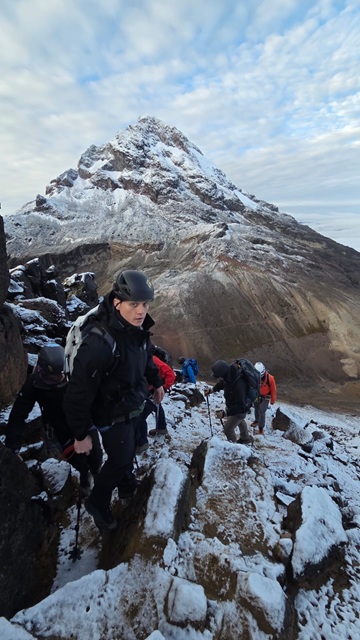
Everyone made the summit of Ixta yesterday. And everyone deserved a great day of rest, which mainly included enjoying the authentic cuisine of Puebla. I always said, "you've never eaten Mexican food, until you've eaten in Puebla".
For breakfast we enjoyed scrambled eggs covered in mole sauce. For lunch we devoured tacos pastor. And now, we are preparing for dinner at one of Puebla's famous restaurants, where we will sample all of the mole sauces that have made this region famous.
No, it's not all about climbing. However, tomorrow the team is looking forward to our next mountaineering objective... Pico de Orizaba.
Stay tuned...
RMI Guide JJ Justman
Hello RMI blog. This is JJ Justman. I am extremely happy to report that the entire team, 100%, got up Ixta this morning! We actually had an early day. We were on the summit early enough to watch the sunrise. We had just a gorgeous day to climb. Everyone's doing very, very well. Just was one heck of a team to climb. Lot of fun and I can't say enough great things about this group. So we are back at camp, we're going to get some hot drinks and then we're going to pack up camp. And we'll be heading to Puebla this evening. So we're certainly tired, we need a little hydration, a little food, but everyone is doing great. And I would like to pass the phone over to one of our team members they'd like to say something to those of you who are following our blog. Hey guys. This is TA Loeffler calling. Had an amazing morning climbing Ixta this morning with JJ and company. This climb, when you put together the two days of climbing with big loads to high camp and then getting up to the summit. Boy did we see a gorgeous sunrise! Popo in front, sending off a plume. And it's pretty surreal to get to the top of the 7th highest peak in North America. And I'm just really proud of everyone on the team. Hello to everyone out there in RMI land and it's great to share a summit with RMI once again.
RMI Guide JJ Justman
HI TA,
Congratulations on your summit!it is really cool that you made it to the top.Did you have a good time on the mountain? Looking forward to having you back for a visit again. Hooray for you from the grade fours at Bishop Abraham Elementary.
Heather and the grade four class
Posted by: Heather Courage on 10/25/2012 at 4:31 am
Hello everyone this is JJ Justman with the RMI Mexican Volcanoes adventure team. We are very happy to report that the entire team is up at high camp on Ixta. We are now at 15,300'. It's a long day carrying heavy packs to get up here, but it is definitely well worth it. I'm looking towards the summit right now. We just have a couple thousand feet to go. So we're getting our tents secured down and guyed out. And we're also working on a little bit of a hot drink as well as a dinner for this evening, which is gonna include some homemade sausage with a little bit of Ramen soup, and cheese quesadillas. Stay tuned tomorrow. I'll definitely give a call in. The weather right now is beautiful. We're keeping our fingers crossed that it's going to remain the same and wish us luck and we'll touch base hopefully with some great news tomorrow. Everyone's doing great and they all say hello. Bye.
RMI Guide JJ Justman
RMI Guide JJ Justman checks in from Ixta's High Camp.
Hello everyone following the RMI blog. This is the Mexican Volcanoes adventure checking in for the day. Our team made it up here. We are officially on Ixta. We're at the lower hut, had a good day getting up. The weather is absolutely beautiful. Good view of Popo, which is a little bit of a smoking volcano right now in the distance. And a great view of Ixta, which is our objective for the next couple of days. But in the mean time, our group is packing gear and getting everything set. We looked at the tents, everything's in order. So now my job is cut out for me. We're going to do a little bit of cooking here and feed the team. For starters, we're going to go with a tortilla soup, but before that we have a little bit of chips and homemade salsa. And then for our main course, we're having a little carne asada. That was a special recipe given to me by RMI Guide, Dan Windham. Looking forward to making a good dinner tonight, getting our bellies full. We're at 13,000' right now so we are officially acclimatizing. So we're going to have a good evening down here on the lower slopes of Ixta and then tomorrow we are going to move up to High Camp on Ixta. We'll check back in and let you know how everything's going, but all is well. Thanks for following along and we will touch back with all of you tomorrow. Take care. Bye.
RMI Guide JJ Justman
RMI Guide JJ Justman checks in from Ixta's lower camp.
On a personal fitness level, time sometimes seems elastic to me: if I have plenty of time to train, I'll sit around and lolly-gag; tell me I only have a couple of months to get prepared and I'll be up at 5 a.m. training like a prizefighter.
The question of, "Will I be ready?" will ultimately be answered only on the climb. However, we can stack the odds in our favor by creating a tracking system that gives us a snapshot of where we are in the preparation process.
A simple method is to make a graph depicting where we are today and where we need to be for the climb. For this example, I used a January Expedition to 22,841' Aconcagua in Argentina if I started training in October:
This allows me to see:
1. What I'm capable of today (see my post "Setting A Baseline" if you need help with this).
2. What I need to accomplish on my target date.
3. Where I should be during the process.
My experience is that progress is rarely a straight line on a graph and you may be ahead or behind at any given point; but you can see generally what you've achieved and identify what work remains to be done throughout the training period.
So, what if you're running short on time to prepare? This happens often. If the goal is ambitious, we may need to intensify our focus and really adopt the mindset of an athlete.
Some training recommendations if you are short on time to prepare:
• Try to establish a sensible progression and use the entire time you have rather than "front load" your training (which could create setbacks or injury).
• If you do have an aggressive training plan, be sure to focus on rest and recovery as well as quality nutrition.
• Make your training as specific as possible: Mountain climbing and hiking are perfect. Cross country skiing, running, Stairmaster, and cycling are all also good. Focus in on these activities to benefit the most from your training.
• Embrace the adventure and focus on the process more than just the result; it's easy to expend a lot of energy thinking only of the summit. By focusing on enjoying my training and doing the best I can each day, I find I enhance my training experience and my overall experience on the climb.
Take some time this week to sit down, pull out a pencil and paper, and graph out the training progression you need for your climb. It will give you a clear picture of not only where you need to be for your climb, but also where you need to be in three months, in one month, and even next week. Keep this graph in a convenient place and pull it out every once in a while to check in on yourself. It can be helpful to establish specific, repeatable benchmarks to revisit during your training to measure your progress. Check out RMI Guide Pete Van Deventer's ideas on using benchmarks.
- John Colver
_________
John Colver is a longtime climber, former mountain guide, and certified personal trainer with the American Council of Exercise. Colver introduced outdoor fitness classes to athletic clubs throughout the greater Puget Sound region before creating his adventX brand. Currently, adventX leads training programs in Seattle and Colver presents clinics on outdoor fitness at companies such as Microsoft, Boeing, the American Lung Association, and REI. Colver lives in Seattle.
Questions? Comments? Share your thoughts here on the RMI Blog!
Hello everyone at RMI. This is JJ Justman calling in with the Mexico Volcanoes adventure team. We had a great day today getting out of Mexico City and arriving in La Malinche where we had our first acclimatization day. For those you don't know a little bit about La Malinche, it's an old volcano, it's non-glaciated. It's actually known as the Weeping Woman. La Malinche is one of Cortez's mistresses. It's a beautiful peak here, standing at 14,640'. Today, our team made it up to 14,000'; had a great trail side lunch. And we returned back down to our cabanas, where we are showering up and getting ready for a great dinner down here in camp. Tomorrow the plan is waking up a little bit early and heading out the door and getting to Ixta. But before we do that, we'll have a little bit of shopping to do, some last minute items for our dinners and breakfasts, but everyone is doing really well. The weather here is absolutely beautiful. We had great views of Ixta, Popo, Orizaba, and of course La Malinche. Knock on wood we're hoping the weather stays, because it was nice to get a little bit of a suntan today and hopefully tomorrow we'll get even a little more sun. We'll touch base and let you know how everything is going. Thanks for following along.
RMI Guide JJ Justman
RMI Guide JJ Justman on Day 1 of Mexico Volcanoes Expedition
As we start the training process we want to decide how often to train, how hard to work, what type of activity to do, and for how long. A useful acronym is F.I.T.T. and it stands for Frequency, Intensity, Type and Time. We can use the F.I.T.T. principles to ensure our training provides the results we expect.
Frequency. The frequency of training is simply how often you train. For example, how often you complete your long hike or your strength training. My experience working with climbers and athletes is that in order to decide how often to train, it is best to look practically at our lifestyle and build the training in around work, family, and other important commitments. Most people can spend an hour or so on exercise most days of the week, with a larger amount of time on the weekends. The good news is that for most people this is enough. Training five days a week provides plenty of opportunity to build the fitness required for mountain climbing.
Intensity. Intensity can range from very easy to extremely hard. This can also be expressed as aerobic intensity and anaerobic intensity. In mountain climbing, the vast amount of activity is aerobic punctuated with shorter bursts of anaerobic activity. This can be reflected in the training plan. For example, longer hiking sessions will be performed at a lower intensity whereas shorter weekday sessions will be a chance to push hard and get the heart rate into the anaerobic range.
Type. A general theory of training is one of specificity. This means that the more closely aligned the type of training is to the actual activity, the more you will benefit. This is important for many climbers, especially if you live in areas with few hills to climb. Most of us will use alternate methods of training and we should make sure that we consider how closely the type of training mimics the actual climb. Hiking, of course, is perfect. A stairmaster or elliptical machines is good. Cycling uses similar muscles and energy systems. Although swimming, yoga, and basketball yield great conditioning benefits, these sports do not translate to climbing in the way that more similar activities do.
Time. Mountain climbing involves long days. It is common to climb for five to eight hours; summit days, such as on Mt. Rainier, often involve 14 to 18 hours of climbing. On these long climbs we generally break the day into segments of about an hour of climbing at a time. During your training a long day of hiking will progressively mimic a day on the mountain. Shorter mid-week training sessions of about an hour develop the habit of putting on a pack and being ready for any rigors the next hour of climbing presents.
Applying the F.I.T.T. principles is a good way of building out a training plan that covers all of our bases. A rough example of a well-balanced training week (in the building phase) could therefore look like this:
• Monday: Rest and Recovery
• Tuesday: Stairs
• Wednesday: Strength training
• Thursday: Short hike
• Friday: Rest and Recovery
• Saturday: 2 hour aerobic activity ie. cycling, hiking, or running
• Sunday: Half-day hike
This example is simply a guideline; everyone will have a slightly different approach to how they map out their training plan. Just as there are many routes to the summit of the mountain, there are many ways to develop a training plan. The important things are that your training plan contains the right balance of activities that develop the fitness and strength to be successful on the mountain. At the same time, the best training plans are ones that fit our lifestyle, are enjoyable, and therefore sustainable.
- John Colver
John Colver is a longtime climber, former mountain guide, and certified personal trainer with the American Council of Exercise. Colver introduced outdoor fitness classes to athletic clubs throughout the greater Puget Sound region before creating his adventX brand. Currently, adventX leads training programs in Seattle and Colver presents clinics on outdoor fitness at companies such as Microsoft, Boeing, the American Lung Association, and REI. Colver lives in Seattle.
To begin a conditioning plan for mountaineering, first establish the baseline of your current fitness level. This baseline allows you to compare your current strengths to what you’ll need on the climb. With this, we can compose a training plan that builds steady improvement between now and the day you set off for the mountains.
To illuminate the task ahead, and to build a plan, consider these questions:
• What are the physical requirements of the climb (ie. pack weight, number of days, hours spent each day)?
• How much time do I have before I climb?
• What are my fitness strengths?
• How much weight can I carry and for how long?
To determine the physical requirements of the climb, look to RMI’s office and website. RMI provides details on the equipment we will be carrying, the itinerary, and the duration of the climb.
How much time is there before the climb? Take out a calendar or a blank sheet of paper and consider how to fit in the three phases of training:
1. Beginning (adaptation)
2. Building
3. Peaking (the final preparation before the climb)
Assessing your fitness strengths with a visit to a qualified athletic trainer will help to quantify your current level of fitness. Or, visit a park and hike your favorite loop or trail with a weighted backpack to gain realistic insight into your capabilities. What I like about assessing the time and weight is that it is simple and you can do it today.
As we move ahead, I encourage you to think about whether you prefer to approach your training scientifically or intuitively. Do you prefer hiring a coach, or do you like to be your own coach? Both methods are successful - sometimes a combination is a nice way to go about it. Throughout training, I encourage you to be consistently aware of two important factors: How long can I go? How much can I carry? On the mountain, these two things really matter.
As an exercise for this week, set aside time to visit a park, sports stadium, or a local hiking area. See how it feels. The purpose of this session is not to push to a maximum effort but to simply experience how it feels to carry a pack up and down inclines.
My encouragement is to not do too much. The "safety first" rule applies to training as well as the mountains. Too much too soon can have a negative effect, or even risk an injury. If this is new to you... don’t feel overwhelmed if today you feel that you have a long way to go.
Two years ago in October, I trained with my friend Kim Porto. She had her sights set on climbing Mt. Rainier and trekking to Everest Base Camp during the following eighteen months. She had never hiked before. On day one, we walked stairs for twenty minutes with our running shoes and no pack. It was enough. From there, we mapped out a plan that steadily increased the training with hiking, stair work, and strength training. By steady training over the months ahead, Kim accomplished both her Rainier climb and her trek to Everest Base Camp.
Remember that moderation and consistency are the keys to success in building endurance!
- John Colver
John Colver is a longtime climber, former mountain guide, and certified personal trainer with the American Council of Exercise. Colver introduced outdoor fitness classes to athletic clubs throughout the greater Puget Sound region before creating his adventX brand. Currently, adventX leads training programs in Seattle and Colver presents clinics on outdoor fitness at companies such as Microsoft, Boeing, the American Lung Association, and REI. Colver lives in Seattle.
Questions? Comments? Share your thoughts here on the RMI Blog!
The final RMI EXPEDITIONS climb of our North Cascade’s season took place under excellent weather & high spirits. The three of us (RMI Guides Jake Beren and Alex Van Steen, with climber Jim Lumberg) enjoyed late season conditions. The chimneys, gullies and summit pyramid didn’t have an ounce of snow in them, making for absolutely fantastic & fun rock scrambling & climbing. On summit morning, we postponed our bid by an hour or two as rain threatened, but by the time we took off the skies were clearing and we enjoyed an improving day and stellar climbing.
RMI Guide Alex Van Steen
I'll never forget the day I decided to be a mountain climber. I was sixteen years old, sitting in a lecture hall at Edinburgh University - captivated by the slideshow being presented by the famous British Expedition Leader, Sir Chris Bonnington and his climbing partner Doug Scott. After it ended I got myself to the front and spoke to the man himself asking, "How do you begin to start to plan an expedition?"
"Just get your boots on, Lad", was the reply, accompanied by a larger-than-life grin and a firm handshake.
I had no response. However, that one comment led to many climbs the Scottish Highlands - and ultimately - onto years of expeditions, mountain climbing including a long stint as a guide. It's been a long and satisfying adventure so far!
I think that after the decision to climb Mt. Rainier or any other major mountain, there ought be a celebratory moment: a pause to mark the start of the preparation and to consider what the months ahead will look like. The climb may be a long way out, but the adventure starts now.
What are some considerations at this point? I recommend taking an inventory of the following:
- Time
- Equipment
- Fitness & Health
- Location & available resources
Time: What time do I have to train? Be realistic about how many hours per week and also consider any vacation time in the months ahead. Is there a day (or half day) each week you can devote to training? What can you do on a daily basis? Can you combine training and a commute? Walk to work with a pack? Ride a bike?
Equipment: Will you be renting or will you likely need some gear of your own? To begin your training, all you'll need now are shoes, boots, a backpack and workout/hiking clothes. And going forward, there'll be good time to experiment with socks, layering and other clothing. Depending where you live (anyone reading this from Chicago or the northern states?), you might get some good use of cold-weather gear this winter during your training.
Fitness & Health: In next week's blog post we'll discuss how to set a baseline. Now is a good time to think about your strengths and any areas you want to improve. In terms of health, this might be a good time to schedule an annual physical examination, to visit the dentist, to take a look at your overall diet, and to generally consider what your athletic lifestyle will look like going forwards.
Location and Available Resources: A climber can train for mountaineering anywhere. However, if you are living in Florida, stationed on a military base halfway around the world, or getting ready for a northern winter, some creativity and imagination will make things more successful. In terms of resources at hand, do you have access to hiking trails? Are there hills? Can you get to a gym or have access to a stair-master or elliptical machine? Do you have a place at home, work, or school where you can workout? Is there a local yoga class, training facility, spin class, or swimming pool? Do you even like any of these activities? Do you have a workout partner, a fitness coach, or a personal trainer?
We'll discuss program design over the next few weeks. For now, a little time considering all of the options available will spark your imagination as to what is going to work for you. I've always thought that the best fitness program is the one you actually do. Personally, I like to enjoy my training and I like there to be variety and somewhat of a social aspect to it all. You'll be putting in some hours and days of preparation over the months ahead and making it as fun and interesting as possible will boost results.
Your climb is months away, yet the adventure has already begun. Congratulations on getting started!
- John Colver
John Colver is a longtime climber, former mountain guide, and certified personal trainer with the American Council of Exercise. Colver introduced outdoor fitness classes to athletic clubs throughout the greater Puget Sound region before creating his adventX brand. Currently, adventX leads training programs in Seattle and Colver presents clinics on outdoor fitness at companies such as Microsoft, Boeing, the American Lung Association, and REI. Colver lives in Seattle.
I have some big mountaineering goals. I’m not sure how much training and fitness is necessary. I’m trading for Ironman Lake Tahoe as a way to get fit for mountaineering. Is doing this enough fitness?
I have asked this question here before. I still have not heard from anyone. I would hate to find out I don’t have enough fitness on the mountain.
Posted by: Will Beaubien on 2/9/2014 at 6:05 pm
Any opinions on CrossFit? I’m somewhat short on time and do this about four times a week. It’s fun. I also do a long endurance hike with weight 4+ hours once a week. I fight forest fires during the summer for the Forest Service and this is my off season training regime. I’m aiming to climb Rainier via the Kautz glacier or another similar route. Any suggestions for adding to or changing my training plan? Thanks!


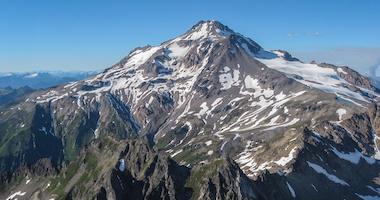


 This allows me to see:
1. What I'm capable of today (see my post "Setting A Baseline" if you need help with this).
2. What I need to accomplish on my target date.
3. Where I should be during the process.
My experience is that progress is rarely a straight line on a graph and you may be ahead or behind at any given point; but you can see generally what you've achieved and identify what work remains to be done throughout the training period.
So, what if you're running short on time to prepare? This happens often. If the goal is ambitious, we may need to intensify our focus and really adopt the mindset of an athlete.
Some training recommendations if you are short on time to prepare:
• Try to establish a sensible progression and use the entire time you have rather than "front load" your training (which could create setbacks or injury).
• If you do have an aggressive training plan, be sure to focus on rest and recovery as well as quality nutrition.
• Make your training as specific as possible: Mountain climbing and hiking are perfect. Cross country skiing, running, Stairmaster, and cycling are all also good. Focus in on these activities to benefit the most from your training.
• Embrace the adventure and focus on the process more than just the result; it's easy to expend a lot of energy thinking only of the summit. By focusing on enjoying my training and doing the best I can each day, I find I enhance my training experience and my overall experience on the climb.
Take some time this week to sit down, pull out a pencil and paper, and graph out the training progression you need for your climb. It will give you a clear picture of not only where you need to be for your climb, but also where you need to be in three months, in one month, and even next week. Keep this graph in a convenient place and pull it out every once in a while to check in on yourself. It can be helpful to establish specific, repeatable benchmarks to revisit during your training to measure your progress. Check out RMI Guide Pete Van Deventer's ideas on using benchmarks.
- John Colver
_________
John Colver is a longtime climber, former mountain guide, and certified personal trainer with the American Council of Exercise. Colver introduced outdoor fitness classes to athletic clubs throughout the greater Puget Sound region before creating his adventX brand. Currently, adventX leads training programs in Seattle and Colver presents clinics on outdoor fitness at companies such as Microsoft, Boeing, the American Lung Association, and REI. Colver lives in Seattle.
Questions? Comments? Share your thoughts here on the RMI Blog!
This allows me to see:
1. What I'm capable of today (see my post "Setting A Baseline" if you need help with this).
2. What I need to accomplish on my target date.
3. Where I should be during the process.
My experience is that progress is rarely a straight line on a graph and you may be ahead or behind at any given point; but you can see generally what you've achieved and identify what work remains to be done throughout the training period.
So, what if you're running short on time to prepare? This happens often. If the goal is ambitious, we may need to intensify our focus and really adopt the mindset of an athlete.
Some training recommendations if you are short on time to prepare:
• Try to establish a sensible progression and use the entire time you have rather than "front load" your training (which could create setbacks or injury).
• If you do have an aggressive training plan, be sure to focus on rest and recovery as well as quality nutrition.
• Make your training as specific as possible: Mountain climbing and hiking are perfect. Cross country skiing, running, Stairmaster, and cycling are all also good. Focus in on these activities to benefit the most from your training.
• Embrace the adventure and focus on the process more than just the result; it's easy to expend a lot of energy thinking only of the summit. By focusing on enjoying my training and doing the best I can each day, I find I enhance my training experience and my overall experience on the climb.
Take some time this week to sit down, pull out a pencil and paper, and graph out the training progression you need for your climb. It will give you a clear picture of not only where you need to be for your climb, but also where you need to be in three months, in one month, and even next week. Keep this graph in a convenient place and pull it out every once in a while to check in on yourself. It can be helpful to establish specific, repeatable benchmarks to revisit during your training to measure your progress. Check out RMI Guide Pete Van Deventer's ideas on using benchmarks.
- John Colver
_________
John Colver is a longtime climber, former mountain guide, and certified personal trainer with the American Council of Exercise. Colver introduced outdoor fitness classes to athletic clubs throughout the greater Puget Sound region before creating his adventX brand. Currently, adventX leads training programs in Seattle and Colver presents clinics on outdoor fitness at companies such as Microsoft, Boeing, the American Lung Association, and REI. Colver lives in Seattle.
Questions? Comments? Share your thoughts here on the RMI Blog!




This article provide many tips. Very useful to me. Thanks a lot ?
Posted by: Michelle M Ruiz on 11/1/2012 at 12:21 pm
View All Comments