BRIEFING
This week, we're loading up your pack with another ten to fifteen pounds of weight. Your ultimate target weight will be 35 to 45 pounds, depending on your individual gear. The added pack weight takes you a big step closer to that goal of preparing for your climb. A side benefit of increasing the amount of gear in your backpack is learning how to pack your gear like a pro! Check out RMI Guide Pete Van Deventer's packing tips for some insights on how to pack a backpack for climbing!
Since day one of Fit To Climb, you've been practicing squats, lunges and other core exercises which are building your upper and lower body strength. This is a great time to focus on your technique, especially for squats (see Fit to Climb: Week 3 for a refresher on proper technique).
This week, you’ll also increase the stair training workout to 60 minutes, pushing it into the “very hard” workout territory. The strength workout is twice as long as when you started; you’ll be doing 4 sets of the 8 exercises. In this week’s workouts you’ll notice that you’re building muscle endurance, indicated by your ability to make repeated efforts with less fatigue.
DESCRIPTIONS OF WORKOUTS
Day 1: Rainier Dozen + Easy Hiking (30 Minutes)
Begin your day with the Rainier Dozen. Feel free to take another 30 to 60 minutes of light exercise if you feel like it (a brisk walk is a great option). If you feel tired, today is a good opportunity be good to take a complete rest day instead. Listen to your body.
Day 2: Rainier Dozen + Stair Interval Training (60 Minutes)
After the Rainier Dozen, warm up for about 10 minutes, and then climb up and down a set of stairs, at a consistent pace, for about 40 to 50 minutes. Cool down with some stretching. You don’t need to carry a pack on your stair interval training, the focus in this workout is on speed and intensity.
Day 3: Rainier Dozen / Rest
Begin your day with the Rainier Dozen. Feel free to take another 30 to 60 minutes of light exercise if you feel like it (a brisk walk is a great option). If you feel tired, today is a good opportunity be good to take a complete rest day instead. Listen to your body.
Day 4: Strength Circuit Training x 4
Repeat the strength circuit training workout introduced in Week 3. After warming up, perform four sets of the following exercises:
• Steam Engine
• Push Up
• Three Quarter Squat
• Russian Twists
• Lunge
• Steam Engine Laying down
• Mountain Climber
• 8 Point Bodybuilder
Spend 40 seconds performing the exercises, and take 20 seconds between exercises to rest and rotate. Take a full minute of rest between each set. Take a full minute of rest between each set. Take ten minutes to cool down by stretching after you’re done.
Day 5: Rainier Dozen / Rest
Begin your day with the Rainier Dozen. Feel free to take another 30 to 60 minutes of light exercise if you feel like it (a brisk walk is a great option). If you feel tired, today is a good opportunity be good to take a complete rest day instead. Listen to your body.
Day 6: Rainier Dozen + Cross Training (1 Hour)
Warm up with the Rainier Dozen and then spend an hour in some moderately vigorous activity as cross training. Listen to your body as to what activity sounds appropriate and have fun with it.
Day 7: 3 Hour Hike
Adding a pack with 15 pounds doesn’t sound like much, but if you’re not used to wearing a pack, it’s quite normal to experience tiredness or muscle ache, especially in the shoulders. If you feel a sharp pain, you should stop. However, if what you feel is muscle fatigue or an ache, do persevere and your shoulders will become used to the pack over the next few weeks.
An organizational aspect to this workout is to practice packing your pack so that the needed gear is easy to accessible, weather proofed and packed in a way that is balanced. Nothing wears you down like a poorly-organized, lop-sided pack.
Practically, if you have been acquiring gear for your climb, you could use it for ballast. If you don't have the specific items that you're climbing with, yet, you can be creative by adding heavy items such as water and bags of rice, or even spare clothes. A tip for anyone who is worried about knee pain on the descent: carry a jug of water to achieve the desired weight on the way up (15lbs = ~1.8 gallons of water). At the high point of the hike you can dump out some, or all, of this water so that you can descend with a lighter load and lessen the strain on your body.
- John Colver
Have a question? See the Fit To Climb FAQ for explanations of specific exercises and general pointers to help you through the Fit To Climb Program.
John Colver is a longtime climber, former mountain guide, and certified personal trainer with the American Council of Exercise. Colver introduced outdoor fitness classes to athletic clubs throughout the greater Puget Sound region before creating his adventX brand. Currently, adventX leads training programs in Seattle and Colver presents clinics on outdoor fitness at companies such as Microsoft, Boeing, the American Lung Association, and REI. Colver lives in Seattle, and is working on his second book, Fit to Climb - a 16 week Mount Rainier Fitness Program.
For the stair interval training, the comments say to climb at a consistent pace for 40-50 minutes. the link however says to do 3-4 intervals of 2 minutes at high intensity. Which is it? thanks.
Posted by: Phil on 9/19/2016 at 7:31 am
With regard to a previous article on the benefits of using trekking poles on the climb of Rainier, how does one coordinate the use of two poles with an ice ax?
It has been three days since Dave, Tshering, Kaji and I reached the summit of Everest. Our short and fast summit bid was a whirlwind of a climb, an exciting and tiring endeavor up and back down the mountain's upper reaches.
Leaving Camp 2 in the early hours of the 20th I was full of excitement and anticipation, eager to finally be setting out on our summit bid after so much time here on the mountain but also nervous about heading to altitudes far higher than I had been to before, uncertain of how my body would react. Within minutes of leaving Camp 2 those thoughts were pushed from my mind, replaced by nothing but pleasure: it was an incredible time to be climbing. The waning moon was still so bright that the entire Lhotse Face shone above us, our shadows stretching across the glacier of the upper Cwm. We switched off our headlamps and climbed by nothing but the light of the moon, easily making out the ice and snow features of the Face as we ascended. We managed to climb at the same rate as the moon's descent so that the moon hung just above Nuptse's Ridge, never managing to slip behind it until daylight was well upon us. Dawn found us reaching Camp 3, passing by the tents of groggy climbers just waking up for the day.
Strapping on oxygen at Camp 3 changed the game. Dave, Tshering, Dawa, Kaji and I cruised past other teams that were just leaving Camp 3. I was amazed by how much stronger I felt, even at the relatively low flow rates we were using. Before long we had crested the Yellow Band and navigated through the Geneva Spur, arriving at the South Col by late morning. Above us clouds gently swirled off of Everest's South Summit and we could pick out climbers descending from the summit. Dave spent some time explaining the route above to me, pointing out notable landmarks and their elevations and what to look for as we passing them in the dark. Soon we crawled into our tent for some much needed rest after our push up from Camp 2, now sitting a vertical mile below us.
We spent the day melting snow and doing our best to recover from the climb. The winds picked up in the late afternoon, gusts shaking the tent walls, but I managed to drift off for an hour or two of restless sleep. Before I knew it we were firing up the stoves, filling our waterbottles with boiling water, and choking down a little bit of food before heading out. Above us we could see a string of lights bobbing up the Triangular Face - climbers who departed a few hours before us. By midnight the evening winds died and we set out - walking across the Col to the base of the Triangular Face. The approach to the Face is far longer than it looks from Camp and I felt like we were making hardly any progress, the silhouette of the mountain above us in the darkness seemed to retreat with each step towards it. But as soon as we hit the Triangular Face and began to gain elevation the mountain side slipped quickly by as we climbed. Before long we had passed the climbers we had seen on the Face from camp and were cresting onto the ridge, pausing on a small bench known as the Balcony, no bigger than the backseat of most SUVs.
After swapping out our partially used oxygen bottles we continued up the ridge towards the South Summit, still some 1,200' above us. We continued upwards, bracing against sporadic gusts of wind sweeping down from above, and battling the frozen condensation that formed on the masks, occasionally freezing the valves. Entering the rock bands below the South Summit Dave stopped and pointed off to the east where a thin line of purple and red was spreading across the horizon. The sky gradually lightened while we navigated the short rock steps and soon the sun found us, suddenly turning the snow and rock brilliant orange around us. The sun brought me a new wave of energy, we were just a handful of vertical meters shy of the south summit and my excitement was growing with each step. The sharp cold we battled throughout the night dulled slightly and my fingers and toes pulsed with warm. Within minutes we were standing at 28,700' on the South Summit looking across the narrow ridge line to the top of Everest just a few hundred feet above.
The final portion of the climb was a blur. Traversing the ridge line to the Hillary Step demanded intense focus with the 8,000' of exposure on each side. We followed the route crossing back and forth across several rock outcroppings, and up the narrow choke of rock and snow up the Hillary Step, moving over the awkward step around at the top of the Step, and up the gentle snow slopes to the summit. The views from the top were stunning, it was incredible to gaze northwards into the Tibetan Plateau, to the south into the middle hills of Nepal, and to the east and west ran the Himalayas, a jagged white strip piercing into the horizon in both directions. Below I could make out the peaks surrounding Base Camp - Pumori, Lingtren, Khumbutse - looking tiny compared to the prominence they hold from below. We spent some time on the summit, snapping a few photos and exchanging celebratory hugs before heading down, reaching camp back at the South Col by late morning.
We rested for a short moment at the South Col before breaking camp and heading back across the Geneva Spur and down the Lhotse Face into a high altitude furnace. Clouds settled on the face, trapping the sun that bounced off the face and rocketing the temperatures. Wearing down suits and carrying big loads, it felt like as much of a battle to descend the face in a couple of hours as it had to ascend it the day before.
Camp 2, at 21,300', never felt so good. We covered a lot of ground in the 36 hours since we left Camp 2 and my legs felt the effort, my toes screamed from the 8,000' descent that day, but the grin on the faces of Dave, Dawa, Kaji, Tshering - and doubtlessly me- told the the bigger story: we were all elated to have had such an incredible climb.
We slept soundly that night and it took us a long time to get moving in the morning, lethargically packing our gear before leaving Camp 2. By the time we walked into the sun while descending the Western Cwm I began feeling stronger, the sun again bringing much needed warmth and energy. We made a furious and fast descent back down through the Khumbu Ice fall, well acquainted with the ladders crossings and tricky sections of the route by now. Emerging from the Ice fall our pace quickened as we climbed up and down the dozens of large pressure ridges of ice back to Base Camp, despite our tiredness we were eager to put the final stretch behind us and just make it back to Camp. Cokes, flip flops and a big meal awaited us.
We've been back at Base Camp for two days now, drying out our gear, sitting in the sun, eating, drinking and recovering from the climb. Melissa Arnot and Dave Morton arrived in Base Camp today; already acclimated from 45 days spent climbing on Makalu, they are hoping to make a fast attempt on Everest before the end of the season. It has been a blast to sit around today swapping stories from the past month and a half of climbing on our respective mountains and catching up with them - it has been a spring full of adventure.
RMI Guide Linden Mallory
Dear friends, family and colleagues: we are happy to get back in touch with you. Before all, we would like to apologize for the lack of communication of the last 10 days, but unfortunately, we were the most frustrated with that issue. Our satellite phone decided not to cooperate with our solar panel, and recharging the battery was an impossible task. Being the last team this season on the mountain, we could not borrow any other means of communication and we understand the worries this might have caused. But this is what being in the Himalayas brings to all of us...
That said, we are eager to announce that entire team is back safe in Kathmandu after having reached the SUMMIT ON THE CENTRAL SUMMIT OF SHISHAPANGMA at 8013metres!!!!
On Oct.11th, Bridget, Jake, Geoff and Elias reached the central summit in the mid afternoon, on a warm and cloudless day, after having followed the NW ridge for several hours from C3 (Elias and Bridget) at 7450m and from C2.5 (Geoff and Jake) at 7100m. The next day, Oct 12th, Eric and Leon, who had made shelter in C3 the previous day, started strong towards the summit. Leon reached the summit hours later, having Eric turning around well above 7600m in a wise and mature decision that honors this young, strong and smart climber, since his cold toes were not warming up in those early hours and up there you are the mercy of the temperatures.
Two days later, the entire team was reunited at Base Camp, from were we would proceed to do several back-carries to clear our gear and trash from anywhere below C1 at 6400m. After another day of rest and packing, we initiated our descent towards the trail head, also called Chinese Base Camp, were we arrived yesterday, the 16th. We were picked up by our truck (who learned about our arrival by a paper note sent down 2 days earlier with a yak shepherd) which would take us to the town of Nyalam, just a few Kilometers away from the Tibetan-Nepali border, to spend the night. This morning (Oct 17th) we made it into Nepal not without a couple small issues at the border and multiple traffic stops en-route to our hotel in Kathmandu, due to the heavy tourist season in the area. Is close to midnight here, so I will stop writing, but we will send you a good recap of the entire expedition soon.
Again, thanks to all of you for your support, your interest and the good vibrations sent. Best regards.
RMI Guide Elias de Andres Martos
Ice season is almost upon us here in Bozeman, Montana with many other U.S. ice destinations soon to follow. I find it very difficult to train for ice climbing this time of year - you want to get comfortable on your tools again, but there isn’t any ice forming yet. These are a few of my favorite pre-season workouts that can get you stronger before you get to swing those picks into a column of ice.
First, I say any climbing is better than no climbing. The rock gym can be a great place to start building upper body strength, balance, and grip strength. I usually warm up by pulling on plastic for an hour or so, mostly easy to moderate routes with two or three that really push me. The goal is to get a little pumped but not so spent that I can’t do a workout after. I take 10-15 minutes to cool down, drink some water, get out of my climbing gear, and transition to the weights.
When I am training specifically for ice climbing I focus most of my efforts on forearms and triceps with some shoulder and bicep work to stay balanced. In my opinion, the best exercises mimic the actual motions done in ice climbing. So, my first go-to ice climbing workout is simply to grab a light dumbbell, 6-12lbs, and hold it like you would an ice tool. If you can watch yourself in the mirror it can help to make sure you maintain good form. Loosely hold the weight in one hand and cock it back over your shoulder, keep your wrist, elbow, and shoulder all in line, and slowly swing the weight like you would an ice tool. Finish with the wrist flick so the weight is just in front of your body, I like to keep my other hand touching my elbow, which helps to encourage good form.
Dead hangs are another great exercise you can do almost anywhere. If you can use your tools that’s the best; I put the picks of both ice tools over a pull-up bar, grab both tools, and hang with elbows slightly bent for 10 seconds. If you are doing it correctly your shoulders should be engaged. I try to draw my shoulder blades towards each other. Do this for 10 seconds on, 10 seconds off for 10 rounds; that is one set for me, and I try to do 3 sets per workout. Don’t push yourself and tweak a shoulder though, or all this training is for nothing. Start with what makes sense for you and then slowly add repetitions, sets, or increase the time of each dead hang. I often integrate sets into my whole workout so I don’t get too bored.
Next: pull-ups. Find out what your max is and then go for 50-80% of that for three sets. If 10 pull-ups is your threshold, do three sets of 5-8. Try to increase this number over time. Again I mix these into the whole workout so that I have some time to recover.
There are a number of great exercises for grip strength and forearms; I constantly switch it up. The standing bar – rope - weight workout is a great one. With a small bar, stick, or dowel, tie a 5-foot rope to the center and a weight on the other end of the rope. With your arms straight out in front of you slowly twist the bar in your hands to wrap the rope up and lift the weight then reverse the motion to lower it back to the ground. Maintain good form and keep your arms parallel to the ground.
Another forearm workout that I really like is to grab two dumbbells of moderate weight, 5-15 lbs, and hold one in each hand. Slowly I let the weights roll down my palm and fingers until they are close to falling out of my hands and then bring them back up. The first few will leave you asking, “what is the point of this?” by rep 20 you will be screaming for mercy.
The plate pinch is both a forearm and grip exercise. Grab two plates, 2.5, 5, or 10lbs, and position them together so the smooth sides face out. Simply pinch them together with one hand and let them hang by your side. You are going for time here, see how long you can hold it first and then aim for three sets in each hand. Gradually add more and more time over a few weeks. Finally, another fantastic grip strength workout is a spring or rubber doughnut trainer. I keep one in my car and try to use it at every red light.
These are just a few of the upper body workouts that I use when I am patiently, or not so patiently, waiting for temperatures to drop and ice to start forming. I hope you enjoy these and I look forward to seeing you all out on the ice soon.
_____
Geoff Schellens is a certified AMGA Rock Guide, Apprentice Alpine Guide, and an avid ice climber. He lives in Bozeman, MT, and will be leading an expedition to Denali's Upper West Rib this spring.Comments? Questions? Share your thoughts here on the RMI Blog!
I will be 66 this May. I am active mountain biking regularly am not overweight but live in New Jersey.
I’m a sea level baby. A few years ago about 5 or 6 my brother-in-law who has summered Rainier dozens of times even Denali without oxygen took me up the mountain. Within sight of Muir after sleeping around 9000 feet the next morning carrying my heavy pack I just ran out of gas.
I want to Summit Rainier.
This year I am very busy with trips but want to do it in 2019.
How should I approach this.
I want to use RMI.
On Monday, the Expedition Skills Seminar - Muir was foiled from getting into the National Park by a large Spring snow storm. We spent the day learning and practicing technical skills like rope ascension and ice climbing. The team then learned about route planning, glaciology, and snow science. Hopes are high that the team can reach Paradise today.
RMI Guide Dave Hahn summits Mt. Everest for a Record Thirteenth Time. On May 20th, 2011, Dave Hahn, Linden Mallory and their Sherpa team stood on the summit of Mt. Everest on a clear and beautiful day. Congratulations!
The team has safely returned to Everest Base Camp.
Congratulations to everyone. I was disappointed that Sara and her dad didn’t summit but she has a whole lifetime to try again. I’m glad you’re back to Base Camp.
Posted by: Sue Eilers on 5/23/2011 at 7:02 am
Hi Dave….and hi there LINDEN! Congrats to Dave on #13…but a special high five to Linden for #1 on Everest. Very happy for you.
Steve from Team Kuwaz- Kilimanjaro
Posted by: Steve di Costanzo on 5/23/2011 at 5:28 am
Rainier Dozen / Hike (2 hrs, 1,500' of elevation gain)
120 min.
Medium
6
Rainier Dozen / Hike (4 hrs, 2,500' of elevation gain)
420 min.
Medium
7
Rainier Dozen / Hike (7 hrs, 4,500' of elevation gain, 45 pounds of pack weight)
420 min.
Medium
Total
17 hrs 24 mins.
BRIEFING
Week 14 may well be harder than the climb itself. This is intentional: in an ideal situation, you want to make the training more difficult than the climb so that you can arrive feeling more than prepared! Self care, organization, and a positive attitude play a critical role in the success of this week’s training. Good luck!
The only easy day this week was yesterday! During the first part of the week, you complete the interval training you are used to from the last few weeks. On Day 4, you have a choice between stair interval training or a fartlek training hike. Heading into the weekend, over three days you’ll complete up to 13 hours on the trail. After this effort, the next big push you’ll do will be on the climb! With the appropriate planning, you could make Days 5 through 7 a three-day backpacking trip. If you are able to, it wouldn’t be a bad idea to take a day off from work so that you can focus on a pretty tough series of workouts.
The goal of these hikes is to prepare you fully for the terrain and efforts you will encounter in the mountains, hence the emphasis on elevations throughout the hikes - nothing beats training for uphill climbing like climbing uphill! Carry whatever amount of weight is necessary to pack all of the gear you will need for the hikes on Days 5 and 6, but aim to carry about 45 pounds on the final hike on Day 7. If you are unable to find steep enough terrain consider finding a series of smaller hills and repeating them until you achieve the needed amount of elevation gain. An altimeter watch is a great tool for this. You can also consider adding a bit of weight to your pack if that sort of elevation gain is out of the question for the terrain you have available but be careful not to injure yourself in the process.
DESCRIPTIONS OF WORKOUTS
Day 1: Rainier Dozen + Easy Hiking (30 Minutes)
Today’s hike is a recovery workout and you can always substitute it with a different activity, such as running, biking or swimming. The important thing is to move at a moderate pace for 30 to 45 minutes. The pace can be conversational and you do not need to be dripping with sweat at the end of the workout.
Day 2: Stair Interval Training: The 1-2-3 Workout
Warm up with some moderate paced stair climbing. Then, make three efforts: one moderately hard, one very hard, and one close to maximal effort, with rest periods in between. This may look like:
• 2 minutes at 50-65% intensity, followed by 3 minutes of rest (1 minute standing, 2 minutes descending)
• 2 minutes at 65-80% intensity, followed by 3 minutes of rest
• 2 minutes at 85-90% intensity, followed by 3 minutes of rest
Repeat this sequence five times.
Day 3: Rainier Dozen / Rest
Begin your day with the Rainier Dozen. Feel free to take another 30 to 60 minutes of light exercise if you feel like it (a brisk walk is a great option). If you feel tired, today is a good opportunity be good to take a complete rest day instead. Listen to your body.
Day 4: Rainier Dozen / Fartlek Training Hike or Stair Interval Training (2 hrs)
This week, you have a choice between a two hour fartlek training hike or your consistent pace stair training workout. Either way, warm up with the Rainier Dozen first.
Day 5: Hike (2 Hours, 1,500 feet of elevation gain)
After a warm up, hike for two hours and aim to cover 1,500’ of elevation change. If you are absolutely not able to take some time off from work or otherwise fit in three consecutive days of hiking, you might opt to skip this hike and do two long days instead by changing the hike on Day 6 to a 6 hour hike.
Day 6: Hike (4 Hours, 2,500 feet of elevation gain)
This is the second day of your three consecutive days of hiking this week. Find a hike that allows for 2,500’ of elevation change and takes about 4 hours. Warm up with the Rainier Dozen, and then hike at a consistent pace. Carry a light pack with you with just the bare essentials of food and water to keep you comfortable and adequately equipped for the hike.
Day 7: Hike (7 Hours, 4,500 feet of elevation gain, 45 pounds of pack weight)
This hike is shorter in distance than last week but bumps your pack weight up to 45 pounds. This is more akin to the weight of your pack on the actual climb. Pick a location that allows you to cover 4,500’ in elevation change.
This will be your longest hike or workout of any kind until your actual summit bid and it’s a great opportunity to practice packing well, exercising the right safety-related steps, and take in the right nutrition. On the hike itself, keep moving at a consistent pace and try out any gear that you’ve recently purchased to make sure it works well for you. Pay close attention to how you feel during the hike because it is a great opportunity to learn from you experience and make any adjustments to your gear or nutrition before the climb itself.
SUMMARY
Hearty congratulations! You not only completed the toughest week of training, but have completed the entire peak phase of the Fit to Climb Program! As you think forward to the final couple of weeks, one thing you should feel confident about is that you have prepared yourself well and are set up for success on your climb.
Next week’s training will be significantly different in that you’ll be resting instead of loading up your body. It’s also true that from this point forward, you really can’t build any more fitness. The best part of this news is that you don’t need to; you are ready!
- John Colver
Have a question? See the Fit To Climb FAQ for explanations of specific exercises and general pointers to help you through the Fit To Climb Program.
John Colver is a longtime climber, former mountain guide, and certified personal trainer with the American Council of Exercise. Colver introduced outdoor fitness classes to athletic clubs throughout the greater Puget Sound region before creating his adventX brand. Currently, adventX leads training programs in Seattle and Colver presents clinics on outdoor fitness at companies such as Microsoft, Boeing, the American Lung Association, and REI. Colver lives in Seattle, and is working on his second book, Fit to Climb - a 16 week Mount Rainier Fitness Program.
Hello from Everest Base Camp,
I spoke with Dave and Melissa at Camp 3 and WOW did they sound great!
The climbing team left Camp 2 early this morning under perfect conditions. As they periodically checked in it sounded like they were truly enjoying the climb and taking pictures when possible. As you can imagine, under harsh weather there isn't time to enjoy the mountain and the views.
Our super Sherpa team started a bit earlier and set up tents at Camp 3 then returned back to Camp 2 to spend the night. The equipment that had been brought up there weeks ago was all intact and the team was able to pull into a well provisioned home for the night. Last I heard Melissa was kicking Dave's you know what in the stove boil off competition for dinner, Go Melissa Go!
As this climb is quickly coming to it's conclusion, and a day like today that can be so pivotal in the future success I get so excited with this good luck. Not that these tough individuals wouldn't meet the challenge of wind, cold and snow. I just like the way it is shaping up.
The weather forecast is still looking good with winds decreasing over the next few days. You have to love that!
The Sherpa team will get out of Camp 2 early tomorrow morning and the climbing team will try and have a seamless hand off of some gear to them from Camp 3, check out time should be around 6:00 am. Then the whole team should climb together up to high camp the South Col, getting there midday, that should allow enough time for rest and preparation for early departure toward the summit that night.
RMI Guide & Everest Base Camp Manager Mark Tucker
RMI Guide Dave Hahn checks in from Camp 3 on Mt. Everest.
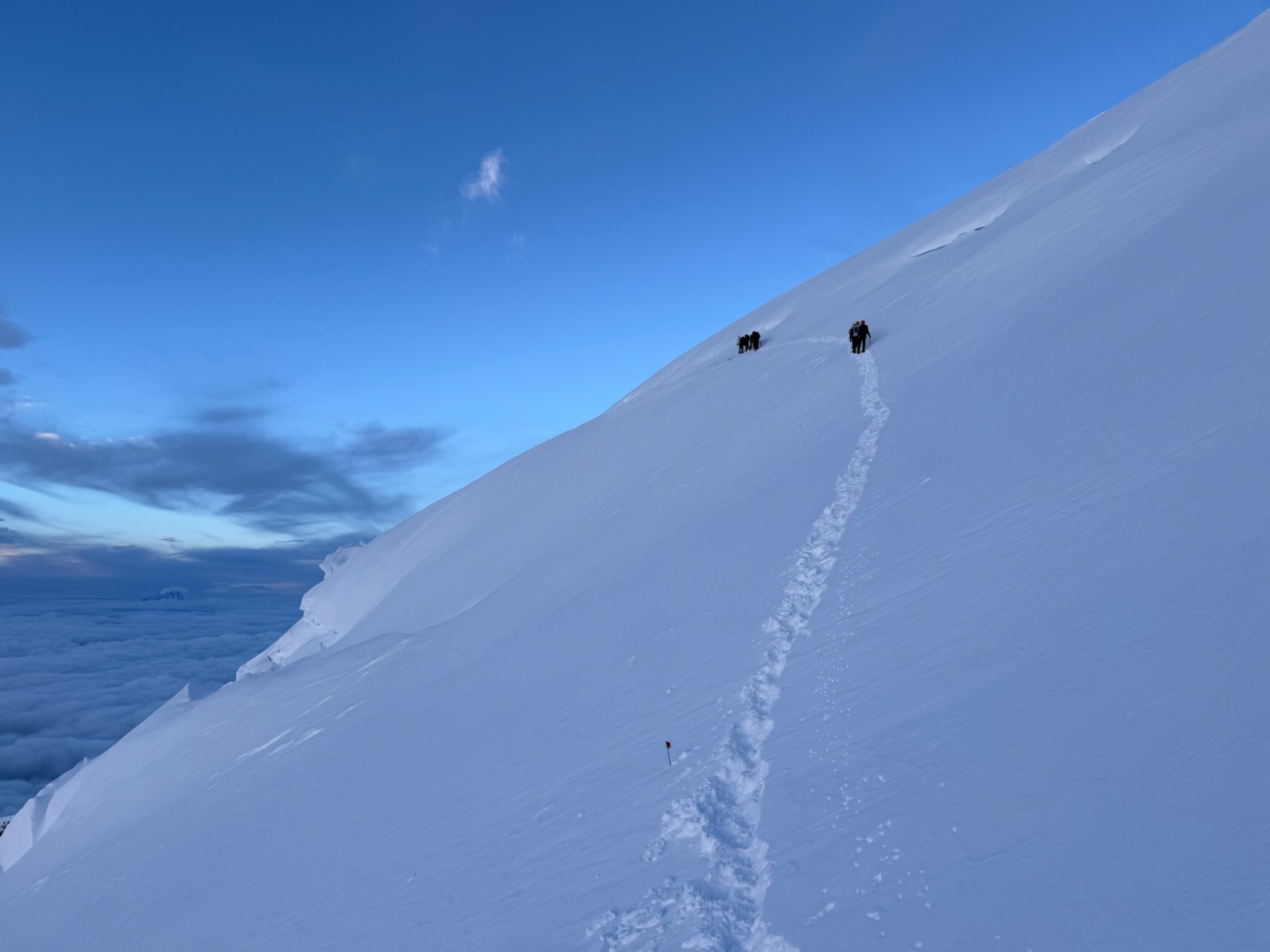
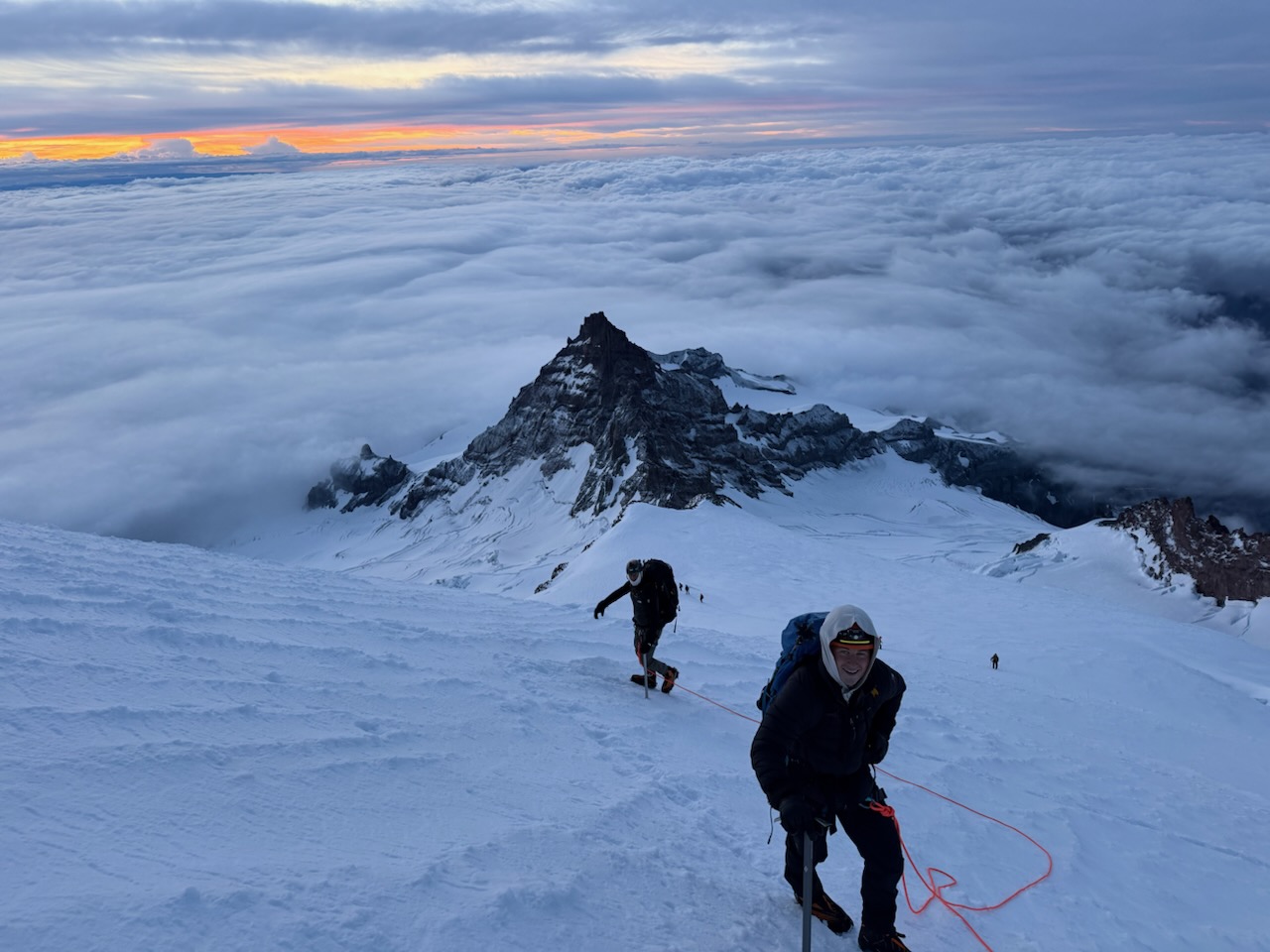
The Four Day Climb teams led by Seth Burns and Jackson Breen reached a high point of 12,300 feet on Disappointment Cleaver before making the decision to turn around. Despite the clear skies above, recent storm snow, challenging route conditions, and difficult travel all contributed to the call to stop their ascent short of the summit.
Sometimes it is wise to turn around. It’s a hard decision, yet most likely the right one. Live to see another day, then try again! Great update! God Bless!
Posted by: Harriette Chiavacci on 6/28/2026 at 4:55 pm
Being on the safe side is always a good choice. Been there done that on the Emmons Glacier Route years ago. Maybe next time you’ll reach the summit.
Keep on trekking.








For the stair interval training, the comments say to climb at a consistent pace for 40-50 minutes. the link however says to do 3-4 intervals of 2 minutes at high intensity. Which is it? thanks.
Posted by: Phil on 9/19/2016 at 7:31 am
With regard to a previous article on the benefits of using trekking poles on the climb of Rainier, how does one coordinate the use of two poles with an ice ax?
Posted by: Greg Jennings on 6/26/2014 at 7:28 am
View All Comments