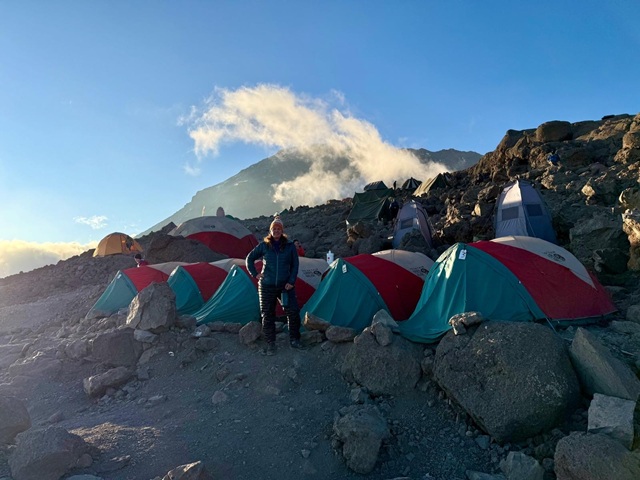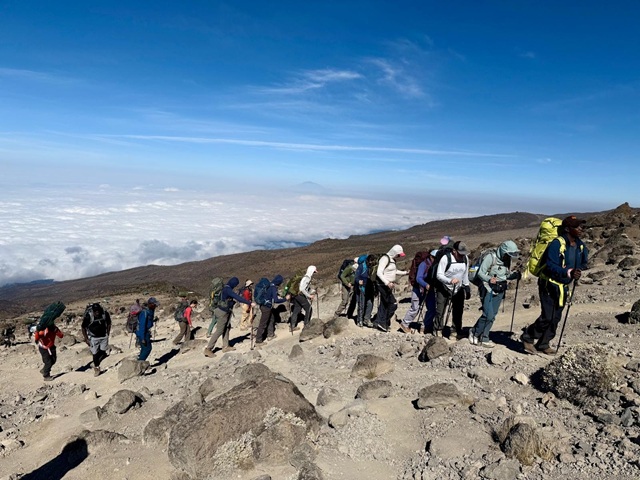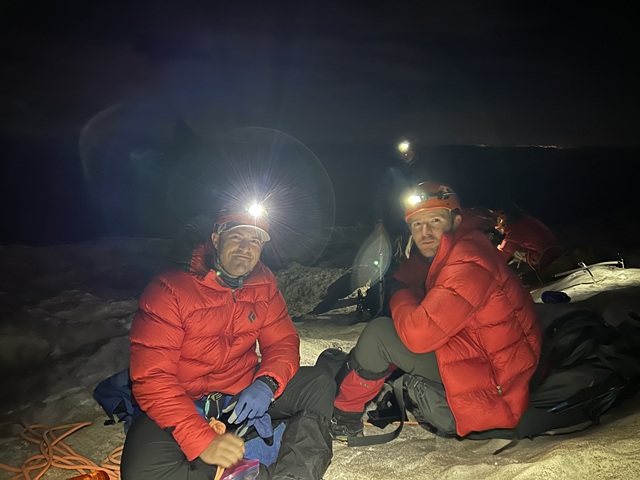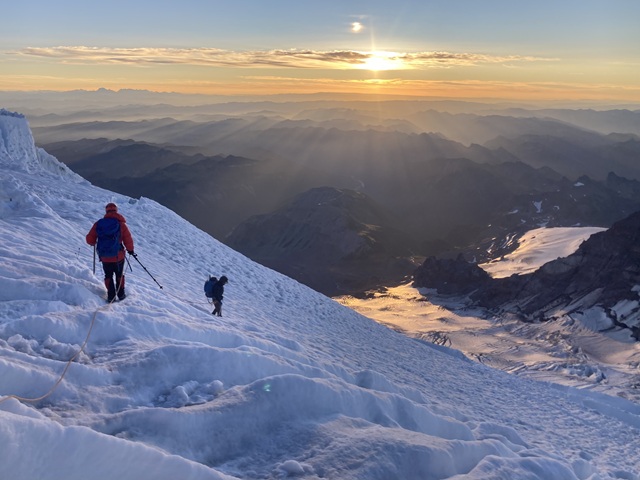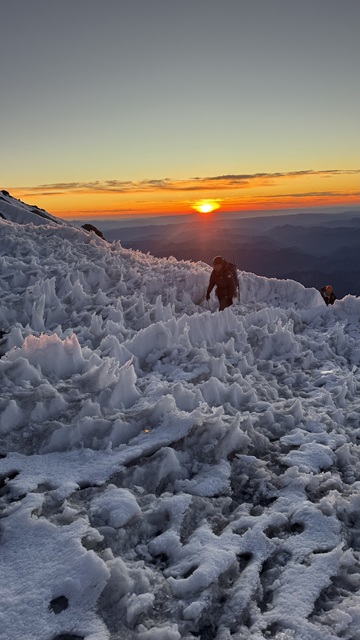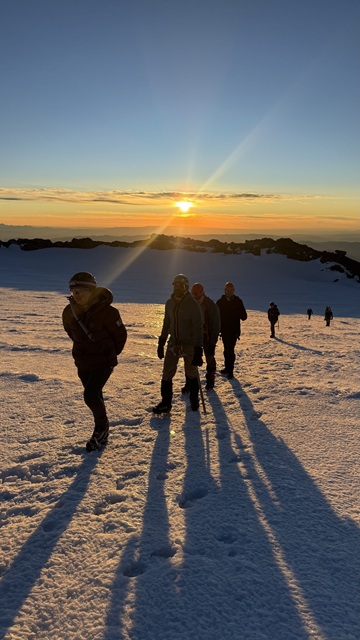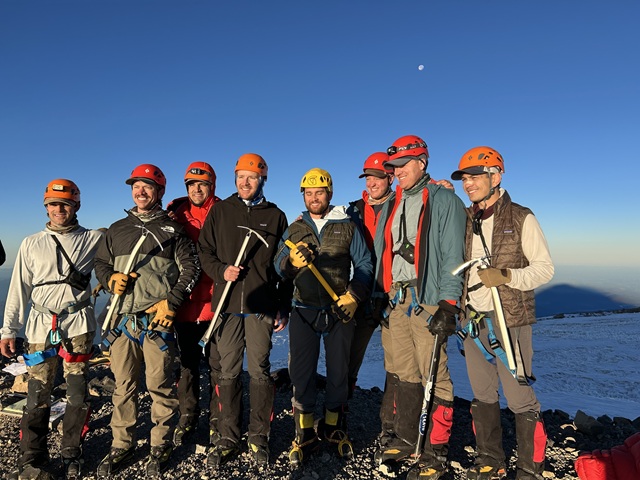
The Four Day Summit Climb led by RMI Guides Brent Okita & Lindsay Mann were unable to summit this morning due to a lightning storm. The teams headed out of Camp Muir on two separate occasions but both times retreated to Camp Muir because of the weather. They will descend from Camp Muir around 9 a.m. We look forward to seeing the groups at Rainier BaseCamp this afternoon.
The Expedition Skills Seminar - Kautz led by RMI Guide Mike Haugen reached the summit yesterday morning and returned to their high camp for a final night on the mountain. This morning they are descending to Paradise and will return to Rainier BaseCamp.
RMI Guide Garrett Stevens and the Expedition Skills Seminar - Paradise weathered the storm on the mountain last night in tents. They will be drying out today and doing more training near their camp. Tomorrow they will ascend to Camp Muir and get ready for their summit attempt.
The RMI Mt. Elbrus team led by J.J. Justman left the hustle of Moscow and flew to Mineralnye Vody and drove to the Baksan Valley at the base of Mt. Elbrus. Check out their video below.
Another casual morning... We ate some breakfast, checked out of the Mercure (our hotel) around 8 am or so, loaded up the van and Jaime's truck, then hit the road. Heading north on the PanAmerican Highway, we left Quito and passed through the town of Otavalo, famous for it's large open air market. Eventually we turned off the highway and headed up into the countryside on our approach to Cerro Fuya Fuya. After many kilometers of driving on a cobblestone road up into the mountains we reached Laguna Mojanda and the base of Fuya Fuya. The lake is actually a giant caldera filled with water (think Crater Lake in OR) and made for a great backdrop to our second training hike. A couple hours of hiking and scrambling brought us to the summit at well over 14,000'. We enjoyed clear and sweeping views from la cumbre of the two valleys below in addition to the big Laguna. After a quick break on top we beat feet for the cars to try and out pace some menacing clouds. Everyone was feeling great.
After another short trip in the van we arrived at the beautiful Hosteria San Luis. Talk about traveling in style, there are beautiful gardens, stables, classic colonial architecture, a pool, and a pond. The gang is settling in and enjoying the last bit of luxury before heading up to the climber's refugio on Cayambe.
I'll call and check in tomorrow night from the refugio,
RMI Guide Billy Nugent
The Mt. Rainier Four Day Summit Climbs led by Casey Grom & JJ Justman made the summit today in beautiful weather. They began their descent at 7:35 a.m.
Congratulations!
Before the big mountain bug bit me, I viewed snow as a blanket that came in the winter and lay quietly in place 'til spring's thaw. All that changed when I decided it wise to educate myself about avalanches. Taking part in the introductory Level 1 avalanche education course, I quickly learned how the snowpack, terrain, and triggers (like climbers or cornice falls) can transform that quiet blanket into a raging white dragon. Interested in learning more about this beast, I enrolled in a Level 2 avalanche course a few years later, and came to understand that each layer of snow that falls forms something of geologic record in that season's snowpack: if the snow falls warm, that layer will stay warm for a long time; if hail falls, it can be evident in the snowpack months later. Even more incredibly—similar to plates of geologic sedimentary matter—that seemingly silent white winter blanket is often actively undergoing radical metamorphosis due to vapor and temperature differences in the layers.
This February—with the support of the RMI Guide Grant—I participated in a Level 3 course. It's something of a graduate level course in the University of Avalanches: A rigorous curriculum that explores the intricacies of snowpack dynamics and the techniques used to assess how stable the snowpack is. Our course took place in the Wasatch Mountains and it began a few days after one of that area's avalanche forecasters had declared it one of the weirdest snowpacks ever. An excellent classroom had been arranged!
A key focus of the course was learning to quickly identify weak layers in the snowpack and then to assess the structure of that instability. One aspect of instability has to do with the kinds of snow crystals in between the layers. A Cliff Notes summary would be: square ones are bad, round ones are good. But how can you tell with something so small? Were they the good guys or the bad guys? First, I had to identify which layer to look at, a process of first poking the snow with my finger to determine layer interfaces, and then prodding it with a fist, four fingers, one finger, a pencil, or a knife to get some grip on the specific hardnesses. Once all that was established, it was time to sort out the good from the bad. Somewhat ironically, amidst all of the grandeur of the Wasatch, I was often peering into the little lens of a snow microscope looking at the edges of myriad little bits of snow to determine their personalities.
Ultimately, beyond peering down a microscope, knowing the snow is a very sensory experience, incorporating sight, sound, and touch in order to determine its stability: windslabs are often squeaky like styrofoam, while faceted grains bounce off a gloved hand and make for a poor snowball. Of course, once stability is determined, the sensory experience is the pure enjoyment—how well does it ski? Through careful tracking of the Wasatch area over our week of study, we knew that north aspects were retaining the best snow. So, after our final exam, involving each person doing a complete analysis of the season's snowpack and weaknesses, we gathered together for a final run back into the front-country. We ripped our skins and then laid tracks down a beautiful bowl, each up us kicking up huge roostertails of powder joy—a reward for all of our diligent study.
The pleasures of backcountry skiing and the benefits of big mountain climbing with skis are becoming increasingly known in the outdoor world and RMI is right out in front of the trend. Safely partaking of those pleasures and benefits involves really coming to know the snow. While in its essence knowledge of the snow is like knowledge itself, where “The more one knows the more one knows they don't completely understand,” coming away from the Level 3 avalanche course, I feel good in knowing that I'm keeping the learning edge sharp. That sharp edge will aid me whether cramponing up alpine routes on Rainier or schussing down couloirs in the North Cascades.
The alarm was set for 11:30 PM at 8000 ft on the Kahiltna Glacier. The rain began at 10:00 PM and continued on and off until 11:20. Rain wouldn't be considered a good thing if you were laying in your sleeping bag hoping that the glacial surface would freeze up in the night to permit safe and easy passage to the Southeast Fork and a possible airplane pickup. So at the appointed wakeup time, we had a soggy glacier, groggy climbers and a murky vision of the world. Although it is still light for twenty four hours in this part of Alaska in mid-July, it isn't very light between about midnight and four. But we made the decision, along with Rob Gowler's AMS group camped nearby, to make a break for the airstrip before the storm got worse. We were on the move by 2:00 AM and stumbling along on snowshoes in the gloom. Surprisingly, it rained no more. It was slow going at first, hitting big crevasses broadside, without being able to see them ahead of time and take evasive action. But conditions improved as we got further down glacier... there had been a great deal of new snow (bridging crevasses) the sky overhead was clearing and the snow surface was consequently freezing, and it was getting lighter. It was a great help to be backed up in route-finding by Rob and the AMS team. Together, as the last climbers on the mountain, we worked through the early morning hours. By seven, we'd solved all significant problems and found ourselves at the foot of "heartbreak hill". We climbed the Southeast Fork to the airstrip and called in the ski-planes. Conditions overhead were good, but it took a few hours until our planes could even get into the range. The bigger storm was still coming in, but all passes into the mountains were already clogged with cloud. We considered ourselves lucky to be flown out in the afternoon. What followed was a whirlwind of drying/sorting gear, connecting with the outer world again and showers and shaves. We enjoyed a fabulous West Rib victory dinner celebration, a summit certificate awards ceremony and copious amounts of laughter over our shared experiences of the past three weeks. Day 20... Trip done... all we could possibly have hoped for in defining a fine expedition.
Best Regards,
RMI Guide Dave Hahn
A HUGE thank you to Dave and the rest of the guides for escorting Anders and the rest of the team up and down this formidable mountain. We appreciated all the updates, and can’t wait to hear all the details when Anders gets home. You certainly faced some challenging weather, and your perseverance and patience paid off in the incredible summit experience. We all appreciate it!
Posted by: the christofferson family on 7/17/2013 at 4:24 pm
Thursday, June 20, 2013
The lower glacier was fully covered in fog when we turned in last night and to our surprise it had cleared completely by the time we decided to walk. The early morning light on the surrounding mountains and the waxing moon in the purple sky made an absolutely surreal walk out of the range. The team finished very strong, hitting the runway in style in the morning just as a pair of Otters hit the upper strip. Now in Talkeetna, the team is enjoying the comforts of reentry and in a few hours we are going to enjoy a big meal cooked over something more refined than a camp stove. What a treat!
It is hard to believe that we are back in town already. Enjoying nearly perfect weather and a very strong team, we were able to take advantage of the weather windows and climb the route entirely by ourselves in quite reasonable conditions. Additionally if there was ever a team to handle some downtime and extra rest days with quality conversation, this was it. Yet the weather smiled upon us and our training and strength as a team really came together for an efficient ascent with great folks. Thanks again to everyone on the team for really rising to the challenge of Denali and matching themselves perfectly to their environment for a safe, successful climb. It has been a pleasure.
RMI Guide Jake Beren
Jake Beren & RMI Organization,
Thank you to the guides at RMI for making it possible for family and friends to keep track of their loved ones while climbing Denali. The map, photos and blog made it possible to live vicariously through your courageous experience.
I hope hot showers, home-cookin’ and comfy beds are in your near future!
Safe travels home!
Congratulations to the Team!
Hola! We're at La Malinche. Everything was pretty smooth getting out of the city this morning and we had great views of Ixta on the drive. Once we checked into out cabins at La Malinche we went for a great hike to acclimatize. 3.7 miles and about 3,500 feet up to a prominent ridge on the mountain. After a few pics we reversed course and headed toward the dinner bell. We'll check in again tomorrow.
RMI Guide Seth Waterfall
Well the snow continues to pile up. Our storm board is reading 68 cm of snow in the past 36-hour period. The wind has been picking up, intensifying the storm. Turns out, this storm is a little bigger then they first thought.
We spent three hours this morning digging out our tents and the cook tent. We're all staying busy here on the glacier, experiencing the other part of Alaska, the weather.
Well not too much else to report, hopefully we'll be off the glacier sooner then later.
RMI Guide Jason Thompson
48 card deck! hilarious. i thought that only happened at my house. i can’t believe you are STHUCK! (christmas story) Brandi, am i seriously going to have to drink wine by myself in Anchorage tomorrow?!?!? stay warm. see you soon. i need to get back to packing… elizabeth
Posted by: elizabeth on 5/11/2012 at 10:38 pm
Good luck on the climb. Have fun walking up and down the runway at base camp. Been there and done that.
The streets of Kathmandu were hardly waking up when we reached the airport this morning, unloading our duffel bags outside of the the domestic terminal in the pre dawn darkness. By the time the morning sun found us, burning as an orange orb just above the eastern horizon, we were loading into a Twin Otter turbo prop plane, a STOL airplane - Short Take Off Landing - capable of landing at Lukla's narrow strip.
Besides some turbulence as we turned into the Khumbu Valley the flight was uneventful, a fact duly noted and much appreciated when flying a tiny airplane into a mountain airstrip like Lukla. Perched at a 10 degree angle and hardly more than several hundred meters long, the Lukla Airstrip is guaranteed to raise your heart rate - the plane touches down bearing full speed toward the hillside at the end of the strip, the brakes are slammed on and the engines roar as the air brakes fire, the plane decelerating from airborne to parked within a matter of seconds. It's exciting to say the least.
By 8:00 am this morning we were all safely in Lukla and we hit the trail shortly thereafter. To say that Kathmandu to Lukla is a change of pace is an understatement. Within minutes we looked at each other remarking at the novelty of hearing birds in the background, not taxi horns. The trail meanders down from Lukla among several villages, eventually reaching the base of the valley where we joined the banks of the Dudh Kosi - the Milky River named for the glacial sediment flowing in it. The trail is really the highway of the Khumbu, a boulevard of hand laid stone a few meters wide, that links the different villages. Passing by front yards bordered by small gates, past teahouses and chortens - Buddhist stupas and flapping prayer flags. Although the distance we covered today was relatively short compared to the days ahead, it felt full by the time we reached Phakding from all of the daily going ons of the Khumbu we saw.
We reached the teahouse as the clouds built in the sky. Before we could do anything we threw in our backs to help the teahouse owners raise their Chotra - a pine truck a dozen meters high that flies vertical prayer flags and serves as the entrance to most houses and compounds in the Khumbu. With a dozen locals, a few ladders and long poles, we managed to raise the Chotra to a vertical position and plant it in the ground. It was an entertaining way to be welcomed into the Khumbu.
We've spent the afternoon at the teahouse, watching periods of afternoon rain blow in. Tomorrow we climb to Namche Bazaar, the major trade center and biggest town of the region where we will spend a few days acclimatizing and exploring the surrounding area.
RMI Guide Linden Mallory
hi im in Gayle Staffords reading class please can you get Matt Brennan to respond
Posted by: Karli L on 12/3/2018 at 10:57 am
View All Comments