


Most Popular Entries
Posted by:
Categories: 50 Years of Climbing


 Susie Lambert and Dave Hahn celebrate their summit of Mt. Rainier.
As we came over the lip of the crater Dave started shouting and high-fiving us that we made it! It was like suddenly the wind stopped and the sun was out and I was in a dream! We crossed the crater and picked a spot in the sun to drop our packs. We put our cameras in our pockets and hiked up to the summit! There were steam vents in the crater which I had read about but was still surprised to see. We signed the summit register and crested the crater to the true summit!! The wind was absolutely raging as we tried to take pictures. After a million pictures, we headed back to our packs.
Susie Lambert and Dave Hahn celebrate their summit of Mt. Rainier.
As we came over the lip of the crater Dave started shouting and high-fiving us that we made it! It was like suddenly the wind stopped and the sun was out and I was in a dream! We crossed the crater and picked a spot in the sun to drop our packs. We put our cameras in our pockets and hiked up to the summit! There were steam vents in the crater which I had read about but was still surprised to see. We signed the summit register and crested the crater to the true summit!! The wind was absolutely raging as we tried to take pictures. After a million pictures, we headed back to our packs.
 Susie Lambert and the Four Day Climb team enjoying their time on the summit of Mt. Rainier.
Back in the crater we took off our puffys and started heading down. The descent to the top of the Cleaver was not as steep as I remember going up. I must be getting used to this thing called mountain climbing! We took a break at the top of the Cleaver and things were warming up. I took off my light down coat and switched out my warm hat for my baseball hat and lightweight gloves. I confided to Dave that I was a little nervous about this part, going down such steep rock in my crampons and he assured me we would be going slowly and carefully and I would be fine. He reminded the whole team that it was very important not to send a rock rolling down because there were climbers below us. We short-roped down the rocks and I carefully put each of my steps in the step Dave's boot had just been in.
Susie Lambert and the Four Day Climb team enjoying their time on the summit of Mt. Rainier.
Back in the crater we took off our puffys and started heading down. The descent to the top of the Cleaver was not as steep as I remember going up. I must be getting used to this thing called mountain climbing! We took a break at the top of the Cleaver and things were warming up. I took off my light down coat and switched out my warm hat for my baseball hat and lightweight gloves. I confided to Dave that I was a little nervous about this part, going down such steep rock in my crampons and he assured me we would be going slowly and carefully and I would be fine. He reminded the whole team that it was very important not to send a rock rolling down because there were climbers below us. We short-roped down the rocks and I carefully put each of my steps in the step Dave's boot had just been in.
 Descending the upper slopes of Mt. Rainier on the descent from the summit.
As soon as we got to the bottom of the Cleaver we were standing in a very dangerous spot – exposed to falling rock from the climbers and the ice fall directly above us as we crossed over to Ingraham Flats. Dave's tone of voice changed to be very serious when he saw a group of climbers stopped a little ways ahead of us on the trail, adjusting something in their packs. We walked the trail until we got to them and Dave said very sternly, "Hey that's great that you guys have found what you consider a safe spot but you are blocking the trail for other climbers behind you, leaving other groups exposed to the falling ice and rocks". The people were embarrassed and apologetic while we went around them.
We went below the climbers and then started to head back up to the trail but the hillside was very steep and Dave told me to turn and go straight up to the trail directly above me. Without question, I turned to get up to the trail. I took two steps and my crampons slipped and my feet went out from under me. I heard my jacket sliding on the ice and I instinctively jammed my ice axe into the snow, driving my shoulder and helmet into the snow to stop my fall. I looked down and saw the group of climbers below, staring up at me with their mouths hanging open and then I looked past them…there was the biggest, bluest crevasse I have ever seen directly below me!
I stayed in that position until Dave's voice pulled me back to reality telling me to dig my feet in. Dave was right behind me and he helped stop my slide (I would like to think my incredible ice axe arrest skills stopped me but Dave might have had something to do with it…). He said very matter of factly, "Get up on the trail." I trusted my crampons but still hugged the hillside and got my ice axe out and stuck it in a little above and tip toed up until I literally crawled onto the trail. I stood up and we continued on. No talking. Leave what just happened behind us and focus on the trail ahead.
About five minutes later there was the crevasse crossing in full daylight. My heart rate shot up and I sped up my pace and suddenly Dave is telling me to slow down. I was causing the rope to become too slack for the person ahead of me. I slowed my pace but that only made me stare at the upcoming crevasse even longer and I swear it was growing wider and bluer before my eyes. I hate to say it but I froze. I allowed my first real doubt to take up space in my brain and that's all it took to make me hesitate and think "I can't do this." I looked ahead and realized my team was still walking slow and steady away from me and if I waited much longer the rope was going to yank me towards the drop off (probably not entirely accurate but that's how my brain was processing it). Once again, Dave's voice behind me snapped me out of it and he said, "You need to cross now." I held my breath and crossed the ladder. I don't even remember it but somehow I did it.
My nerves were shot and I couldn't concentrate. Dave had to remind me twice to switch my ice axe to the uphill side so I used that as something to focus on and made sure if I did nothing else I was going to keep the ice axe on the uphill side. Having just that to focus on and keeping my breathing under control helped a lot. We got to our resting point at Ingraham Flats and we were able to take off our packs and sit down. I was doing everything I could to keep it together but I got the shakes, uncontrollable tremors in my legs as the tension left my body. I told Dave, "Thanks for what you did back there. I saw past the group of people. I saw what was below me."
Dave just smiled, shrugged, and said, "You weren't going anywhere." I truly feel like he saved my life. No doubt in my mind.
Descending the upper slopes of Mt. Rainier on the descent from the summit.
As soon as we got to the bottom of the Cleaver we were standing in a very dangerous spot – exposed to falling rock from the climbers and the ice fall directly above us as we crossed over to Ingraham Flats. Dave's tone of voice changed to be very serious when he saw a group of climbers stopped a little ways ahead of us on the trail, adjusting something in their packs. We walked the trail until we got to them and Dave said very sternly, "Hey that's great that you guys have found what you consider a safe spot but you are blocking the trail for other climbers behind you, leaving other groups exposed to the falling ice and rocks". The people were embarrassed and apologetic while we went around them.
We went below the climbers and then started to head back up to the trail but the hillside was very steep and Dave told me to turn and go straight up to the trail directly above me. Without question, I turned to get up to the trail. I took two steps and my crampons slipped and my feet went out from under me. I heard my jacket sliding on the ice and I instinctively jammed my ice axe into the snow, driving my shoulder and helmet into the snow to stop my fall. I looked down and saw the group of climbers below, staring up at me with their mouths hanging open and then I looked past them…there was the biggest, bluest crevasse I have ever seen directly below me!
I stayed in that position until Dave's voice pulled me back to reality telling me to dig my feet in. Dave was right behind me and he helped stop my slide (I would like to think my incredible ice axe arrest skills stopped me but Dave might have had something to do with it…). He said very matter of factly, "Get up on the trail." I trusted my crampons but still hugged the hillside and got my ice axe out and stuck it in a little above and tip toed up until I literally crawled onto the trail. I stood up and we continued on. No talking. Leave what just happened behind us and focus on the trail ahead.
About five minutes later there was the crevasse crossing in full daylight. My heart rate shot up and I sped up my pace and suddenly Dave is telling me to slow down. I was causing the rope to become too slack for the person ahead of me. I slowed my pace but that only made me stare at the upcoming crevasse even longer and I swear it was growing wider and bluer before my eyes. I hate to say it but I froze. I allowed my first real doubt to take up space in my brain and that's all it took to make me hesitate and think "I can't do this." I looked ahead and realized my team was still walking slow and steady away from me and if I waited much longer the rope was going to yank me towards the drop off (probably not entirely accurate but that's how my brain was processing it). Once again, Dave's voice behind me snapped me out of it and he said, "You need to cross now." I held my breath and crossed the ladder. I don't even remember it but somehow I did it.
My nerves were shot and I couldn't concentrate. Dave had to remind me twice to switch my ice axe to the uphill side so I used that as something to focus on and made sure if I did nothing else I was going to keep the ice axe on the uphill side. Having just that to focus on and keeping my breathing under control helped a lot. We got to our resting point at Ingraham Flats and we were able to take off our packs and sit down. I was doing everything I could to keep it together but I got the shakes, uncontrollable tremors in my legs as the tension left my body. I told Dave, "Thanks for what you did back there. I saw past the group of people. I saw what was below me."
Dave just smiled, shrugged, and said, "You weren't going anywhere." I truly feel like he saved my life. No doubt in my mind.
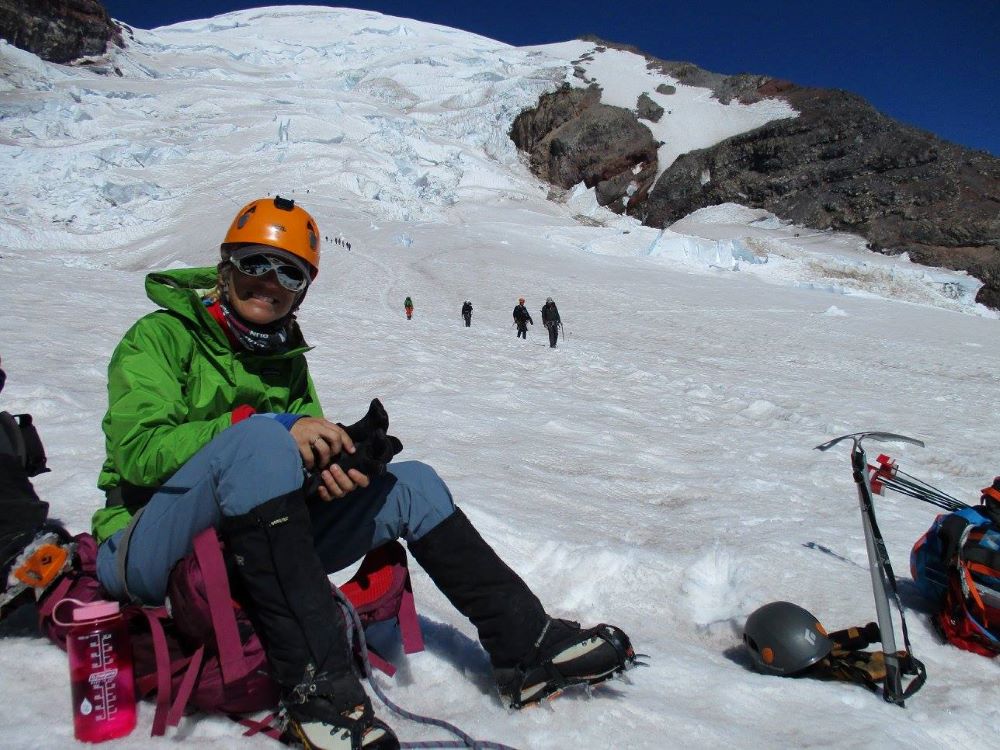 Enjoying the rest break at Ingraham Flats on the descent.
We took a long rest at that spot in the sun, enjoying the feeling of accomplishing a goal we have all worked towards for so long. We watched as the group from the 5-Day Climb made their way across the glacier towards us. They were spending their day getting glacier practice and, later, resting for their summit attempt. We chatted with them and then continued down Cathedral Gap, across the Cowlitz Glacier and then to Camp Muir. We arrived at camp at 10:15 AM but it felt more like 4:00 PM.
We took an hour to pack up all our gear, eat, and start hiking down the Muir Snowfield. Everybody lightened up during this time and we walked as a group, boot skied or butt slid down the snowfield. It was a comical and lighthearted way for our team to reconnect and just enjoy being together. We made it down to Paradise and caught the RMI Shuttle to Rainier BaseCamp. We gathered as a team one final time and ate pizza. Each guide said a few words and they gave us a picture of our route and also a certificate for those who summited. Our group left, one by one, and before I left, the few people still at the table were practically falling asleep, except for the guides who seem to have endless energy!
This morning I wrote a letter to my guides and dropped off at their office. I am so thankful for them and their confidence and their skill and sense of humor! It was the most memorable trip I have ever had!
Enjoying the rest break at Ingraham Flats on the descent.
We took a long rest at that spot in the sun, enjoying the feeling of accomplishing a goal we have all worked towards for so long. We watched as the group from the 5-Day Climb made their way across the glacier towards us. They were spending their day getting glacier practice and, later, resting for their summit attempt. We chatted with them and then continued down Cathedral Gap, across the Cowlitz Glacier and then to Camp Muir. We arrived at camp at 10:15 AM but it felt more like 4:00 PM.
We took an hour to pack up all our gear, eat, and start hiking down the Muir Snowfield. Everybody lightened up during this time and we walked as a group, boot skied or butt slid down the snowfield. It was a comical and lighthearted way for our team to reconnect and just enjoy being together. We made it down to Paradise and caught the RMI Shuttle to Rainier BaseCamp. We gathered as a team one final time and ate pizza. Each guide said a few words and they gave us a picture of our route and also a certificate for those who summited. Our group left, one by one, and before I left, the few people still at the table were practically falling asleep, except for the guides who seem to have endless energy!
This morning I wrote a letter to my guides and dropped off at their office. I am so thankful for them and their confidence and their skill and sense of humor! It was the most memorable trip I have ever had!
Posted by: Linden Mallory
Categories: Expedition Dispatches Elbrus Southside


RMI Guide Linden Mallory on the team departure from Everest Base Camp.
I miss you so much! These pictures are beautiful! I wish iwere there with you. I couldn’t do the climb right now, but you could rent me a helicopter driver! I am going over to Seattle on Friday the 15, and will be at the airport Saturday morning to greet you! ONE MORE WEEK!!!!!!!!! I love you! Sweet man
Posted by: Deb McLaughlin on 4/7/2011 at 11:17 pm
Tim,
Lay off those cigars so you can make it to the top!
Wish I was there!
Rick
Posted by: Rick on 4/5/2011 at 6:40 pm
Posted by: Alex Van Steen
Categories: Guide News Responsible Climbing


Posted by: Casey Grom, Abby Westling, Nicole De Petris, Trevor Katz, Bailey Servais, Robert Whyte
Categories: Expedition Dispatches Mount Rainier
Elevation: 10,188'
The Four-Day climb led by Casey Grom and Abby Westling enjoyed the sunrise from Muir Peak this morning. After extreme temperatures in the forecast and a very warm night, RMI guide, Casey grom reported that the team was already starting to bake in th sun at around 7am this morning. The team is currently on their descent and return to Basecamp this afternoon.
Nice work team!
Great decision making on behalf of the guides. Safety first, Summit second.
Posted by: Lee Hoedl on 8/15/2023 at 3:43 pm
Posted by: Alex Van Steen
Categories: Carstensz Pyramid Responsible Climbing
 “Moses now ensures that commercial operators treat their porters well and pay their porters as promised. What he told me was only 75% of the porters had been paid as promised. His task is not an easy one because he is effectively policing both foreign operators as well as the Indonesian operators. That said, he was shocked because I spent so much time chit-chatting with him on the way to Hitadipa. I asked him about his family, I showed him pictures of my own family, and I engaged in what I consider just standard kindnesses that you would show to anybody who you were walking a few hours with, but he told me that no foreigner had ever expressed so much interest in him as a person as I did that day. This really rather shocked me. I told him, “Moses, you are an ‘usua me,’ you are a good man, you’re working on behalf of your people and you’re doing a hard job.” He sincerely appreciated that.
“In this arena of going into schools and sports clinics and churches, I was invited and took the opportunity to speak at two church services, I assisted with an inter-faith Muslim/Christian soccer camp, and I spoke in two high school classrooms at an international school. One of my most intense experiences came in this arena.
“We’d been hiking through the jungle all day and the rain was just incessantly pouring on us. We were coming into a village called Gamagae and all of a sudden I hear all these men yelling. As I am walking into town I see all these people running toward me and one of them was highly agitated, really waving his arms and yelling loudly. This is how I was introduced to Atan Topani.
“Moses now ensures that commercial operators treat their porters well and pay their porters as promised. What he told me was only 75% of the porters had been paid as promised. His task is not an easy one because he is effectively policing both foreign operators as well as the Indonesian operators. That said, he was shocked because I spent so much time chit-chatting with him on the way to Hitadipa. I asked him about his family, I showed him pictures of my own family, and I engaged in what I consider just standard kindnesses that you would show to anybody who you were walking a few hours with, but he told me that no foreigner had ever expressed so much interest in him as a person as I did that day. This really rather shocked me. I told him, “Moses, you are an ‘usua me,’ you are a good man, you’re working on behalf of your people and you’re doing a hard job.” He sincerely appreciated that.
“In this arena of going into schools and sports clinics and churches, I was invited and took the opportunity to speak at two church services, I assisted with an inter-faith Muslim/Christian soccer camp, and I spoke in two high school classrooms at an international school. One of my most intense experiences came in this arena.
“We’d been hiking through the jungle all day and the rain was just incessantly pouring on us. We were coming into a village called Gamagae and all of a sudden I hear all these men yelling. As I am walking into town I see all these people running toward me and one of them was highly agitated, really waving his arms and yelling loudly. This is how I was introduced to Atan Topani.
 “I know a bit about Moni culture - I know that they speak loudly; I know that their language is clipped; I know that they don’t smile the same way that we smile, at least not right off the bat – so I was aware of that – but I also didn’t see any or didn’t hear any of the standard language that let me know that they were welcoming me. They were yelling but I wasn’t hearing ‘amakanea,’ ‘amakanenga,’ some of the welcoming phrases that I normally hear.
“Atan was really upset because the last tourist group to come through had come into his church and made a mess. They cooked in his church and left garbage in his church and then left the village. Understandably, he was upset. He wants tourists. He really wants tourists. But he needs tourists to behave considerately. Atan and I spent about two hours doing what’s called “muna muna” - “men’s talk.” Together we developed the “Sugapa Route Visitor Protocols” for travelers: what to do or what not to do when you visit these villages.
“Here again, the essential question was, ‘Atan, if you want a partnership, what does a partnership look like?’ And Atan says, ‘I want visitors, and they are welcome to use our church as shelter, but I want them to be considerate of my community.’ When I came home, I translated this document into Bahasa Indonesian, Dutch, German, Spanish, Japanese and Russian, and now they are ready to be posted in different villages along the Sugapa route.”
Part of a “Giving Relationship” entails sitting down on equal terms and discussing the desires and needs of both parties. A simple concept, yet not always followed in many outfitting practices.
“In my most recent trip, I spent just under a month and visited about ten communities, going village-to-village and connecting with random individuals.
“I know a bit about Moni culture - I know that they speak loudly; I know that their language is clipped; I know that they don’t smile the same way that we smile, at least not right off the bat – so I was aware of that – but I also didn’t see any or didn’t hear any of the standard language that let me know that they were welcoming me. They were yelling but I wasn’t hearing ‘amakanea,’ ‘amakanenga,’ some of the welcoming phrases that I normally hear.
“Atan was really upset because the last tourist group to come through had come into his church and made a mess. They cooked in his church and left garbage in his church and then left the village. Understandably, he was upset. He wants tourists. He really wants tourists. But he needs tourists to behave considerately. Atan and I spent about two hours doing what’s called “muna muna” - “men’s talk.” Together we developed the “Sugapa Route Visitor Protocols” for travelers: what to do or what not to do when you visit these villages.
“Here again, the essential question was, ‘Atan, if you want a partnership, what does a partnership look like?’ And Atan says, ‘I want visitors, and they are welcome to use our church as shelter, but I want them to be considerate of my community.’ When I came home, I translated this document into Bahasa Indonesian, Dutch, German, Spanish, Japanese and Russian, and now they are ready to be posted in different villages along the Sugapa route.”
Part of a “Giving Relationship” entails sitting down on equal terms and discussing the desires and needs of both parties. A simple concept, yet not always followed in many outfitting practices.
“In my most recent trip, I spent just under a month and visited about ten communities, going village-to-village and connecting with random individuals.
 “One of the other cultural differences that really was striking to me was that even if you enjoy conversation or you consider yourself a patient person, you have nothing on the Moni. The Moni absolutely love to converse and converse. I found that I had to sit for hours and hours and converse, which was really challenging for me. When I would converse with the people, when I would sit in their huts and at their tables and tell them that I was traveling through the land - rather than helicoptering - to meet the people whose lands I wanted to travel with my customers, they were all incredibly receptive. As a matter of fact, one gentleman – said, ‘This is good talk. This is good talk.’ I won’t ever forget that because it means so much for the Moni to say that.”
A "Giving Relationship" goes beyond being empathetic and actively listening. It also means contributing the skills and experiences we have to our partners in order to prepare them for future collaborations. During his recent visit to Papua, Alex led a training seminar for local porters to teach the practices and progressions of a climbing expedition.
“I had arranged with our Moni partner for various Moni villages to come together – or the men in those villages to come together – in one place and participate in a seminar where we could teach them how to work with tourists. The training seminar was a raging success. We discussed what was working well in other areas where we operate, like our Peru and our Nepal treks, what wasn’t working well, such as porters being mistreated, which we hear a lot about, and what we might need to change, for example, there is no plan at all for human waste in Papua. We discussed how to keep the porters healthy and safe along the trek and in the mountains, we practiced setting up tents, and we concluded by awarding certificates of accomplishment to the porters who participated in the training so that they could show evidence of learning to whatever tour operator might want to hire them; not just our guides, not just us.
“It is difficult to know if this is accurate or not, to be quite honest, but I was told that this was the very first time that a foreigner ever hosted a seminar for indigenous Papuan people; this is the very first time that an indigenous Papuan man was the tour operator rather than an Indonesian or a foreigner. Thirty-five men from varying villages, some were Moni, some were of the Dani tribe, received certificates.”
“One of the other cultural differences that really was striking to me was that even if you enjoy conversation or you consider yourself a patient person, you have nothing on the Moni. The Moni absolutely love to converse and converse. I found that I had to sit for hours and hours and converse, which was really challenging for me. When I would converse with the people, when I would sit in their huts and at their tables and tell them that I was traveling through the land - rather than helicoptering - to meet the people whose lands I wanted to travel with my customers, they were all incredibly receptive. As a matter of fact, one gentleman – said, ‘This is good talk. This is good talk.’ I won’t ever forget that because it means so much for the Moni to say that.”
A "Giving Relationship" goes beyond being empathetic and actively listening. It also means contributing the skills and experiences we have to our partners in order to prepare them for future collaborations. During his recent visit to Papua, Alex led a training seminar for local porters to teach the practices and progressions of a climbing expedition.
“I had arranged with our Moni partner for various Moni villages to come together – or the men in those villages to come together – in one place and participate in a seminar where we could teach them how to work with tourists. The training seminar was a raging success. We discussed what was working well in other areas where we operate, like our Peru and our Nepal treks, what wasn’t working well, such as porters being mistreated, which we hear a lot about, and what we might need to change, for example, there is no plan at all for human waste in Papua. We discussed how to keep the porters healthy and safe along the trek and in the mountains, we practiced setting up tents, and we concluded by awarding certificates of accomplishment to the porters who participated in the training so that they could show evidence of learning to whatever tour operator might want to hire them; not just our guides, not just us.
“It is difficult to know if this is accurate or not, to be quite honest, but I was told that this was the very first time that a foreigner ever hosted a seminar for indigenous Papuan people; this is the very first time that an indigenous Papuan man was the tour operator rather than an Indonesian or a foreigner. Thirty-five men from varying villages, some were Moni, some were of the Dani tribe, received certificates.”
 “Giving Relationship” is far more than a simple catch phrase, it’s a long and complicated process but one that we feel is the only legitimate way to pursue a sustainable partnership.
“As a biased-toward-action American, I wanted to do more. We all do; we want to do it all. But the truth is that relationship building is an incredibly slow and incredibly lengthy process…I don’t immediately even expect others to replicate the couple of years and all the trips of relationship building that I’ve done there, especially not if you’re only going there for a one or two week adventure and maybe once in your life. But in visiting anywhere even once, we can know so much more about this place than simply, ‘I need rubber boots because there’s a lot of mud!’ We can know a lot more than that.
“We believe that this social ethic of “Giving Relationship” does equal access in Papua, not just for the sake of access, but also for the sake of the people and the land there,” explains Alex.
In simple terms, this type of relationship building and long term approach to our partnerships and our climbing objectives is the right thing to do.
See the full presentation here…
_____
Alex Van Steen is a Supervisor at RMI with over 240 ascents of Mt. Rainier by way of more than 20 routes. Since 2012, Alex has led RMI’s effort to create a sustainable tourism industry and developed RMI’s position as the only western commercial guide service to partner with an indigenous Papuan outfitter. He has taken his training and education to Papua and spent time with local community leaders building relationships as well as training and educating porters to work with expeditions. Additionally, Alex has spent more than a decade involving himself in community outreach and education. Locally, he works extensively with at-risk youth as a mentor, pastor, and guardian.
“Giving Relationship” is far more than a simple catch phrase, it’s a long and complicated process but one that we feel is the only legitimate way to pursue a sustainable partnership.
“As a biased-toward-action American, I wanted to do more. We all do; we want to do it all. But the truth is that relationship building is an incredibly slow and incredibly lengthy process…I don’t immediately even expect others to replicate the couple of years and all the trips of relationship building that I’ve done there, especially not if you’re only going there for a one or two week adventure and maybe once in your life. But in visiting anywhere even once, we can know so much more about this place than simply, ‘I need rubber boots because there’s a lot of mud!’ We can know a lot more than that.
“We believe that this social ethic of “Giving Relationship” does equal access in Papua, not just for the sake of access, but also for the sake of the people and the land there,” explains Alex.
In simple terms, this type of relationship building and long term approach to our partnerships and our climbing objectives is the right thing to do.
See the full presentation here…
_____
Alex Van Steen is a Supervisor at RMI with over 240 ascents of Mt. Rainier by way of more than 20 routes. Since 2012, Alex has led RMI’s effort to create a sustainable tourism industry and developed RMI’s position as the only western commercial guide service to partner with an indigenous Papuan outfitter. He has taken his training and education to Papua and spent time with local community leaders building relationships as well as training and educating porters to work with expeditions. Additionally, Alex has spent more than a decade involving himself in community outreach and education. Locally, he works extensively with at-risk youth as a mentor, pastor, and guardian.


It was a relief to sleep “low down” at 10,000 ft last night. The air had oxygen and humidity and everything we’d been missing up high on Kili. We ate breakfast at 7 AM and got walking downhill through the rainforest at 8 AM. The trail was in better-than-expected condition. It can be slick and muddy, which can make the 4,000 ft descent treacherous, but today we found it pretty easy going. The team flew down the track at a record setting pace, making the Mweka Gate in just two hours and fifteen minutes. Hot showers can be a powerful motivator. A short distance from the National Park, our Barking Zebra staff treated us to one final picnic lunch. We then thanked each of the 46 men who’d put so much effort and kindness into helping us climb the mountain. After tips were passed out, the staff sang a few very fun and traditional songs while pulling us in to dance along. We then said our goodbyes and got on board the bus for the two hour ride back to Usa River. We checked into the Rivertrees Hotel and sprinted for the showers. When we next met to plan our four days of Safari, the team was nearly unrecognizable in fresh clothing and shampooed hair. We enjoyed a dinner outside under the big trees and wished our climbing partner Rob a safe journey homeward since -as planned- he’ll head home and come back for Safari on a future trip.
Safari starts in the morning!
Best Regards
Posted by: Dominic Cifelli, Seth Burns, Mike Bennett, Tom Skoog
Categories: Expedition Dispatches Mount Rainier
Elevation: 10,080'


The first trip of the Mt. Rainier season is always a special one and just like that, it has come and gone. We spent the week learning skills like crevasse rescue, rappelling, glacier travel, the basics of snow safety, and even some fixed line travel. It was a busy week! We didn’t make the summit and in mountaineering, that’s part of the game. Sometimes the mountain, no matter how much we want it, just says no to going up high. It’s a tough pill, but a worthwhile one to take in stride and with conviction that the decision was the right one. We’ll take home the skills, the memories, and the bug to come back and try again another day.
The weather is becoming wetter and windier and looks to be trending that way for our descent tomorrow. The hot food, showers, and beds in town will be that much sweeter.
Cheers to a great week and a great start to the season, Team!
RMI Guide Dominic Cifelli

Posted by: Dave Hahn, Mike King, Dominic Cifelli
Categories: Expedition Dispatches Vinson Massif
Elevation: 12,500'

Thursday, December 30, 2021 - 8:38 pm PT
Our run of perfect weather continues on Vinson Massif! We got out of the big sleeping bags at 10:15 this morning when the shadow loosened its cold grip. We weren’t interested in a quick and hectic start or jumping out on the climbing route immediately. Scott and Hannah -our superb ALE guides- cooked up a sumptuous breakfast of scrambled eggs and bacon. We ate, we looked each other in the eye, we polled the gang as to how the night had gone and how each climber felt about pushing higher. And then we pushed higher. We put on our crampons and got ice axes in hand and headed for the fixed ropes. This section would be the “meat” of the day, roughly 2,000 vertical feet on steep and firm snow slopes, protected by a continuous line of rope, anchored every 200 feet or so. We spent a good three or four hours on the wall and a few more on the lesser angled glacier above it. The lead ropes pulled in a little after 8 PM and got busy building camp for those who would follow. We climbed in fine weather, but things are on the cold side, with our estimates centering on about -30 F. It was quite challenging to climb safely in such conditions with the odd 3 mph breeze coming through. The team rocked it. We ate a long dinner and drank hot beverage after hot beverage to rehydrate and regain energy. It is 1:30 AM now, the sun is still beaming on the tents and everybody has turned in, excited to be here -close to 12,500 ft- and excited for a rest day on the final day of 2021.
Best Regards,
RMI Guide Dave Hahn
Posted by: Peter Whittaker, Ed Viesturs, Zeb Blais, Pete Van Deventer
Categories: Expedition Dispatches Mount Rainier
Elevation: 14,410'
Great work, team! Can’t wait to hear more and see some photos.
XO-Vanessa
Posted by: Vanessa Fry on 8/5/2015 at 3:27 pm
Congratulations guys! Sure it was awesome :)
Posted by: Kathy Rubio on 8/5/2015 at 9:00 am




HUGE CONGRATS, Susie !!!!!
Beautiful pics of GREAT ACCOMPLISHMENT !!!!!!!!!!
LOTS ‘O LOVE TO Y’ALL ! ! ! !
Posted by: Sara & Sam Reid on 7/7/2019 at 6:33 pm
HUGE
Posted by: Sara & Sam Reid on 7/7/2019 at 6:24 pm
View All Comments