Most Popular Entries
The last few days have been filled with training, climbing and socializing around our Base Camp. A few observations:
1. Everest Base Camp has now swelled to about 350 people, with all the corresponding tents and equipment. It is massive, and it takes up acres and acres of space on top of a moving glacier. In addition, Everest BC is visited each day by organized groups of trekkers who hike up from Lukla to see the place (and the show). The glacier is not flat, but is a series of small undulations in the moving ice (which is mostly covered with rocks). Yesterday during a training run we climbed a portion of the way up the Khumbu Icefall and, from close to 18,000 feet, we got to see the entire camp. What a sight!
2. Socializing. Last night our group invited over the Base Camp doctors for dinner. The head physician has been running the Base Camp medical clinic for 9 years, so she was well known to Dave Hahn (who, again, seems to know everyone). The Base Camp doctors are incredibly knowledgeable about high altitude illnesses, and their presence in camp has no doubt saved many lives. They are here to treat everyone, including climbers, climbing Sherpas, porters, and trekkers (and anyone else). The ten of us had a great meal, and then played speed scrabble (which encouraged the use of slang words), and then Apples to Apples. As an aside, we all learned some interesting slang words from the different nationalities (Scotland, Nepal, etc.). Sara McGahan even threw in some slang used by 10th graders. I know that I learned quite a bit.
3. It is up to a group of incredibly courageous and talented Sherpas to fix line up Mt. Everest each year through one of the most dangerous parts of the climb - the Khumbu Icefall. These folks - called "Icefall Doctors" - are employed directly by the national park and are paid out of the fees the climbers pay to access the mountain. The Khumbu Icefall is the section of Mt. Everest that is between Basecamp and Camp I, and it is extremely dangerous because it is ever shifting as the glacier slowly moves ahead and tumbles down the mountain, and also because it is susceptible to avalanches from surrounding peaks. When shifting or an avalanche takes place, massive amounts of solid ice moves (and you don't want to be anywhere in the neighborhood when it happens). The Icefall Doctors also place ladders across huge crevasses and rope up steep sections of the Icefall, which is used by climbers to pull themselves up the mountain, but, as importantly, to "clip into" for safety. There would be literally no way for a climber of my capability to climb this mountain without the Icefall Doctors. They are amazing people.
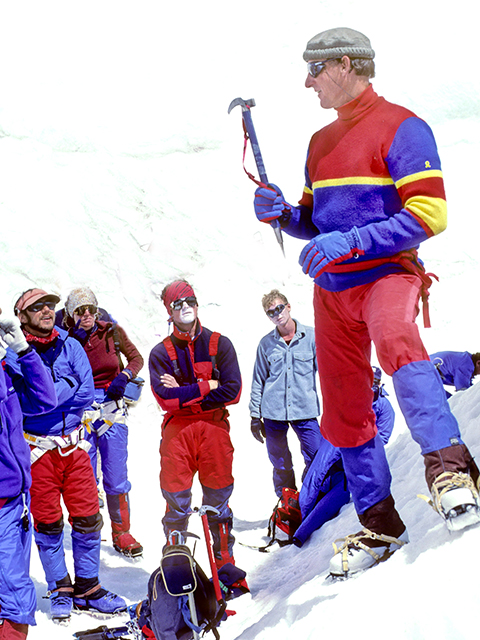
4. In the incredibly capable hands of our lead guide Dave Hahn, Sara and I have been climbing around Base Camp in order to do two things: 1) continue to acclimatize, and 2) work on the skills that we need to move quickly up the mountain. One of the greatest dangers that we face on Everest is avalanches, and speed is one of our best ways to minimize our danger. We are working hard to be able to move quickly and safely though the icefall. We need to be able to breathe (this always helps!) and to have a comfort level on ladders and fixed line. Dave has spent days with us helping us
with these skills, and we will be continuing to work on them in the days ahead. Only then will we venture up to higher places on the mountain.
5. Fun. One of the reasons that trekkers and climbers alike come to Base Camp is that it is a fun place. Every day people come by to socialize with us. Mark Tucker (our Base Camp manager) is always ready with some kind of game. Mark and I teamed up to win a horse shoe throwing contest, and the other night we had a poker tournament (Texas hold em) with guides from other groups. We have also played golf on the frozen ponds on the icefall, with yours truly hitting a hole in one, much to the chagrin of Mr. Tucker (it earned me 50 rupees - ha!). So, there is always something going on, with people coming and going, and it is one of my favorite things about climbing. The people are adventurous, interesting, international, and fun loving - the best people in the world in my opinion.
So, thanks for following our blog. We are working hard and will have more to report in the days ahead.
Bill M.
Our first day got off to a successful and fun start. For one, after 2 1/2 days of flight delays and less than stellar performance by my airline, I finally arrived in Arusha in time for our team meeting and a little breakfast. Our last two teammates got to the hotel just as we were beginning our orientation. Everyone's baggage even made it!
It was fun getting to know everybody and I think we all agree we have a pretty fun group. With equipment checks all done and a great dinner we're excited to get underway and start making our way up this beautiful mountain.
Sunrise on the mountain from 25,000' this morning has done nothing but pump me up to start our climb of Kilimanjaro. We're ready!!!
--RMI Guide Brent Okita and team
The Four Day Climb July 20 - 23 reached the 14,410' summit of Mt. Rainier led by RMI Guides Christina Dale and Nikki Champion. Blue skies but chilly temps and winds around 20 mph accompanied them on their climb. After enjoying the views from the summit of Mt. Adams, Mt. St. Helens and the Cascade range, the teams began their descent from the crater rim around 6:45 am. Once they reach Camp Muir they will repack and continue their descent to Paradise (5,400').
Nice work climbers and congratulations!
Saturday June 11 - 11:59am PT
The last few days have been a blur.
Yesterday we had a hard but a rewarding summit day. The autobahn was mild, but the summit ridge greeted us with high winds, and blowing snow. Despite the mountains best efforts, our entire team made it to the summit and safely back to 17k camp for a late dinner.
Even though we all wanted to sleep in following the summit - we woke up around 9:30am, had a quick hot breakfast, and tore down camp to begin the long process of descending back to the airstrip.
RMI Guide Nikki Champion and Team
RMI Guide JJ Justman began guiding for RMI in 1998 and his climbing and guiding resume includes a long list of notable peaks from all corners of the world. We recently caught up with JJ to hear about his guiding career and his latest pursuits.
RMI: Where have you been climbing this winter?
JJ: This winter I have been climbing in a few of my favorite places. I first went down to Argentina to lead another expedition on South America's highest peak,
Aconcagua. It was nice to stand on top at 22,841 feet and it was my 14th summit. Unfortunately I was only able to do one expedition there. Usually, I like to climb Aconcagua twice. Instead in February I returned to the States and led a
Winter Expedition Skills Seminar on Mount Rainier. We had a great team of climbers and in the beginning the weather was fantastic. We made it up to Camp Muir on a beautiful day but in typical fashion, winter crept back in and it was nasty as ever. This may seem like a downer when on a climb but it's actually a lot of fun to be in that kind of weather. You end up learning a lot about how to survive in bad conditions. That winter expedition ended on a Friday and the next day I flew to Mexico to guide the
Mexican Volcanoes Ixta and Orizaba, another favorite climb of mine. It had been awhile since I had been down to Mexico and I simply forgot not only how fun the climbing is but how amazing the food is. You don't know Mexican food until you've been to Puebla.
RMI: You’ve been guiding for the better part of two decades, what are a couple of highlights from your guiding career?
JJ: Boy, that is a great question. I have many highlights. The first is having guided on Rainier since 1998 pretty much day in and day out for the summer season. I have 188 summits but what I love is having shared those summits with literally over a thousand people. I love climbing Rainier so much for that reason. You are always climbing with new folks, many of whom are mountaineering for the first time. Another highlight has been my Himalayan career. I've climbed on 6 of the 14 8000 meter peaks. I did not summit on all of them. On the contrary. However, I've guided and led safe and successful expeditions in some rather inhospitable environments. Simply experiencing those landscapes is something that cannot be explained, you have to literally do it and see it for yourself to understand its beauty. Out of all the Himalayan expeditions I have done, Dhaulagiri, which is the seventh highest in the world stands out for me. It was 2002, my first Himalayan 8000 meter peak. It is a mountain not many people attempt and our small climbing team was the only expedition there that year. Talk about cool! It felt like we were the original explorers in that region to discover and attempt climbing the mountain. It was steep, the weather was relentlessly horrible and we tried to summit on three separate occasions. And every time the weather screamed at us "No". Regardless, we made it up just shy of the summit and our team was one of the greatest teams I have climbed with. A well knit group. I could go on and on but I'll stop it there. Those are a few of my highlights.
RMI: How has guiding changed for you over the years?
JJ: Guiding for me is like any other industry. Things change. Things evolve. For me, I have taken the attitude of being a life-long learner. Every year there are new tips, new tricks, new methods about short roping, anchors, crevasse rescue, and emergency medicine. I enjoy learning new ways to do things and most of the time I am learning these things from younger guides who are going through their own official education in guiding. I don't want to be the "old guy" who is stuck in the past thinking "my way is the best way". There is always something to learn. I've also been fortunate to be mentored by some of the best mountain guides in the world. And I find the most important skill a guide can have and often the most difficult to learn is the "soft skills" of communication. Great guides have great empathy. Personally I learned this on my summit of Everest in 2004. Coming back down off the summit I was utterly exhausted! And I remember thinking, "this is what my clients on Rainier feel like after making the summit!" I climb Rainier so much I am used to it but for someone who has never done it, well, they get exhausted. A good guide can empathize with their fellow climbers because we have all been there, we have all felt that uncomfortable pain of exhaustion. It's a bitter sweet aspect of standing on top of big mountains, whether it is
Rainier,
Denali,
Aconcagua, or
Everest.
RMI: You create some great short videos from your climbs, how did you get interested in creating those?
JJ: I became interested in making videos of my climbs because of the dispatches I used to do for my Himalayan climbs: it was fun to share photos and videos of the climbs. Families and friends of the climbers enjoyed seeing their loved ones and the environment they were in. On Rainier, one of the things guides would hear is about how people wish they would have taken more photos. Of course the main objective is to summit and climbers have enough to focus on. So I shoot video throughout the climb and then do a quick down and dirty edit and post the video for anyone to see on a Facebook Page called "
The Guiding Life". For me, shooting video on a climb is just part of the job. My camera is connected to my ski pole so all I have to do is push a button so it doesn't distract from my main responsibilities of guiding. And people have really enjoyed and appreciated being able to see themselves in action on the mountain.
RMI: What do you enjoy most about being a mountain guide?
JJ: What I enjoy most about being a mountain guide is taking people into one of the most beautiful environments in the world. When you look at a mountain from down below like 99% of people do, they think it is beautiful. Spectacular even. However, when you stand up on that mountain looking down below, it is a completely different world. And it is amazing. Again, it is something you don't understand until you see it with your own eyes. In order to stand on any mountain's summit a person has to be tough. You must break through that mental barrier that says "I don't know if I can do this." Keeping climbers safe in an environment that can be dangerous and coaching them through tough situations to accomplish great things is what I love about guiding. For some folks climbing Rainier is the most unbelievable thing they have ever done. For some others they get the climbing bug and have to go higher. No matter what, I love sharing the raw power of just being in the mountains. Experiencing one of the most beautiful places you can be.
RMI: You’ve done over 15 Expeditions to Aconcagua, what advice do you have for climbers looking to climb South America’s highest mountain?
JJ: To date, I have done 16 expeditions to Aconcagua, the highest mountain in South America. For many climbers, Aconcagua is the first real "expedition style" climb they do. So there is a little bit of learning you have to do, some subtle differences from a typical climb. One of the biggest obstacles people face is boredom. Expedition climbs like Aconcagua are all about patience. You have to have patience. You have to acclimatize properly, which means on days you are feeling great, you may have to rest and just take it easy. Weather will always come in and you will have to wait out a storm. You have to be patient. Again, it is the mental game that gets most people on climbs. You have to be tough. Tough beats Strong every time. And if you are tough and hang in there you will be rewarded with the most amazing view South America has to offer.
RMI: What does your upcoming climbing season look like?
JJ: My upcoming climbing season for 2012 is another whirlwind but I wouldn't have it any other way. I will be on
Mount Rainier from beginning to end, May through September. However, I am excited to have a two week stint where I will be going back to Russia to guide
Mount Elbrus. I am really looking forward to that climb because it is with some folks I have climbed with a lot all over the world. I missed that point when talking about what I enjoy most about guiding. I love developing friendships where over the years I get to share in more and more climbing experiences with the same people. After my tour in Russia and on Rainier I will be leading a
Mexico's Volcanoes trip in October before I head back to Argentina in late November where I will be leading two expeditions on
Aconcagua, one starting December 3 and the other starting January 2. It's still early in the game but there is already talk of the
Himalayas, a place I always want to return to.
The Four Day Summit Climbs led by
RMI Guides Paul Maier and
Geoff Schellens were forced to turn around this morning due to deteriorating weather conditions.
The teams reached the top of
Disappointment Cleaver at 12,500' before making the decision to turn back.
We look forward to seeing them back at Rainier BaseCamp this afternoon.
Day 10
Leaving the ruckus of Basecamp behind, the team enjoyed a smooth ascent to Camp 1 today. The massive rock buttresses of the upper mountain certainly made us feel tiny. It is peaceful moments like today, in epic places like this where we are reminded of how small we all are. It feels great to be established on the upper mountain.
Till next time,
RMI Guide Luke Wilhelm
6:55 a.m. Nepalese Time
ON THE SUMMIT!
Perfect conditions with some other teams around.
Everybody in great shape.
Congratulations to RMI Guides Dave Hahn and Linden Mallory!!!
RMI Guide Mark Tucker
On The Map
Namaste everyone!
Well, we did it! Everyone successfully made it to Everest Base Camp on a beautiful day. We had a relaxing start to allow the day temperatures to rise enough so that the hike would be pleasant. The team hiked for almost 3 hours to reach base camp or EBC as we call it, stopping along the way many times to take pictures and enjoy the grandiose views.
Once here, we were greeted with the best food, thus far, for lunch and several team members decided to enjoy hot showers while it was still warm and sunny. Although the temperature wasn’t high, the intensity of the sun at this altitude made it feel quite warm to us.
Everyone is doing great and looking forward to a good night’s rest after the day of trekking to get here. We are sleeping on the Khumbu glacier in a campsite chopped out of the ice. Our camp is surrounded by mountains and glaciers in nearly all directions. It’s incredibly stunning to say the least.
Tomorrow the team will make some phone calls to loved ones back home to say hello. So, if you see a bizarre number on your phone appear, please answer. We are calling from our satellite modem since there isn’t WiFi or cell reception here.
That’s all for now!
Casey and Crew
Today we started our day at 6:30 refreshed after a much needed nights sleep, we had breakfast, then hit the trail one last time. It took just under three hours to reach the Kilimanjaro National Park gate where the team had lunch and said our final goodbyes to our amazing crew that took such great care of us on the mountain.
We finished the little celebration by handing out their well deserved tips and then hopped aboard our awaiting bus for the ride back to the lodge.
Finally we are all safe and sound, cleaner, and smelling fresh after an exciting seven day journey up and down Kilimanjaro.
Stayed tuned, Safari starts tomorrow!
RMI Guide Casey Grom and crew
Previous Page
Next Page
hi bill and sara. I love reading your blog each morning. best of luck to you both! love, becca
Posted by: becca newton on 4/15/2011 at 6:53 am
Keep the blogs coming. My 8-year old daughter and I are really enjoying your posts and pictures. Good luck to Bill, Sara, and the rest of the climbers. Hope you reach the top and stay safe.
Posted by: E.Black on 4/14/2011 at 7:56 pm
View All Comments