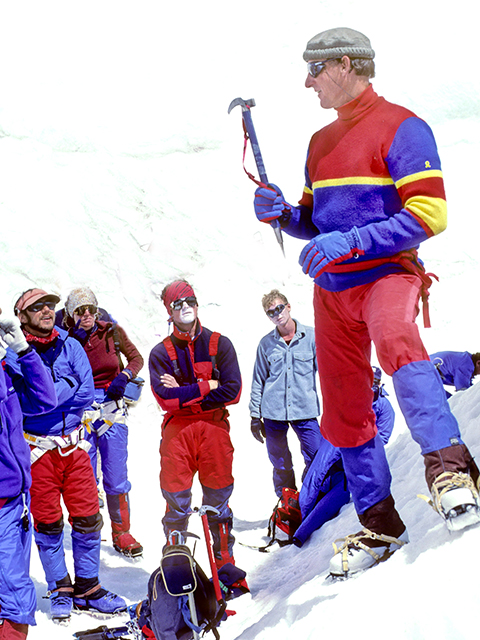
The rains came shortly after we finished our breakfast this morning, and refused to let up until 3 o'clock this afternoon. We spent the majority of the day passing the time in our tents before finally getting out for a little training this evening. The views cleared in time for us to enjoy them while eating dinner, and we're all ready to head for the summit tomorrow!
RMI Guide Ben Ammon & Team
Today is a beautiful and sunny day in Pheriche, at 14,200 feet. So many of the tea houses look and feel the same along the trek, it is easy to forget exactly where we are, but as I walked down the narrow dirt path after breakfast, I could feel exactly where I was. My lungs started moving a little faster and I could feel my heart rate increase, even with my slow steps on the relatively flat trail. As my nostrils expanded to take in the available oxygen I remembered that I am now at high altitude. I know, some of you that live just above sea-level are thinking that we have been at high altitude all along, but it is here that my physiology now agrees with that. Between 8,000 and 14,000 feet our bodies are undergoing some major changes to compensate for the increasingly more obvious loss of atmospheric pressure. Today, my lungs have to work a little harder, and my heart is pumping a little faster to get all of the new red blood cells around my body. I am thankful for all of the things that my body is doing to adjust to living in a world with less atmospheric pressure to keep all of the oxygen molecules within my breaths grasp, but mostly I am thankful to the red blood cells. They are the porters of my blood, carrying around all of the oxygen my lungs will grab onto. If all things go well, my blood pH will alter, and that will increase my respiratory rate telling my lungs that they need to expand and contract more times to achieve the same effect that they had at my house in Idaho. My blood will produce more of those invaluable little porters (the red blood cells) so that every time my ventilation is effective (the simple mechanical act of air rushing into my lungs) respiration will be effective (the actual exchange of gases deep inside my lungs) and then perfusion can happen (the red blood cells delivering the oxygen to all of my tissues). It makes me feel a little tired just to write that, I can only imagine how my body is feeling repeating this cycle over multiple thousands of times per day. When put this way, it is easy to see why we need so many rest days. Our bodies need to get used to this exhaustive act at this elevation before being challenged by the next increase in elevation.
Today, the team feels good. As I look around at Dave doing crosswords, Seth reading Rolling Stone and Erica sipping tea I can tell that they are all acclimatizing well. There are a variety of reasons that one might not acclimatize so well, and surprisingly, the reasons are not so easy to predict. Some people have a physiological make up that slows the adjustments inside of their body as they get higher in elevation. It is hard to find a correlation between this response and much of anything- especially fitness. There are of course some more obvious factors that will prevent your body from getting all that work done. If someone is sick already, maybe even just a head cold, the body is already working overtime and it decreases the resources that can be used for altitude acclimatization. The same is true if someone is dehydrated or under extreme physical exertion. That is certainly part of the reason that we take a nice even pace on our move days, we don't want our hearts and lungs fighting to keep up, because eventually they will not be able to catch up with us, and will let us know. Likely in the form of acute mountain sickness.
Acute mountain sickness is usually the first sign from your body that you need to slow down and stay at the elevation you are currently acclimatized to. Basically, your physiology is saying 'hey, wait for me!'. Consider this a warning, because your body will be persistent if you do not listen, and give you a louder reminder, one that you cannot ignore. Acute mountain sickness (AMS) can start with a variety of symptoms, the most common being a headache. It can be hard to know if it is from dehydration or sun or actually the altitude. If I am at a new elevation and I do experience a headache, I will start by drinking 1/2 a liter of water and consciously taking a few extra deep breaths as I rest. That first altitude headache often sets in after a day of moving and then coming to rest. While moving, we are naturally breathing a bit harder than when at rest. Once that movement stops and our respirations drop the whole process slows, making your brain a little hungry for some more oxygen. I don't mind taking little Ibuprofen or Excedrin for this headache, but I am very aware that the medication is what is making the headache go away, not the fact that the problem is gone...I will keep alert for other signs of AMS. My dinner might look horrible (lack of appetite), I might feel a little more tired than normal (lassitude), the room may spin as I toss my cookies (nausea and vomiting). If I stand to walk and feel uncoordinated or dizzy (ataxia) I know that it is time to act. Actually, I might not know that it is time to act if my mental status is decreasing, that really is one of the great dangers of AMS. Fortunately, I am traveling with an amazing team and we are all looking out for the signs that someone isn't acclimatizing well. So, what to do if these symptoms appear? Well, the best thing would be to descend 2000-3000 feet. As you go down in elevation, the positive effects are almost instant. At just a few thousand feet lower, I can start to feel better. The key now is to rest at this elevation and let my body catch up before going higher again. It also helps to hike a few thousand feet during the day, but sleep at the same altitude for a few nights. That gives my body a chance to taste a higher altitude while still recovering at a lower one (you will notice this once we embark on our climbing schedule at 'extreme altitude').
High altitude illness will not likely go away without some action from you (DESCENT)! Conversely it often progresses and gets worse. You can get swelling and fluid accumulation in your brain that will cause further changes in your level of consciousness, possibly even causing you to go unconscious or stop breathing. That is called cerebral edema, a brain injury caused by increased intracranial pressure secondary to swelling in the brain. It can even look a lot like a stroke or traumatic brain injury, just with a different cause. This is a serious and life threatening emergency, and this person needs descent (which can be complicated if they aren't conscious), oxygen and steroids to decrease the swelling in the brain. Bad news bears.
The other life threatening altitude emergency is pulmonary edema, which is fluid build up in the lungs. As the pressure outside decreases, the pressure inside of our pulmonary vessels increases and sometimes the leak into the spaces in our lungs that are vital for gas exchange. This is basically a pneumonia and will cause difficulty breathing, and difficulty absorbing the oxygen (which could precipitate cerebral edema). This is another one where we need immediate descent and oxygen as well as some medications that can reduce the causes of the fluid build up.
Here in Pheriche there is a medical clinic staffed and run by the Himalayan Rescue Association. There are western trained doctors working there (often volunteering time away from their own medical practices). This clinic is open to climbers, trekkers and porters. They do an altitude talk each afternoon and they do an amazing job educating people on the above mentioned dangers and the importance of listening to your body and being conservative. As a medical professional, I am thankful that the clinic is here. So many people feel sick and assume they just needed to do more training when realistically, their bodies aren't adjusting to the altitude. The clinic helps to educate people and reduce the trepidation about descending if you aren't feeling well.
Our group is experienced, yet that doesn't guarantee that we are safe from altitude illness. What it does do is ensure that we are paying attention, and we have created a schedule that will allow our bodies to physiologically adjust to the rigors we are presenting. So today, as I watch Dave complete crosswords with impressive speed, Seth is reading Rolling Stone and Erica excitedly orders and eats her second helping of food for the day, I can say we are looking pretty good physiologically, and it is a beautiful day at 14,200 feet in Pheriche.
RMI Guide Mike Walter and team reach the Summit of Mt. Baker at 7:11 am today. The team had great climbing and warm weather. They are on the descent and will be back at the traihead later this afernoon.
Sunday, October 8, 2017
Hey this is Christina in Mexico with a blog post:
Some of our team, our world champion boxer, Patty, summited La Malinche today! The rest of us had a truly great day and got in a big acclimatization hike up to 13,400 feet. The best part of the day was that everyone felt great and was so happy to be hiking up way above the Mexican countryside. The climb took us up through the green forests and to the summit ridge where we watched thunderheads roll across the land below. We can back down in a whirlwind of conversations and laughter to hot showers and a sizzling dinner. Everyone is looking forward to Ixtaccihuatl.
RMI Guide Christina Dale
RMI Guides Win Whittaker and Paul Rachele lead their teams of ALA Climbers to the summit of Mt. Rainier this morning. Win reported light winds, mild temperatures and an overall beautiful day. The teams began their descent from the crater rim shortly before 7 am. They will return to Camp Muir and then continue to Paradise.
We look forward to celebrating with them at Rainier BaseCamp later today.
Well folks, a lot has happened over the last 48 hours and I'm sorry to have been keeping you waiting. June 1, we woke up to somewhat clearing skies at 14,000' Camp and decided to pack up and get as far downhill as we could. Aside from an interesting GPS guided tour through an area known as the "Polo Field" the weather held out and we made it all the way back to the Southeast Fork of the Kahiltna Glacier where we began our trip. We arrived just before midnight and quickly set up our tents, had a quick dinner and went to sleep with dreams of flying out the next morning. Well those dreams came true. This morning we woke to the sound of camp bustling with life when clear skies and the sound of basecamp manager Lisa's voice booming through the early morning with warnings that we should start getting ready to fly off. A few hours later we were in the sky heading towards Talkeetna. The trip has finally come to an end. It's been a fantastic three weeks here in the great Alaska Range and its bittersweet to see it end. We'll meet up for one last team dinner tonight before going our separate ways tomorrow. Thanks to everyone for following along. It's been a wild ride!
RMI Guide Steve Gately
Morning at Low Camp is a tough, tough thing. The sun doesn't hit camp until about 11:15 AM and until then, things are mighty cold in the shadow of Vinson. It isn't dark at night, since the sun doesn't go below the horizon, but when it goes behind the mountain we burrow pretty deeply into our down sleeping bags.
We rolled out this morning to find a lot more cloud than we expected. But there didn't seem to be any wind blowing on the high peaks and so we geared up to do our carry to high camp. We set out bright and early at 1:45 PM. It started snowing lightly as we approached the fixed ropes, but it wasn't particularly cold. The rope sections were a workout, for sure. We climbed continuously steep snow slopes that averaged about 35 degrees for hour after hour. Leaving the ropes we still had a final hour and a half of glacier climbing to reach high camp. All in all it took us about 6 and a half hours to get there. Views weren't unlimited since the cloud and intermittent snows stayed with us, but we got glimpses of the giant mountains around us. We cached supplies at high camp (12,300 ft) and then skedaddled on down reaching our tents and some good strong sunshine at 10:30 PM. Dinner and hot drinks finished the day. A fine and hard day of climbing, we all agreed. Now we look forward to a rest day at low camp.
Best Regards,
RMI Guide Dave Hahn
James, What an endeavor! Hope the mountain stays friendly for your expedition. Be safe and healthy, and good luck! This your cousin from San Francisco.
Posted by: Linda (Shin) Sager on 12/11/2012 at 8:29 am
Julie-Prayers your way as you attempt the summit. You can do it! Kara & Cindy
Our Five Day Summit Climb May 14 - 18, 2011 reached the summit of Mt. Rainier today under beautiful blue skies. This is our first program of the 2011 Summer Season and we are pumped that the team was able to make the top. According to RMI Guide Casey Grom "This is as good as it gets!"
The team was beginning their descent from the summit ridge shortly after 10 am Pacific time. The group will return to Camp Muir, rest and repack before making the final descent to Paradise.
Congratulations to RMI Guides Casey Grom and Adam Knoff and their teams!
What a beautiful day for a rest day. We had a leisurely brunch of breakfast burritos before spending the afternoon building our kitchen for the next few days and learning all the skills necessary for the fixed lines. The weather looks a bit gross tomorrow, so we prepped camp by battening down the hatches and building snow block walls. We are hoping to carry to the top of the fixed lines as soon as weather allows. We will wake up tomorrow and see if that is the day.
Hey Kevin! I hope you and the team got some great rest to prepare and refuel to go high! I am sending thoughts of strength and stamina your way!!! All the best weather wishes too!!!
Tashi Delek! All is well here in Namche Bazaar. We're having a great time so far on the trek into base camp. This morning we slept in a little bit and had a nice long breakfast. After that we hit the trail for an acclimatization hike to the villages of Khumjung and Kunde.
Khumjung is the home of one of the Hillary schools and kids from all over the area walk there every day to attend class. The villages all looked nice and tidy as the fields have all been freshly tilled and the yaks are all gone up the valley carrying gear for the expeditions.
We were able to catch a couple of glimpses of Lhotse and Nuptse but Everest was in the clouds all day. That was OK though as Ama Dablam and Thomserku were out and looking very proud.
The team members are all doing well and are getting progressively more psyched as we head up the valley. Tomorrow we will spend another day in Namche acclimatizing before we move on.
RMI Guide Seth Waterfall
Congratulations Pat Doring and team! What a tremendous accomplishment!
Posted by: Maureen and Greg Beaton on 6/30/2017 at 6:53 am
Way to go Pat Doring. Congratulations to you and the whole team.
Posted by: Marybeth Casey on 6/30/2017 at 3:54 am
View All Comments