




RMI Expeditions Blog
Posted by: Dave Hahn
Categories: Expedition Dispatches Vinson Massif


Posted by: Kel Rossiter
Categories: Guide News Guide Grant


 Fortunately, time and time again, in the face of doom, gloom, cats, and dogs we put ourselves into position for success and just barely, and just somehow, squeaked it out. For the first few days we enjoyed the relative “rain shadow” that the Washington Pass area of the North Cascades provides. Washington Pass doesn't allow for glacial travel though—an integral part of the AGE—so after two days we had to leave that safe harbor for the shores of Mt. Shuksan. We arrived in the Lake Ann/Fisher Chimneys trailhead in a steady drizzle. By the time we packed up, things had improved, but the rest of the day was something of an ongoing “fashion show” as we put on a rain shell, took it off, added a warmth layer, and tried to predict what the weather would look like in five minutes. And in the backs of our minds all imagined how things might unfold. Happily, we were most certainly rewarded for our efforts: By the time we topped out on Fisher Chimneys and rolled into our bivvy site, we were high above the roiling sea of grey valley clouds. So often it's the case on Mount Rainier that we'll radio down to Ashford and hear that they're thick in the rain while up at Camp Muir we're above it all. Such was the case on Shuksan, and the next day we managed to circumnavigate the Upper Curtis, Sulphide, and Crystal Glaciers and climb the summit massif's Northeast Ridge—my first time doing that particular route and highly recommended!
As the forecast shifted from grim to grimmer, we again decided to head over to Washington Pass. Driving over Highway 20 toward our meeting point at the Cutthroat Peak trailhead, my windshield wipers clicked a steady rhythm in time with the electronic music I was listening to to try to psych myself up. I arrived early at the trailhead and the rain continued. I cranked more psych music as I attempted some gear-sorting-inside-the-car-yoga poses. Then, miraculously, it began to clear. Not the swift and sure kind of clear that let's you know a new weather attitude is on the way—more like the resistant backing away of an angry dog that's just been called by it's owner, but enough to make a climb seem viable. We racked up, packed up, and headed for Cutthroat Peak's South Buttress. While it is true that “you can't win if you don't play”, it's also true that it's a bad idea to climb yourself so far up an objective that retreat becomes untenable. Fortunately, the South Buttress offers plenty of bail options, so with one eye on the clouds and the other on my rope coils, we moved upward, steadily gaining another plum Cascade peak.
By then, we'd heard reports from a group of Advanced Alpine Guide Course participants that the Boston Basin area (home to West Ridge of Forbidden, Torment-Forbidden Traverse, Sharkfin Tower, and Sahale Peak, among others) had already received six inches of the new winter's snow. Fresh snow poses it's own set of problems in the alpine world, but deciding that fresh snow was more palatable than dealing with the reported dousing on the way, so up we went!
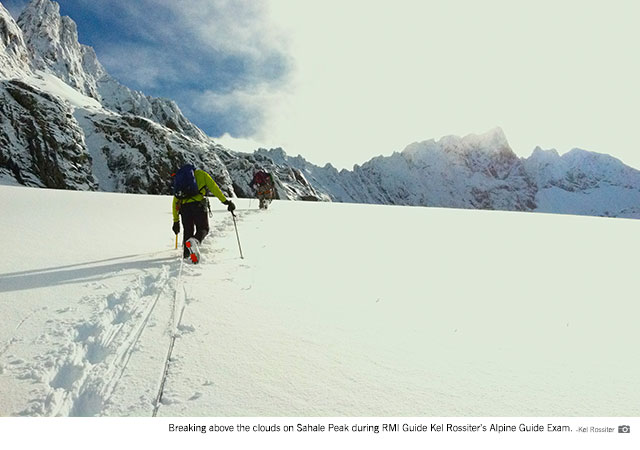
These days, I'm climbing on snow for at least a part of almost every month of the year, but it's not often I'm dealing with fresh snow in September. Skis or snowshoes weren’t a part of our packing list, so lift-kick-step-sink-lift was the interminable process as we moved up through the now 10 inches of fresh snow covering the Quien Sabe Glacier. A circumnavigation/summit of Sahale Peak was our goal, and we eyed the valley clouds warily as we proceeded in dogged pursuit. Soon the clouds enveloped us and in between breaks we attempted to plot the best path ahead. After some steep, snow-laden slopes, a bergschrund crossing, and the final rocky summit scramble we were on top of our last AGE objective, Sahale Peak!
Fortunately, time and time again, in the face of doom, gloom, cats, and dogs we put ourselves into position for success and just barely, and just somehow, squeaked it out. For the first few days we enjoyed the relative “rain shadow” that the Washington Pass area of the North Cascades provides. Washington Pass doesn't allow for glacial travel though—an integral part of the AGE—so after two days we had to leave that safe harbor for the shores of Mt. Shuksan. We arrived in the Lake Ann/Fisher Chimneys trailhead in a steady drizzle. By the time we packed up, things had improved, but the rest of the day was something of an ongoing “fashion show” as we put on a rain shell, took it off, added a warmth layer, and tried to predict what the weather would look like in five minutes. And in the backs of our minds all imagined how things might unfold. Happily, we were most certainly rewarded for our efforts: By the time we topped out on Fisher Chimneys and rolled into our bivvy site, we were high above the roiling sea of grey valley clouds. So often it's the case on Mount Rainier that we'll radio down to Ashford and hear that they're thick in the rain while up at Camp Muir we're above it all. Such was the case on Shuksan, and the next day we managed to circumnavigate the Upper Curtis, Sulphide, and Crystal Glaciers and climb the summit massif's Northeast Ridge—my first time doing that particular route and highly recommended!
As the forecast shifted from grim to grimmer, we again decided to head over to Washington Pass. Driving over Highway 20 toward our meeting point at the Cutthroat Peak trailhead, my windshield wipers clicked a steady rhythm in time with the electronic music I was listening to to try to psych myself up. I arrived early at the trailhead and the rain continued. I cranked more psych music as I attempted some gear-sorting-inside-the-car-yoga poses. Then, miraculously, it began to clear. Not the swift and sure kind of clear that let's you know a new weather attitude is on the way—more like the resistant backing away of an angry dog that's just been called by it's owner, but enough to make a climb seem viable. We racked up, packed up, and headed for Cutthroat Peak's South Buttress. While it is true that “you can't win if you don't play”, it's also true that it's a bad idea to climb yourself so far up an objective that retreat becomes untenable. Fortunately, the South Buttress offers plenty of bail options, so with one eye on the clouds and the other on my rope coils, we moved upward, steadily gaining another plum Cascade peak.
By then, we'd heard reports from a group of Advanced Alpine Guide Course participants that the Boston Basin area (home to West Ridge of Forbidden, Torment-Forbidden Traverse, Sharkfin Tower, and Sahale Peak, among others) had already received six inches of the new winter's snow. Fresh snow poses it's own set of problems in the alpine world, but deciding that fresh snow was more palatable than dealing with the reported dousing on the way, so up we went!
These days, I'm climbing on snow for at least a part of almost every month of the year, but it's not often I'm dealing with fresh snow in September. Skis or snowshoes weren’t a part of our packing list, so lift-kick-step-sink-lift was the interminable process as we moved up through the now 10 inches of fresh snow covering the Quien Sabe Glacier. A circumnavigation/summit of Sahale Peak was our goal, and we eyed the valley clouds warily as we proceeded in dogged pursuit. Soon the clouds enveloped us and in between breaks we attempted to plot the best path ahead. After some steep, snow-laden slopes, a bergschrund crossing, and the final rocky summit scramble we were on top of our last AGE objective, Sahale Peak!
 By day's end I was back in a Bellingham motel room, enjoying the comforts of a shower, eat-in Thai Food, and 581 channels. On every weather channel, stoic looking forecasters delivered the report with the delicacy of a cancer ward counselor: the patient's condition was not improving. I spooned the last bit of tofu out of my box of green curry and grinned: For the last ten days we'd prevailed in the face of such gloom and doom forecasts, and now, with the AGE wrapped up I was much more than just a survivor, I was finally an AMGA Certified Alpine Guide!
 Achieving AMGA Alpine Guide Certification only occurred through a lot of support. Thanks to RMI/Whittaker Mountaineering/Eddie Bauer-First Ascent for their solid support of guide professional development. Thanks to all of the RMI guides who, through their sharing of skills, techniques, and approaches, have honed my own alpine guide skills; and particular gratitude to Andres Marin, Geoff Schellens, Jake Beren, Levi Kepsel, Eric Frank, Leon Davis, Elias De Andres Martos, and Rob Montague who shared with me their time and talents in the field as I worked toward this goal.
- RMI Guide Kel Rossiter
Achieving AMGA Alpine Guide Certification only occurred through a lot of support. Thanks to RMI/Whittaker Mountaineering/Eddie Bauer-First Ascent for their solid support of guide professional development. Thanks to all of the RMI guides who, through their sharing of skills, techniques, and approaches, have honed my own alpine guide skills; and particular gratitude to Andres Marin, Geoff Schellens, Jake Beren, Levi Kepsel, Eric Frank, Leon Davis, Elias De Andres Martos, and Rob Montague who shared with me their time and talents in the field as I worked toward this goal.
- RMI Guide Kel Rossiter
Posted by: Dave Hahn
Categories: Expedition Dispatches Vinson Massif


Posted by: Dave Hahn
Categories: Expedition Dispatches Vinson Massif
_Punta_Arenas.png)
Posted by: Dave Hahn
Categories: Expedition Dispatches Vinson Massif


Dave and Team -
Hi Guys! I will be following you on your journey to get an idea of what to expect when I arrive there in a couple of weeks.
-Larry Seaton
Posted by: Larry Seaton on 11/22/2013 at 6:52 pm
Posted by: Elias de Andres Martos
Categories: Expedition Dispatches Everest BC Trek
Elevation: 4,383'

Posted by: Adam Knoff
Categories: Mountaineering Fitness & Training
Posted by: Elias de Andres Martos
Categories: Expedition Dispatches Everest BC Trek
Elevation: 12,325'


On The Map
Great photos you’ve been posting. Thanks!
Posted by: Deblan on 11/14/2013 at 11:02 pm
Posted by:
Categories: Guide News


 With expeditions like this, the unknowns are bound to be many; I heard differing opinions on just about everything. “Kathmandu is modern and you can buy all your supplies there,” one person would say, and then the next day I would hear the opposite. For the record, Kathmandu is definitely not modern - but all this can be fun. I found adventure in the 21st century and that seems to be rare. So I planned for what I could and insulated myself from what I couldn’t. It was exhilarating to know that I had no concept of everything I’d face.
Near midnight on the 1st of September, I hit the tarmac of Kathmandu International Airport. The city of Kathmandu sits within a large valley at the foot of the Himalaya. Its streets are crowded and its buildings somewhat dilapidated, but the people are kind and the food is fantastic. Surely much has changed since the first westerners arrived, but there is still a sense of lore about the place. Hindu temples, large and small, are strewn about, and filled with worshipers while Buddhist monks’ roam the streets. The entirety of this scene is cast against the gear shops and bustle of everyday city life in a place steeped in climbing history.
With expeditions like this, the unknowns are bound to be many; I heard differing opinions on just about everything. “Kathmandu is modern and you can buy all your supplies there,” one person would say, and then the next day I would hear the opposite. For the record, Kathmandu is definitely not modern - but all this can be fun. I found adventure in the 21st century and that seems to be rare. So I planned for what I could and insulated myself from what I couldn’t. It was exhilarating to know that I had no concept of everything I’d face.
Near midnight on the 1st of September, I hit the tarmac of Kathmandu International Airport. The city of Kathmandu sits within a large valley at the foot of the Himalaya. Its streets are crowded and its buildings somewhat dilapidated, but the people are kind and the food is fantastic. Surely much has changed since the first westerners arrived, but there is still a sense of lore about the place. Hindu temples, large and small, are strewn about, and filled with worshipers while Buddhist monks’ roam the streets. The entirety of this scene is cast against the gear shops and bustle of everyday city life in a place steeped in climbing history.
 On September 10th I arrived at Chinese Base Camp, the “end of the road”. Over the previous week I’d driven through the alpine rainforests of Nepal and into the moonscape of the Tibetan Plateau. At the Tibetan border it is necessary to leave your Nepali ride and walk across the “Friendship Bridge” flanked on either side by the Nepalese and Chinese military. Once across, I met my Chinese Liaison and Tibetan driver. We quickly departed and speedily wove through the streets of Zhangmu, a border town perpetually stuck in a dense fog of clouds as they collide with the rising Tibetan Plateau. At Chinese Base Camp (BC, 16,300') I still was 2,400’ vertical feet and an unknown distance from Advanced Base Camp (ABC). I spent 3 days at BC waiting for yaks (pack animals that would move my supplies to ABC). While waiting, I developed a terribly bothersome head cold; unfortunately this was not the only time I got sick during this expedition. Days later and sick as a dog, I trekked the last distance into ABC, low visibility, snowing hard with a frigid wind in my face.
We erected ABC (18,700') and soon I fell into the rhythm of establishing higher camps mixed with days of leisure. Everything seemed to slowly come together, as I prepared my body and my supplies for a possible summit window in the beginning of October. I think what kept me most sane during the expedition was my focus on the immediate. An undertaking such as this can be daunting if you try to grasp the sum of the next 20-day span, including the challenges yet to be overcome. So I’d only spool out as much time as was immediately necessary in my mind, and kept my thoughts off the many days ahead of me to reach the summit.
Throughout the climbing period of the expedition I kept a brisk pace between camps, taking care not to push myself so hard that I couldn’t construct camp and take care of myself adequately afterwards. It’s a fine line up there; it’s far too easy to push yourself past the limit. I saw this countless times with other climbers but they had the safety net of Sherpas, guides, and teammates to assist them when they took on too much. I had no such safeguard and this was something I had to always take into account. I wouldn’t want to put a negative connotation on climbing solo though, because it was gratifying in its simplicity.
On September 30th I pulled into Camp 3 at 24,500’. I recall constructing camp atop a small ridge of snow perched beneath the notorious Yellow Band. Here I definitely felt the altitude. Beneath me two Sherpa friends were digging in a platform for their team’s arrival. I’d look over at them as I was catching my breath and they’d be doing the same, smiling and laughing with each other at the ridiculousness of it all.
Climbing without supplemental oxygen and solo (or as solo as it gets on Cho Oyu) has dangers that are heightened, namely the two forms of edema: HAPE and HACE. These affect the lungs and/or brain and are deadly if they persist without descending to lower altitudes. These conditions mainly strike during the night as your breathing naturally decreases. Being on your own when this happens can be mortally dangerous. I took measures to lower my risk by staying hydrated, well feed, comfortable, stress free, and I always kept a wary eye on my breathing and short term memory. The year prior I’d seen firsthand the grim realities of high altitude mountaineering on Argentina’s Aconcagua, after a rescue of another team turned tragic. Cerro Aconcagua was my previous high point at 22,841’. Everything beyond was unknown and I was well above that now and pushing higher. In hindsight, perhaps maybe I should have been more nervous at these altitudes, but I suppose I never felt threatened by them. As was the case in all my previous expeditions, the altitude only seemed to leave me breathless and nothing worse, not even a headache. And so I hydrated, ate and went to bed excited for my summit attempt only hours away.
On September 10th I arrived at Chinese Base Camp, the “end of the road”. Over the previous week I’d driven through the alpine rainforests of Nepal and into the moonscape of the Tibetan Plateau. At the Tibetan border it is necessary to leave your Nepali ride and walk across the “Friendship Bridge” flanked on either side by the Nepalese and Chinese military. Once across, I met my Chinese Liaison and Tibetan driver. We quickly departed and speedily wove through the streets of Zhangmu, a border town perpetually stuck in a dense fog of clouds as they collide with the rising Tibetan Plateau. At Chinese Base Camp (BC, 16,300') I still was 2,400’ vertical feet and an unknown distance from Advanced Base Camp (ABC). I spent 3 days at BC waiting for yaks (pack animals that would move my supplies to ABC). While waiting, I developed a terribly bothersome head cold; unfortunately this was not the only time I got sick during this expedition. Days later and sick as a dog, I trekked the last distance into ABC, low visibility, snowing hard with a frigid wind in my face.
We erected ABC (18,700') and soon I fell into the rhythm of establishing higher camps mixed with days of leisure. Everything seemed to slowly come together, as I prepared my body and my supplies for a possible summit window in the beginning of October. I think what kept me most sane during the expedition was my focus on the immediate. An undertaking such as this can be daunting if you try to grasp the sum of the next 20-day span, including the challenges yet to be overcome. So I’d only spool out as much time as was immediately necessary in my mind, and kept my thoughts off the many days ahead of me to reach the summit.
Throughout the climbing period of the expedition I kept a brisk pace between camps, taking care not to push myself so hard that I couldn’t construct camp and take care of myself adequately afterwards. It’s a fine line up there; it’s far too easy to push yourself past the limit. I saw this countless times with other climbers but they had the safety net of Sherpas, guides, and teammates to assist them when they took on too much. I had no such safeguard and this was something I had to always take into account. I wouldn’t want to put a negative connotation on climbing solo though, because it was gratifying in its simplicity.
On September 30th I pulled into Camp 3 at 24,500’. I recall constructing camp atop a small ridge of snow perched beneath the notorious Yellow Band. Here I definitely felt the altitude. Beneath me two Sherpa friends were digging in a platform for their team’s arrival. I’d look over at them as I was catching my breath and they’d be doing the same, smiling and laughing with each other at the ridiculousness of it all.
Climbing without supplemental oxygen and solo (or as solo as it gets on Cho Oyu) has dangers that are heightened, namely the two forms of edema: HAPE and HACE. These affect the lungs and/or brain and are deadly if they persist without descending to lower altitudes. These conditions mainly strike during the night as your breathing naturally decreases. Being on your own when this happens can be mortally dangerous. I took measures to lower my risk by staying hydrated, well feed, comfortable, stress free, and I always kept a wary eye on my breathing and short term memory. The year prior I’d seen firsthand the grim realities of high altitude mountaineering on Argentina’s Aconcagua, after a rescue of another team turned tragic. Cerro Aconcagua was my previous high point at 22,841’. Everything beyond was unknown and I was well above that now and pushing higher. In hindsight, perhaps maybe I should have been more nervous at these altitudes, but I suppose I never felt threatened by them. As was the case in all my previous expeditions, the altitude only seemed to leave me breathless and nothing worse, not even a headache. And so I hydrated, ate and went to bed excited for my summit attempt only hours away.


 Summit Day
I awoke at 12 midnight; outside I could hear guides addressing their climbers, the hiss of oxygen bottles as the regulators were spun on and the crunch of crampons engaging the firm snow as the first teams departed. Climbers’ torches faintly lighted my tent as they passed and the walls were lined with ice that rained down with the slightest nudge. I gave myself a once over, everything felt good and I was ready. I roused and started my stove, opened a few vents to ensure proper ventilation and stuck my head out the top of the tent. I had spoken to the leaders of the other expeditions and they were leaving quite early, at 12 midnight which meant they had woken up hours earlier. My plan was to leave as late as 2 am for two reasons: firstly I wanted to meet sunrise sooner as I would be running colder without O’s (oxygen), and secondly to give the other teams a large enough head start to ensure I could keep warm by continually climbing. But this night would be hapless from the moment I spilled my hot water all over the tent.
As the other teams passed, and in a moment of carelessness, I fumbled a liter of water in my tent. Luckily, everything required for the summit push was outside in my pack. But with the threat of getting my boots or down suit wet I decided to depart for the summit immediately. The time was 1 am, an hour earlier than I had planned, and as soon as I left my tent I saw a traffic jam forming at the Yellow Band – a formation of rock above Camp 3. Hoping that their supplemental oxygen would see them through with some speed I continued on, but as I ascended it became apparent that they would not climb as hastily as I had hoped. As I sat in line below this technical rock step my extremities lost feeling. Swinging them in circles - something we call “windmills”, easily reinvigorated my hands. But climbing through the chilly night, I wasn’t able to completely regain feeling in my toes, this was a constant concern. However, I had not lost the ability to wiggle them as I took each step so I continued climbing into the night.
Summit Day
I awoke at 12 midnight; outside I could hear guides addressing their climbers, the hiss of oxygen bottles as the regulators were spun on and the crunch of crampons engaging the firm snow as the first teams departed. Climbers’ torches faintly lighted my tent as they passed and the walls were lined with ice that rained down with the slightest nudge. I gave myself a once over, everything felt good and I was ready. I roused and started my stove, opened a few vents to ensure proper ventilation and stuck my head out the top of the tent. I had spoken to the leaders of the other expeditions and they were leaving quite early, at 12 midnight which meant they had woken up hours earlier. My plan was to leave as late as 2 am for two reasons: firstly I wanted to meet sunrise sooner as I would be running colder without O’s (oxygen), and secondly to give the other teams a large enough head start to ensure I could keep warm by continually climbing. But this night would be hapless from the moment I spilled my hot water all over the tent.
As the other teams passed, and in a moment of carelessness, I fumbled a liter of water in my tent. Luckily, everything required for the summit push was outside in my pack. But with the threat of getting my boots or down suit wet I decided to depart for the summit immediately. The time was 1 am, an hour earlier than I had planned, and as soon as I left my tent I saw a traffic jam forming at the Yellow Band – a formation of rock above Camp 3. Hoping that their supplemental oxygen would see them through with some speed I continued on, but as I ascended it became apparent that they would not climb as hastily as I had hoped. As I sat in line below this technical rock step my extremities lost feeling. Swinging them in circles - something we call “windmills”, easily reinvigorated my hands. But climbing through the chilly night, I wasn’t able to completely regain feeling in my toes, this was a constant concern. However, I had not lost the ability to wiggle them as I took each step so I continued climbing into the night.
 After the Yellow Band, I threaded my way through a steeper section comprised of rock and snow, unclipping from the fixed lines and passing other teams as often as I was able too. The process of passing other teams at that altitude is quite tiring, as I had to abandon my efficient rhythm for a faster pace outside of the beaten in route, at times breaking into the snow up to my knees. Luckily I only had to do this 3 or 4 times as the majority of the climbers were moving faster than I was, with their bottled oxygen giving them more stamina. I recall one moment at 25,800' when I became exceedingly nauseous. But it quickly passed and I continued on. This was the only moment I felt the altitude affect me.
At Camp 3, when I left, it was warm and still with high clouds touching the summit, but now, at 26,000', a light wind had picked up and the last of the high clouds were blowing over me. My suit was covered in ice and I had to stop periodically to rewarm my face by burying it in the cowl of my hood. As I reached striking distance of the summit (or so I thought) the horizon became faintly lit. And I encouraged by what it signified!
As I came over the top onto the summit plateau I saw a high point off to my left, but Liz Hawley, an elderly woman who keeps the records of the Himalaya, warned me against this. I met Liz in Kathmandu, and discussed my plan for the expedition. She instructed me, “When you enter the plateau you’ll see a high point off to your left that seems to be the obvious summit, but go forward and slightly to your right and continue until you see Everest. This will be the true summit.” I recalled her words and continued on straight. Those last 45 minutes plodding along at 26,900' for what seemed an eternity, a quarter of a mile, the summit not even visible (or so I thought) was the hardest for me. I had nothing to hold onto. The plateau seemed to stretch beyond the visible horizon. Despair mounted at the thought of having to start grid searching for the damnable thing. I scanned the plateau again. It was then that I noticed a single string of prayer flags off in the distance to my right; on a mound no higher than 3 feet from the point I was standing. It was the summit, maybe one of the least climactic summits I’ve experienced, but I was deeply relieved when I got there and found myself standing at the summit of Cho Oyu!
Alex Barber on the summit of Cho Oyu
I was on top for about 15 minutes. Most of the time seated on my pack eating peanut M&Ms and washing them down with warm Tang from my thermos. I made a speedy descent to Camp 3, quickly packed and made the entire descent to ABC, arriving soon after dusk. Dawa, one of my cooks waited outside of ABC for me with hot tea and a huge smile, after a celebratory embrace we descended the last 15 minutes together into ABC. I felt relieved to be finished. The day was October 1st, I had summited at 8:20 am that morning Nepali time.
You know, I’ve been asked what it felt like for everything to culminate and be on top. That feeling of accomplishment or exhilaration - what was it like? But I think what draws me isn’t that singular moment at the top or any feeling of exhilaration from being there. Instead it’s the quieter and constant sense of contentment that comes from the simplicity of mountaineering, the journey along the way and being surrounded by extraordinary beauty that challenges you to conquer – not the mountain – but yourself. For me the journey is the destination.
After the Yellow Band, I threaded my way through a steeper section comprised of rock and snow, unclipping from the fixed lines and passing other teams as often as I was able too. The process of passing other teams at that altitude is quite tiring, as I had to abandon my efficient rhythm for a faster pace outside of the beaten in route, at times breaking into the snow up to my knees. Luckily I only had to do this 3 or 4 times as the majority of the climbers were moving faster than I was, with their bottled oxygen giving them more stamina. I recall one moment at 25,800' when I became exceedingly nauseous. But it quickly passed and I continued on. This was the only moment I felt the altitude affect me.
At Camp 3, when I left, it was warm and still with high clouds touching the summit, but now, at 26,000', a light wind had picked up and the last of the high clouds were blowing over me. My suit was covered in ice and I had to stop periodically to rewarm my face by burying it in the cowl of my hood. As I reached striking distance of the summit (or so I thought) the horizon became faintly lit. And I encouraged by what it signified!
As I came over the top onto the summit plateau I saw a high point off to my left, but Liz Hawley, an elderly woman who keeps the records of the Himalaya, warned me against this. I met Liz in Kathmandu, and discussed my plan for the expedition. She instructed me, “When you enter the plateau you’ll see a high point off to your left that seems to be the obvious summit, but go forward and slightly to your right and continue until you see Everest. This will be the true summit.” I recalled her words and continued on straight. Those last 45 minutes plodding along at 26,900' for what seemed an eternity, a quarter of a mile, the summit not even visible (or so I thought) was the hardest for me. I had nothing to hold onto. The plateau seemed to stretch beyond the visible horizon. Despair mounted at the thought of having to start grid searching for the damnable thing. I scanned the plateau again. It was then that I noticed a single string of prayer flags off in the distance to my right; on a mound no higher than 3 feet from the point I was standing. It was the summit, maybe one of the least climactic summits I’ve experienced, but I was deeply relieved when I got there and found myself standing at the summit of Cho Oyu!
Alex Barber on the summit of Cho Oyu
I was on top for about 15 minutes. Most of the time seated on my pack eating peanut M&Ms and washing them down with warm Tang from my thermos. I made a speedy descent to Camp 3, quickly packed and made the entire descent to ABC, arriving soon after dusk. Dawa, one of my cooks waited outside of ABC for me with hot tea and a huge smile, after a celebratory embrace we descended the last 15 minutes together into ABC. I felt relieved to be finished. The day was October 1st, I had summited at 8:20 am that morning Nepali time.
You know, I’ve been asked what it felt like for everything to culminate and be on top. That feeling of accomplishment or exhilaration - what was it like? But I think what draws me isn’t that singular moment at the top or any feeling of exhilaration from being there. Instead it’s the quieter and constant sense of contentment that comes from the simplicity of mountaineering, the journey along the way and being surrounded by extraordinary beauty that challenges you to conquer – not the mountain – but yourself. For me the journey is the destination.
 Alex Barber is a mountain guide for RMI Expeditions and splits his time between the beaches of Southern California and mountains around the world. Alex will be guiding an Expedition Skills Seminar – Winter in January before returning to the Himalaya this spring to attempt Lohtse and Shishapangma. Read more about his climb and follow the upcoming adventures on www.alexanderbarber.com.
Congratulations Alex!
Posted by: Jen and Nick Boekenoogen on 11/26/2013 at 9:53 am
Alex - I am so impressed and proud of you! What an extraordinary journey and story. But I guess I should expect nothing less from you as you are an extraordinary young man. You are so often on my mind. God’s peace to you my friend - and hope to see you again this summer on the Emmons. Linn Perkins
Posted by: Linn Perkins on 11/16/2013 at 9:07 am
Posted by: Elias de Andres Martos
Categories: Expedition Dispatches Everest BC Trek
Elevation: 17,575'




Congrats Kel!! Photos look awesome!! I will be back to Rainier in 2014, this time in August and determined to make the summit.
Posted by: Scott Cadman on 11/26/2013 at 7:20 am
View All Comments